
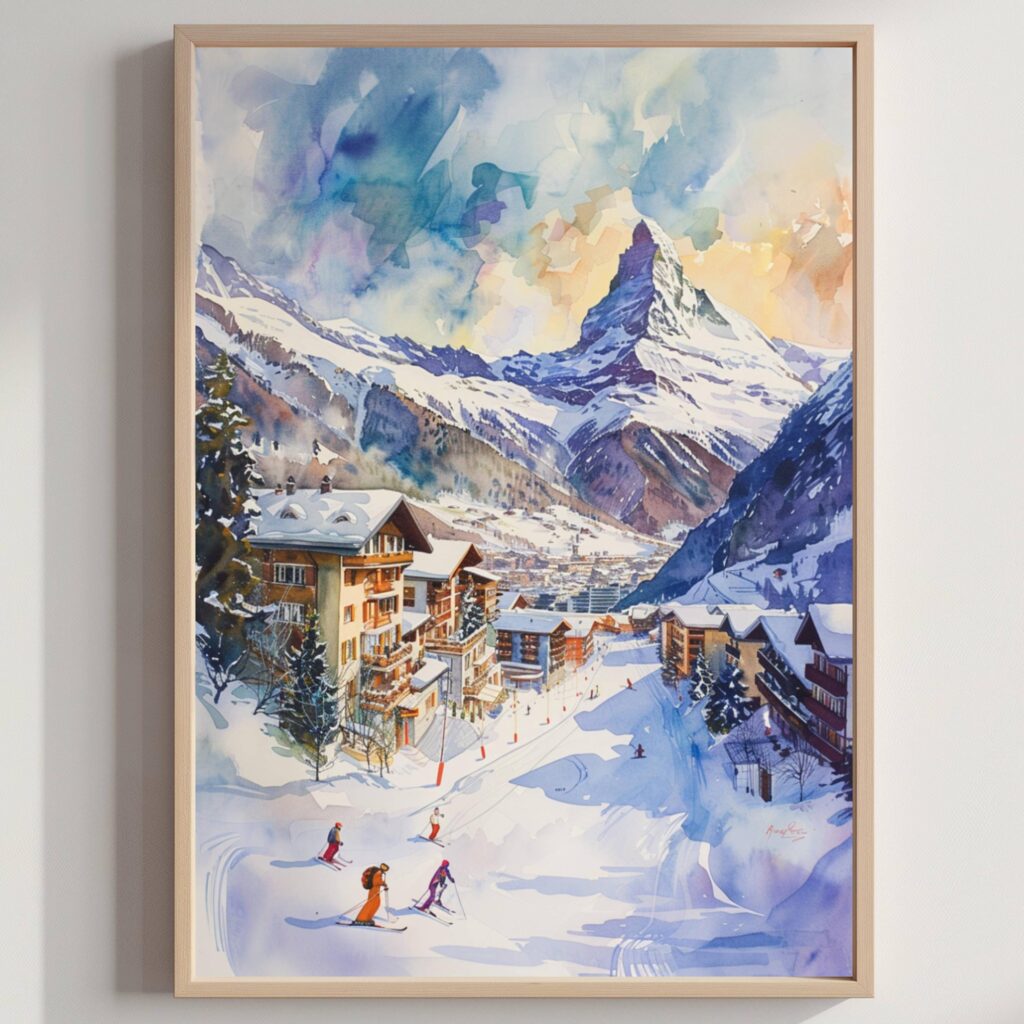
Zermatt has banned petrol and diesel vehicles from its streets since the early 20th century, visitors and residents alike travelling instead by electric taxi, horse-drawn carriage, or on foot, a restriction originally adopted for practical reasons tied to the village’s narrow mountain valley setting that has since become a defining part of its identity and appeal, one of relatively few major European alpine resorts to maintain a genuinely car-free town centre at this scale.
The Matterhorn, rising directly above the village, remained unclimbed until 1865, when English mountaineer Edward Whymper led the first successful ascent, a climb that ended in tragedy on the descent when four of the seven-member party fell to their deaths, an accident significant enough in mountaineering history that it’s sometimes credited with marking the end of what’s often called the golden age of alpinism.
A Village Built Almost Entirely on Mountaineering Tourism
Zermatt’s transformation from a modest farming settlement into an internationally renowned mountaineering destination began substantially in the mid-19th century, as the Matterhorn’s dramatic, near-symmetrical pyramid shape drew increasing numbers of climbers and, later, tourists content simply to view rather than summit it, the peak’s distinctive silhouette becoming one of the most photographed mountain profiles in the world. The Gornergrat railway, opened in 1898, remains one of the highest open-air cog railways in Europe, carrying visitors up to sweeping panoramic views of the Matterhorn and surrounding glaciers without requiring any mountaineering experience at all.
Zermatt sits at the base of a cluster of peaks exceeding 4,000 metres, and the surrounding Zermatt Ski Paradise ski area connects across the Italian border to Cervinia, forming one of the highest-altitude, most snow-reliable ski regions in the Alps.
Painting a Village Beneath an Unmistakable Peak
Zermatt’s traditional wooden chalets beneath the Matterhorn’s dramatic pyramid give a watercolourist striking alpine contrast to work with. We’ve captured that setting in our own Zermatt Watercolor Print, painted first by hand and printed to order on archival paper, a small piece of Switzerland for a wall at home.
Kept free of cars and shadowed by a peak that resisted climbers for decades, Zermatt remains a village whose relationship with its own mountain has always been equal parts reverence and risk.