
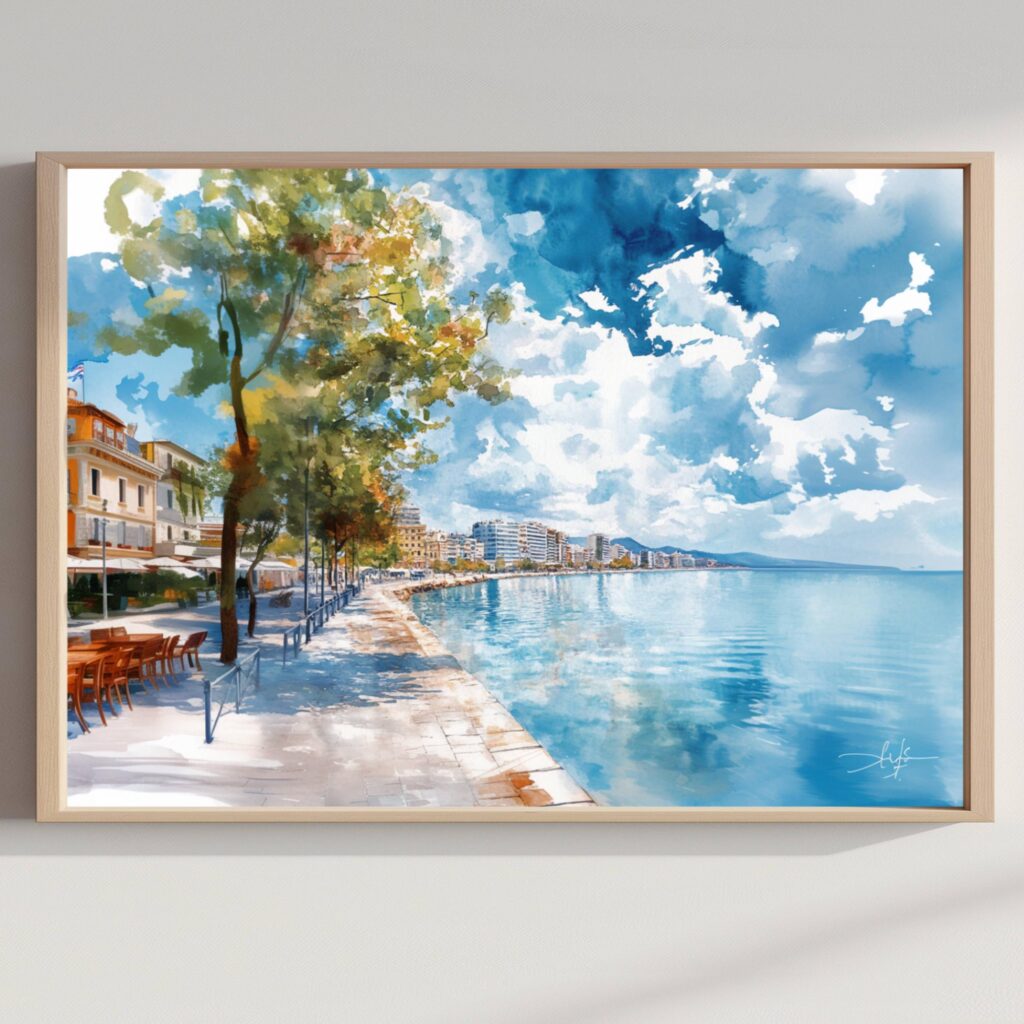
Thessaloniki was founded in 315 BCE by Cassander, a general of Alexander the Great, who named the city after his wife, Alexander’s half-sister, making it, in a sense, a city built directly from Macedonian royal legacy. Despite being Greece’s second-largest city today, Thessaloniki has often lived somewhat in Athens’s shadow internationally, even though it arguably possesses a more continuously layered, unbroken urban history, having served as a major city under Roman, Byzantine, and Ottoman rule in succession, largely without the periods of decline and rediscovery that shaped Athens’s more famous ancient ruins.
The White Tower, the city’s most recognisable landmark, was built by the Ottomans in the 15th century as part of the city’s fortifications, and despite its now-benign, whitewashed appearance and status as a symbol of the city, it once served as a prison and site of executions, its current pale colour reportedly achieved through a symbolic 20th-century whitewashing intended to help residents move past that darker history.
A City With One of Europe’s Longest Jewish Histories
Thessaloniki was once home to one of the largest and most significant Sephardic Jewish communities in Europe, following mass expulsion from Spain in 1492, so substantial that the city was sometimes referred to as the “Mother of Israel,” Ladino, a Judeo-Spanish language, was widely spoken there for centuries. That community was almost entirely destroyed during the Holocaust, over 90% of the city’s Jewish population deported and killed, a devastating loss the city has worked in recent decades to more fully acknowledge and memorialise.
Thessaloniki’s Rotunda, originally built by the Roman Emperor Galerius around 306 CE, has served over the centuries as a mausoleum, a church, and later a mosque under Ottoman rule, before returning to use as a church, a single building whose changing function traces the city’s entire layered religious history in miniature.
Painting a Tower Beside the Aegean
The White Tower against Thessaloniki’s waterfront and the Aegean beyond gives a watercolourist a clean, historically resonant subject to work with. We’ve captured that setting in our own Thessaloniki Watercolor Print, painted first by hand and printed to order on archival paper, a small piece of Greece for a wall at home.
Founded for a Macedonian queen and shaped since by Romans, Byzantines, Ottomans, and a Jewish community nearly erased, Thessaloniki remains one of the more genuinely layered cities in the Mediterranean.