
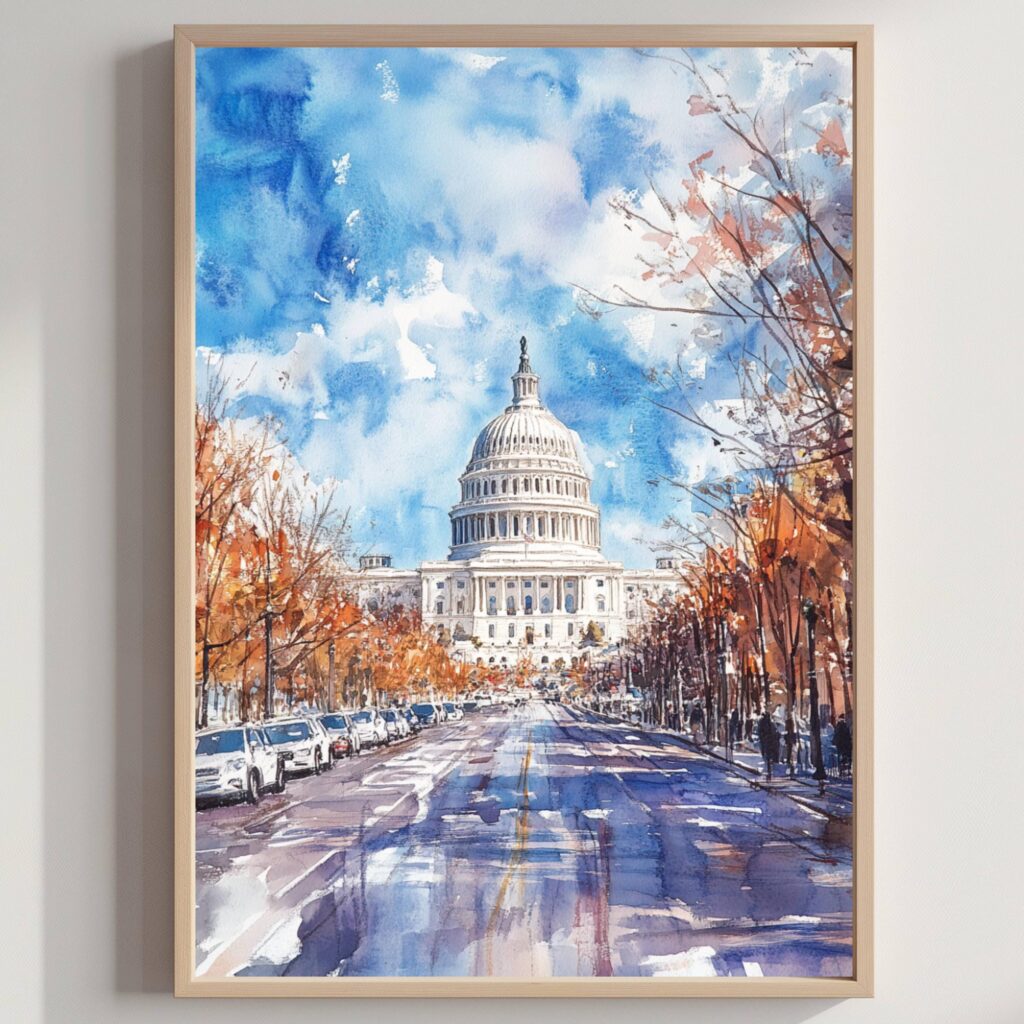
The United States Capitol’s construction, beginning in 1793, relied substantially on enslaved labourers, hired out by their owners to work alongside free labourers on the building’s foundations and stonework, a history that went largely unacknowledged in official accounts for over two centuries until a congressional task force formally documented it in the early 2000s. The building itself has never really stopped changing, its current cast-iron dome, added between 1855 and 1866, replaced a smaller original dome that had come to look disproportionately modest as wings were added to accommodate a rapidly growing Congress.
That dome, weighing roughly 4,000 tonnes despite being made primarily of cast iron rather than stone, was controversially continued during the Civil War, President Lincoln reportedly insisted construction proceed even as war raged, viewing the dome’s completion as a symbol that the Union itself would continue.
A Building Meant to Represent, Not Just Govern
The Statue of Freedom, standing atop the dome, was itself partly modelled and cast with the assistance of Philip Reid, an enslaved sculptor who worked on the statue’s bronze casting process, a detail rediscovered and more widely publicised only in recent decades. The Capitol’s original design emerged from a public competition in 1792, won by an amateur architect, Dr. William Thornton, a physician with no formal architectural training, beating out submissions from more established professional architects of the era.
The building sits at the literal centre of Washington DC’s street grid, all four quadrants of the city’s addressing system radiate outward from the Capitol, making it, quite deliberately, the geographic as well as symbolic centre of the capital.
Painting a Dome Built to Represent Endurance
The Capitol’s white dome against Washington’s open sky gives a watercolourist a clean, monumental subject to work with. We’ve captured that presence in our own US Capitol Watercolor Print, painted first by hand and printed to order on archival paper, a small piece of Washington DC for a wall at home.
Built partly by hands never fully credited and continued deliberately through a civil war, the Capitol remains a building whose history is considerably more complicated than its clean white silhouette suggests.