
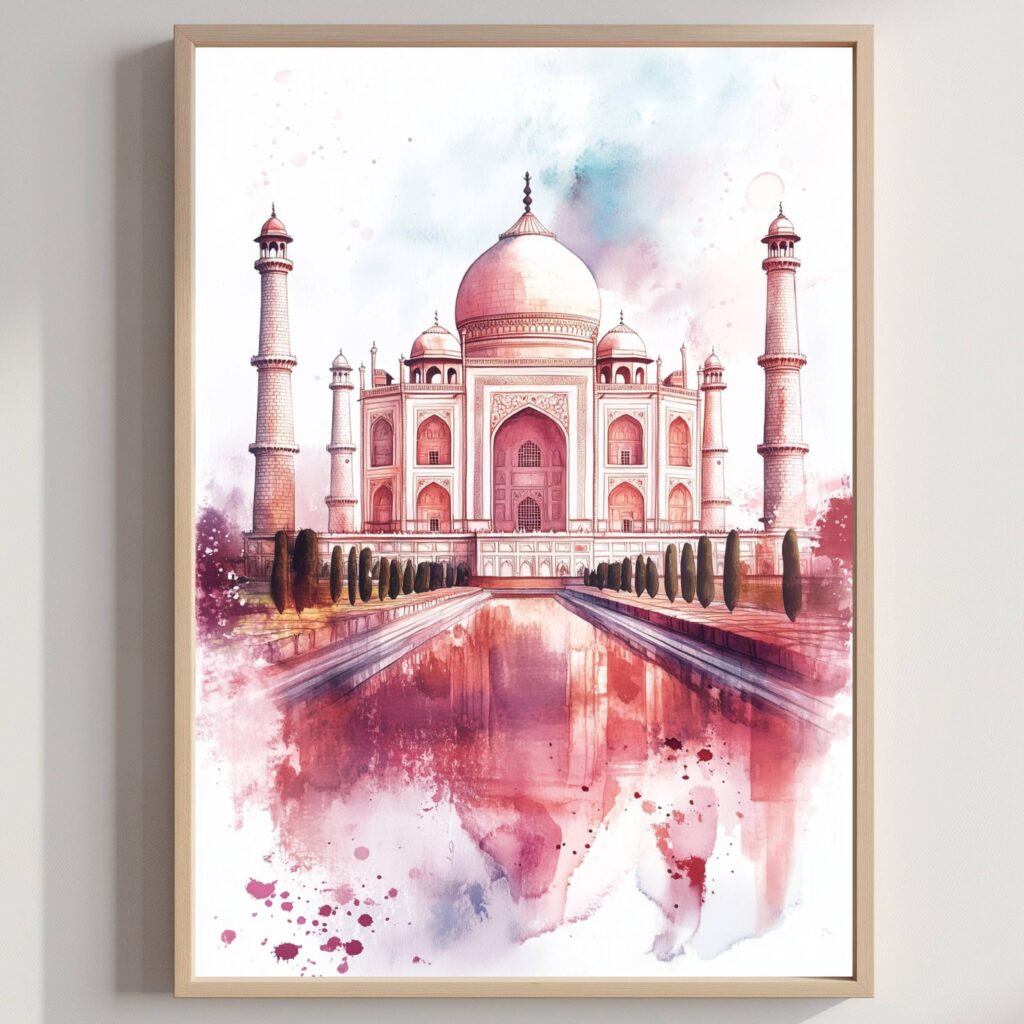
The Taj Mahal is, at its core, a grave. Emperor Shah Jahan commissioned it in 1632 following the death of his wife, Mumtaz Mahal, during the birth of their fourteenth child, and spent the next twenty-two years and the labour of an estimated 20,000 workers turning that loss into the most famous building in India. It remains, unusually among the world’s great monuments, a mausoleum built for love rather than power.
The white marble that gives the Taj Mahal its glow was carried over 300 kilometres from Rajasthan, while precious stones for its inlay work, jade, turquoise, lapis lazuli, sapphire, arrived from as far as Tibet, China, and Sri Lanka. The building famously shifts colour through the day, pale pink at dawn, brilliant white at midday, golden at sunset, an effect architects and poets alike have spent centuries trying to properly describe.
A Legend That Outgrew the Facts
Popular legend holds that Shah Jahan planned a second, black marble mausoleum for himself across the river, and that he had the hands of his architects cut off to prevent them ever building anything comparable again. Neither claim holds up to historical scrutiny, but both persist, a measure of just how mythic the Taj Mahal’s story has become. What is true is stranger and sadder: Shah Jahan was overthrown by his own son and spent his final years imprisoned in nearby Agra Fort, able only to gaze at his wife’s tomb from a distance.
The complex is built with near-perfect symmetry, except for one deliberate exception: Shah Jahan’s own tomb, added later beside his wife’s, sits slightly off-centre, the one asymmetrical element in an otherwise flawless design.
Painting Marble at Dawn
Few buildings reward a watercolourist’s obsession with shifting light quite like the Taj Mahal, its white marble changing character with every hour of the day. We’ve tried to capture that glow in our own Taj Mahal Watercolor Print, painted first by hand and printed to order on archival paper, a small piece of Agra for a wall at home.
Nearly four centuries on, the Taj Mahal remains exactly what it was built to be: an almost unbearably beautiful expression of a single, specific grief.