
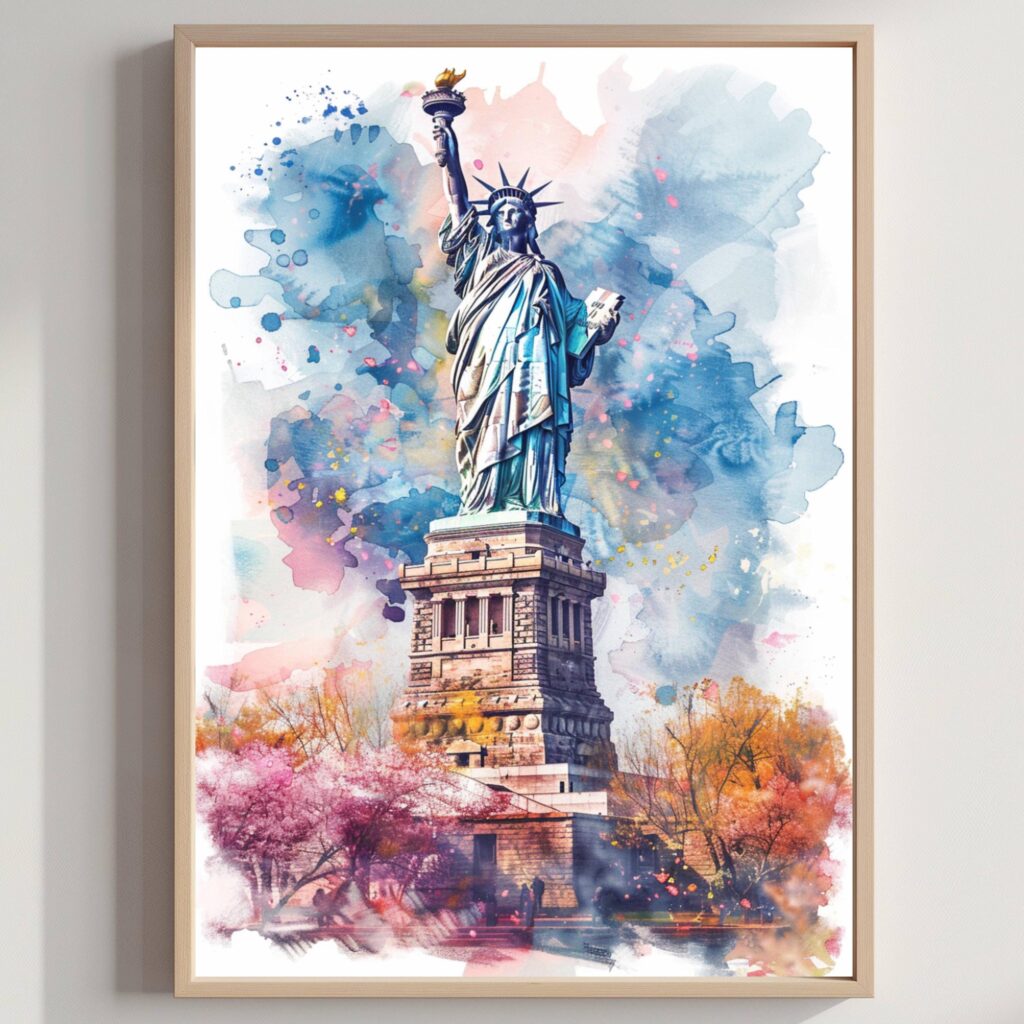
The Statue of Liberty was a joint effort from the start: France funded and built the statue itself, while the United States was responsible for the pedestal, and for years it looked like the American half of the bargain might not get finished. Fundraising for the pedestal stalled badly until publisher Joseph Pulitzer launched a campaign in his newspaper, promising to print the name of every donor, no matter how small the contribution, ultimately raising the needed funds largely from ordinary readers rather than wealthy patrons.
Designed by sculptor Frederic Auguste Bartholdi with structural engineering by Gustave Eiffel, yes, that Eiffel, the statue’s copper skin is only about 2.4 millimetres thick, roughly the thickness of two stacked pennies, supported by an internal iron skeleton flexible enough to sway slightly in strong winds without damage.
Green by Accident, Not Design
When it was unveiled in 1886, the Statue of Liberty was a shining copper-brown, its now-iconic green patina developed gradually over roughly 30 years as the copper naturally oxidised in the open air, a chemical transformation nobody specifically designed but that has since become inseparable from the statue’s identity. Emma Lazarus’s poem “The New Colossus,” including its famous line about “huddled masses yearning to breathe free,” wasn’t part of the original dedication at all, it was added to the pedestal in 1903, 17 years after the statue’s unveiling.
The seven spikes on Liberty’s crown represent the seven continents and seven seas, a deliberate choice reflecting the statue’s intended message as a universal, not just American, symbol of freedom.
Painting Copper Against the Harbor
The statue’s weathered green against open harbour sky and water gives a watercolourist a striking, quietly monumental subject. We’ve captured that harbour presence in our own Statue of Liberty Watercolor Print, painted first by hand and printed to order on archival paper, a small piece of New York for a wall at home.
Funded by ordinary readers after wealthy donors weren’t enough, the Statue of Liberty has always, in some sense, belonged more to the public than to any single patron.