
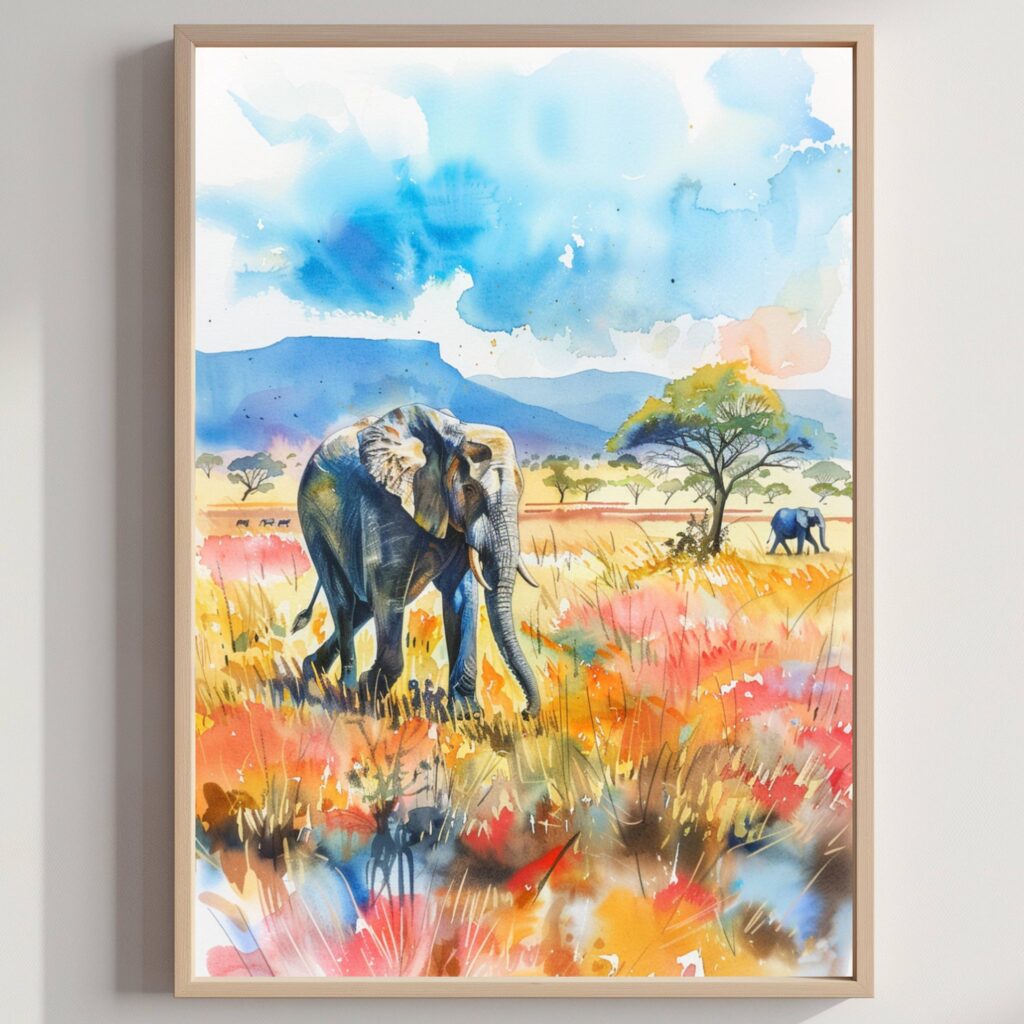
The Serengeti hosts the largest overland mammal migration on Earth, an estimated 1.5 million wildebeest, along with hundreds of thousands of zebra and gazelle, moving in a continuous, roughly circular route across the plains of Tanzania and into Kenya’s Maasai Mara in pursuit of seasonal rain and fresh grazing. The migration has no true beginning or end, animals are simply always somewhere along the route, timing shaped entirely by rainfall patterns rather than any fixed calendar.
The name “Serengeti” comes from the Maasai word “siringet,” meaning “the place where the land runs on forever,” an apt description for a landscape of over 30,000 square kilometres of largely unbroken savanna, one of the last places on Earth where a large-mammal migration still moves largely unimpeded by fences or roads.
A Landscape Shaped by Ancient Volcanoes
The Serengeti’s famously fertile soil comes from volcanic ash deposited by eruptions from the Ngorongoro Highlands thousands of years ago, creating the nutrient-rich grasslands capable of supporting such an enormous concentration of grazing animals. That same volcanic history produced the nearby Ngorongoro Crater, a collapsed volcanic caldera now home to one of the densest populations of predators anywhere in Africa, effectively a natural, walled enclosure for wildlife.
Maasai communities have lived alongside the Serengeti’s wildlife for centuries, their traditional pastoral lifestyle developed in careful, longstanding coexistence with the same migratory patterns conservationists now work to protect.
Painting Gold Grass and Open Sky
The vast golden grassland and huge open sky of the Serengeti give a watercolourist scale and light unlike almost anywhere else. We’ve captured that endless horizon in our own Serengeti Watercolor Print, painted first by hand and printed to order on archival paper, a small piece of Tanzania for a wall at home.
Named for land that runs on forever, the Serengeti remains one of the rare places where an ancient, unbroken rhythm is still allowed to continue entirely on its own terms.