
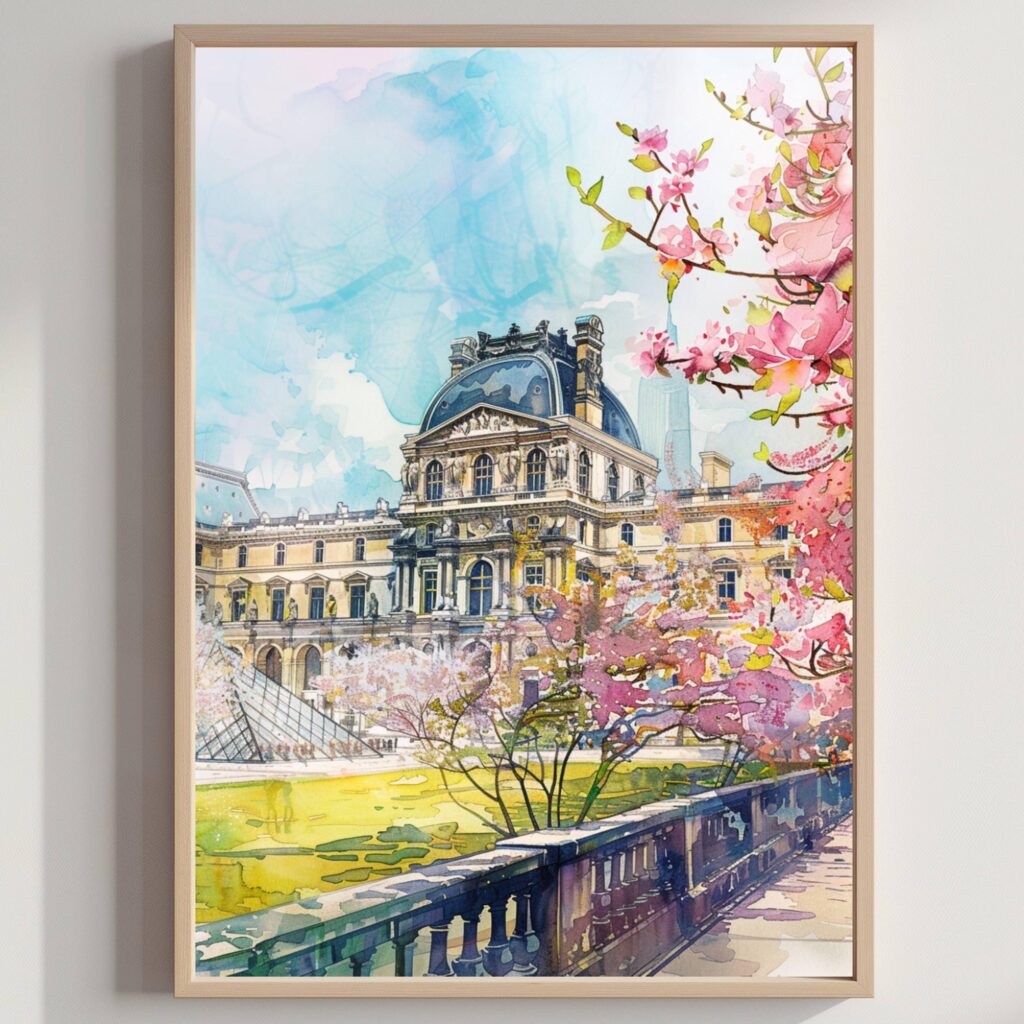
The Louvre began as a medieval fortress, built around 1190 by King Philip II to defend Paris from the west, decades before it ever housed a single painting. Its foundations, including the original moat and towers, are still visible today in the museum’s lower level, a fortress buried beneath one of the world’s greatest art collections. It only became a royal palace in the 14th century, and only a public museum after the French Revolution, opened in 1793 as a statement that the nation’s art now belonged to its citizens rather than its kings.
The glass pyramid that now marks its main entrance, added in 1989, was hugely controversial at the time, critics called architect I. M. Pei’s modern addition an act of vandalism against a historic palace. It has since become as recognisable as the museum itself, a rare example of a contested modern intervention winning over its harshest critics within a generation.
Too Big to See in a Day
The Louvre holds roughly 380,000 objects, though only around 35,000 are on display at any time, if a visitor spent just 30 seconds looking at every displayed work, it would take over 100 days to see them all. Its most famous resident, the Mona Lisa, is protected behind bulletproof glass following a 1956 acid attack and a later attempted theft, drawing crowds so large that most visitors now see it from several metres back, phones raised.
Long before it was a museum, the palace was also home to French kings for centuries, its Grande Galerie originally built specifically to connect the Louvre to the Tuileries Palace, since destroyed, along a covered route the royal family could walk without ever stepping outside.
Painting a Palace of Glass and Stone
The contrast between Pei’s clean glass pyramid and the ornate classical stone surrounding it gives a watercolourist a genuinely striking composition to work with. We’ve captured that juxtaposition in our own Louvre Museum Watercolor Print, painted first by hand and printed to order on archival paper, a small piece of Paris for a wall at home.
Built first to keep Paris safe and only later to hold its treasures, the Louvre remains a fortress that quietly won a much longer war for the public’s affection.