
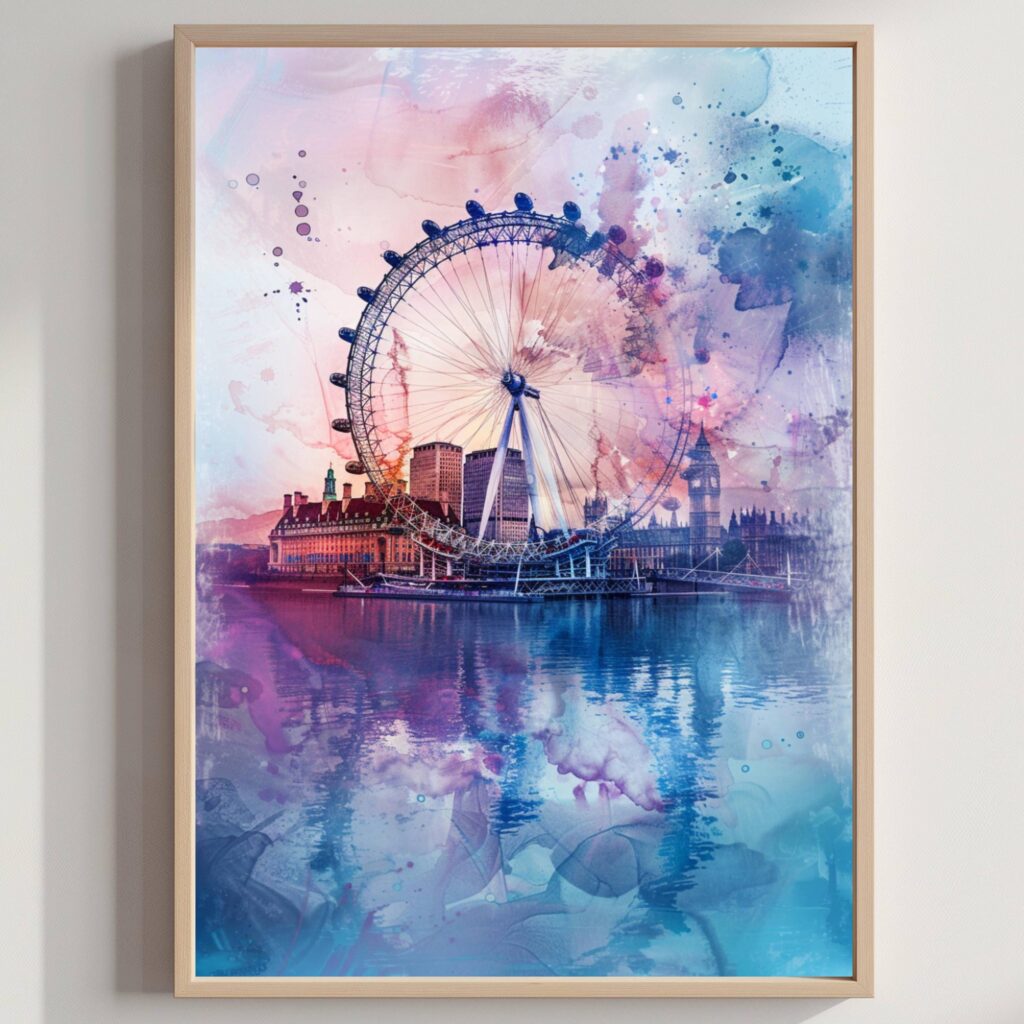
The London Eye was originally granted planning permission for just five years when it opened on the South Bank of the Thames at the turn of the millennium in 2000, conceived as a temporary structure to mark the year 2000 alongside other Millennium-funded projects across Britain. Its immediate and lasting popularity, drawing millions of visitors annually from the outset, led to that temporary permission being repeatedly extended until the wheel was granted permanent status, and it now stands as one of London’s most visited paid attractions.
At 135 metres tall, the London Eye was the world’s tallest Ferris wheel at the time of its construction, a title it held until larger wheels were later built in China and elsewhere, though it remains the tallest cantilevered observation wheel, supported on one side only rather than a full axle structure.
A Structure Assembled Flat on the River, Then Raised
Due to its scale, the London Eye’s central structure was largely assembled lying flat on platforms in the River Thames before being gradually raised into its upright position over several days in October 1999, a delicate engineering operation that was, at one stage, briefly halted when a cable issue occurred partway through the lift. The wheel’s 32 sealed passenger capsules, each representing one of London’s 32 boroughs, take roughly thirty minutes to complete a single rotation, moving slowly enough that the wheel never actually needs to stop for passengers to board.
The London Eye offers views stretching up to 40 kilometres on a clear day, taking in landmarks across the city from a vantage point that, until its construction, London’s skyline had never really offered to the general public at this scale.
Painting a Wheel Above the Thames
The London Eye’s clean modern silhouette against the Thames and Westminster skyline gives a watercolourist a striking contrast of contemporary form and historic backdrop to work with. We’ve captured that setting in our own London Eye Watercolor Print, painted first by hand and printed to order on archival paper, a small piece of London for a wall at home.
Built to last five years and still turning a quarter century later, the London Eye remains a temporary structure that simply never got around to leaving.