
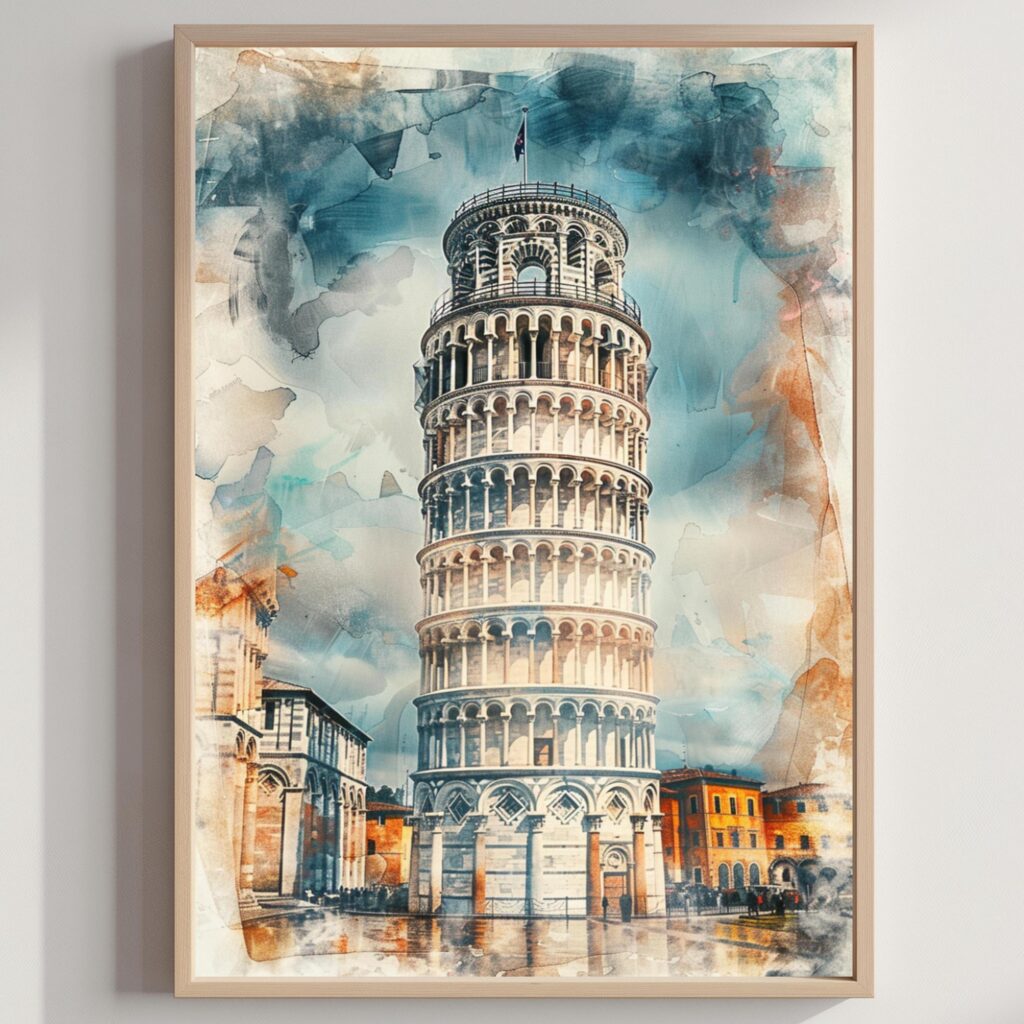
The Leaning Tower of Pisa began tilting almost immediately after construction started in 1173, the soft, unstable subsoil beneath its foundations simply couldn’t support the tower’s weight evenly, and builders noticed the lean after completing just three of its eight storeys. Rather than start over, construction continued in fits and starts over the next two centuries, with later builders compensating by making upper storeys slightly taller on the tower’s lower side, an improvised fix that gives the tower a subtle banana-like curve rather than a straight lean.
By the late 20th century, the tilt had become genuinely dangerous, reaching an angle steep enough that engineers closed the tower to the public in 1990, fearing eventual collapse. A major stabilisation project through the 1990s removed soil from beneath the raised side, reducing the lean by about 45 centimetres and buying the tower an estimated 300 years of continued stability.
A Tower That Made Physics Famous
Galileo Galilei, born in Pisa, is popularly said to have dropped two different-sized cannonballs from the tower to disprove Aristotle’s theory that heavier objects fall faster, a story most historians now believe is likely apocryphal, though it has become inseparable from the tower’s identity regardless. Real or not, the legend reflects Pisa’s genuine historical role as a centre of scientific and mathematical learning during the medieval and Renaissance periods.
Millions of visitors now travel to Pisa specifically to take the same photograph, arms outstretched as though holding the tower upright, a piece of tourist ritual almost as famous as the tower’s actual architecture.
Painting a Landmark That Leans on Purpose
The tower’s distinctive tilt against open Tuscan sky gives a watercolourist an unusual, instantly recognisable subject to capture. We’ve painted that famous lean in our own Leaning Tower of Pisa Watercolor Print, printed to order on archival paper, a small piece of Italy for a wall at home.
Built as a mistake and preserved as a marvel, the Leaning Tower of Pisa remains one of the few landmarks whose flaw became, quite literally, its entire appeal.