
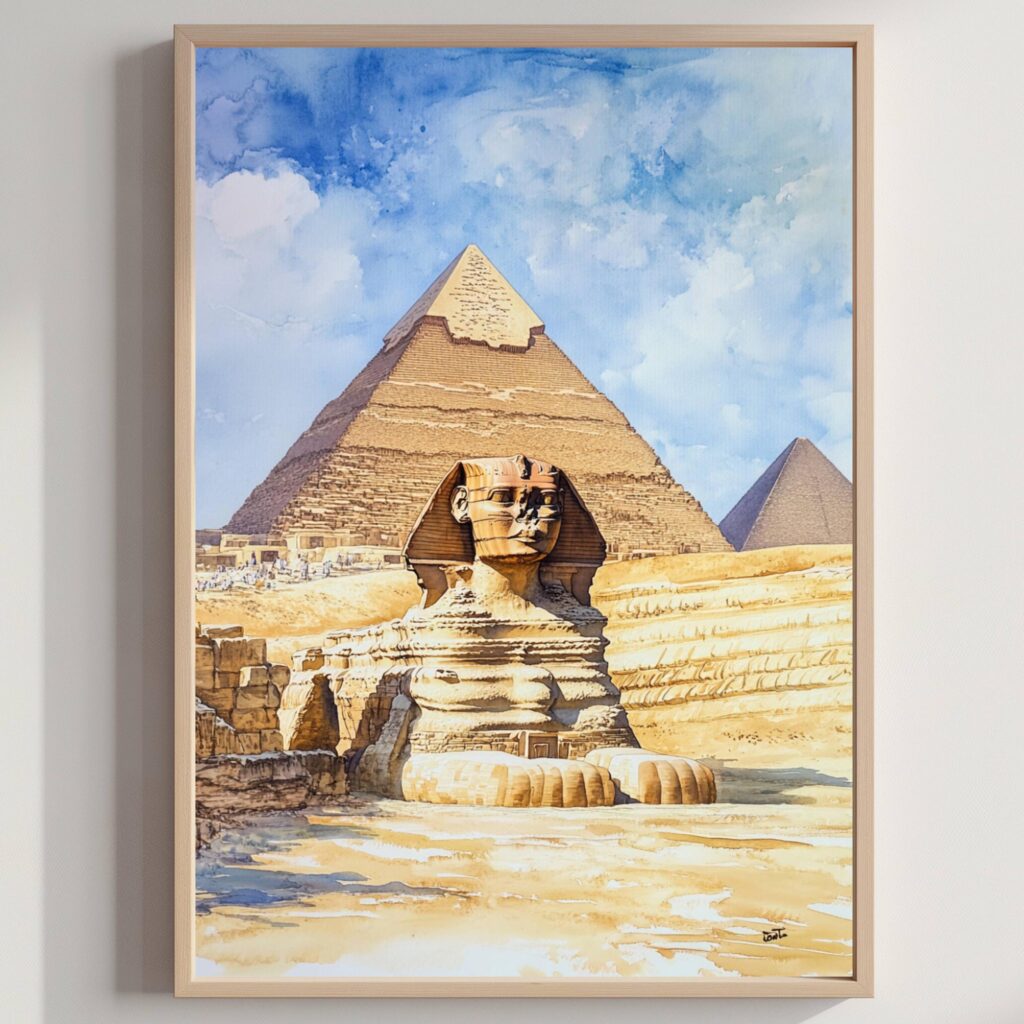
The Great Sphinx of Giza, carved directly from a single mass of limestone bedrock, is generally believed by most Egyptologists to have been built during the reign of Pharaoh Khafre around 2500 BCE, its face possibly modelled on the pharaoh himself, though the monument bears no inscriptions confirming its exact date or purpose, leaving genuine scholarly debate around some of the details of its construction. For long stretches of its history, the Sphinx lay buried up to its neck in desert sand, and the earliest recorded excavation to clear the sand away was undertaken by the young prince who would become Pharaoh Thutmose IV around 1400 BCE, over a thousand years after the monument’s original construction.
The Sphinx’s nose, missing today, was likely already damaged well before commonly repeated myths blaming Napoleon’s troops, with earlier accounts and drawings from before Napoleon’s 1798 Egyptian campaign already showing the nose absent, an example of a persistent historical myth that simply doesn’t match the documentary evidence.
A Monument That Has Needed Repeated Rescue From the Sand
The Great Sphinx has required extensive conservation work across the 20th and 21st centuries, its limestone body vulnerable to erosion from wind, humidity, and the desert’s own shifting sands, a genuinely ongoing effort to preserve a structure that has already survived roughly 4,500 years of exposure. A dream stele erected between the Sphinx’s paws by Thutmose IV records his own account of being told in a dream to clear the sand away in exchange for future kingship, one of the earliest surviving written records referencing the monument directly.
The Sphinx sits as part of the larger Giza pyramid complex, aligned with the pyramids of Khufu, Khafre, and Menkaure, its exact relationship and precise construction sequence relative to the pyramids remaining a subject of ongoing archaeological study.
Painting a Monument Carved From the Desert Itself
The Sphinx’s weathered limestone form against the surrounding desert and pyramids gives a watercolourist genuine ancient texture and warm, sun-worn colour to work with. We’ve captured that setting in our own Great Sphinx Watercolor Print, painted first by hand and printed to order on archival paper, a small piece of Egypt for a wall at home.
Buried and uncovered more than once across 4,500 years, the Great Sphinx remains a monument whose survival has always depended on someone deciding, again and again, that it was worth digging back out.