
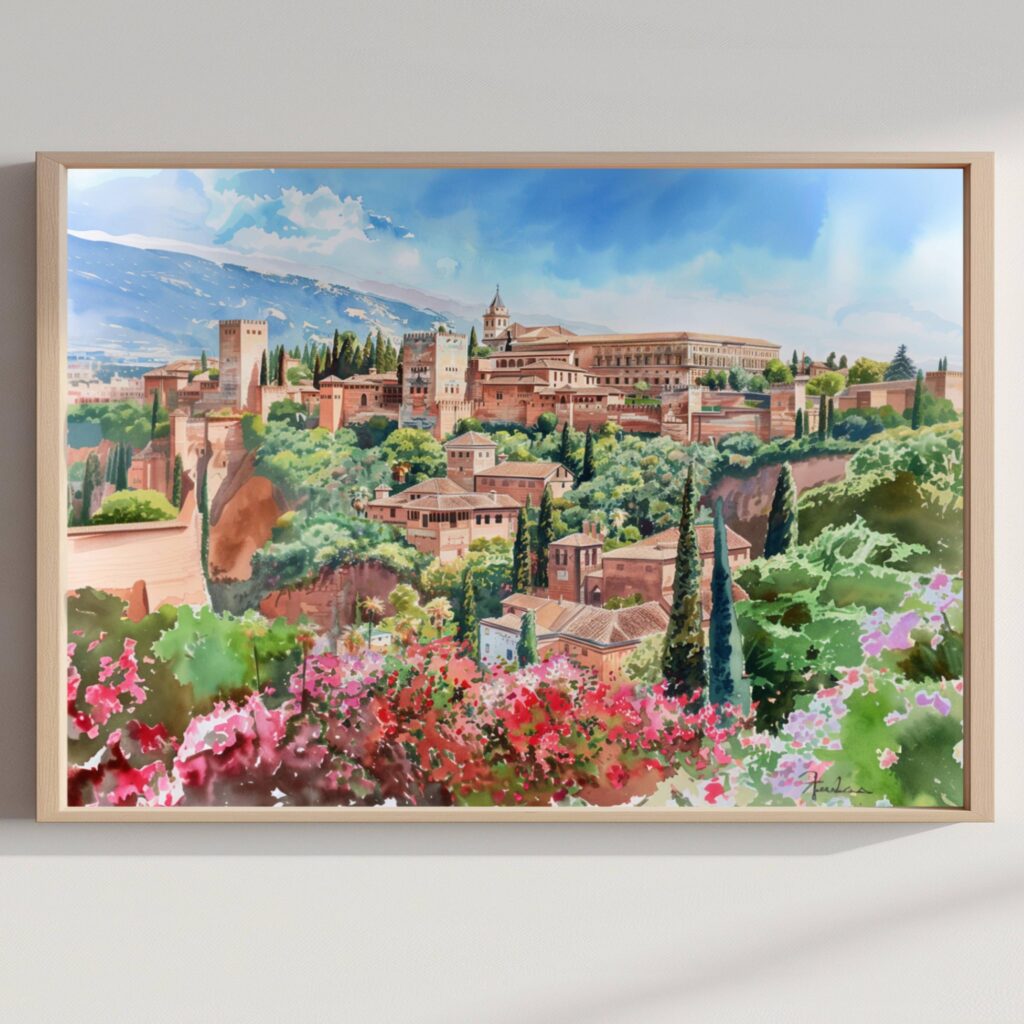
The Alhambra’s name comes from the Arabic al-hamra, “the red one,” a reference to the reddish clay used in its outer walls, visible from across Granada even before visitors reach its gates. Built mainly under the Nasrid dynasty from the 13th to 14th centuries, it was the last Muslim stronghold in Spain, its intricate palace complex constructed even as the centuries-long Reconquista closed in around it.
Inside, the Nasrid Palaces are covered almost entirely in geometric tilework, carved stucco, and calligraphy quoting Quranic verse and poetry, some of it praising the very rooms it decorates. The Court of the Lions, with its famous fountain supported by twelve stone lions, was designed with mathematical precision, water channels running throughout the complex to cool the air, a functioning irrigation system disguised as pure ornament.
Saved by a Writer, Nearly Lost to Neglect
After the Reconquista in 1492, the Alhambra fell into centuries of gradual decline, at points used as a barracks, and Napoleon’s troops nearly destroyed it entirely in 1812, mining several towers before a Spanish soldier disarmed the explosives. It was American writer Washington Irving, living in the abandoned palace in 1829 while writing Tales of the Alhambra, who helped spark the romantic fascination that eventually led to its careful restoration.
Today the site limits daily visitor numbers strictly, tickets to the Nasrid Palaces specify an entry time slot, a modern echo of a building whose entire design was originally about controlling exactly how light, water, and space moved through it.
Painting Light Through Carved Stone
The intricate shadow and filtered light of the Alhambra’s carved stucco give a watercolourist rare texture and pattern to work with. We’ve captured that layered detail in our own Alhambra Palace Watercolor Print, painted first by hand and printed to order on archival paper, a small piece of Andalusia for a wall at home.
Built as a vision of paradise on Earth and nearly lost to war and neglect, the Alhambra endures as proof that beauty, sometimes, is its own best defence.