
Stonehenge was built in stages, over roughly 1,500 years, beginning around 3000 BCE, with the massive sarsen stones that give the monument its recognisable silhouette added later, around 2500 BCE. That construction timeline alone tells us it was never a single project with a single purpose, but a site that generations of Neolithic Britons kept returning to, adapting, and rebuilding.
The smaller bluestones at the site’s centre are, in some ways, the more remarkable feat: geologists have traced their origin to the Preseli Hills in Wales, roughly 240 kilometres away, meaning Neolithic builders somehow transported multi-tonne stones across that entire distance without wheels, using only rollers, sledges, and enormous coordinated labour.
Built to Track the Sun
Stonehenge’s alignment is precise enough that it cannot be coincidental, the monument is oriented so that the sun rises directly over the Heel Stone on the summer solstice and sets in almost the same alignment on the winter solstice. That astronomical precision has fuelled theories ranging from a solar calendar to a ceremonial site tied to the seasons, though the exact rituals performed there remain genuinely unknown, no written records exist from the culture that built it.
Cremated human remains found at the site suggest it also served, at least in part, as a burial ground, spanning centuries of use, layering funerary and ceremonial purpose in ways archaeologists are still working to fully untangle.
Painting Stone Against an Open Sky
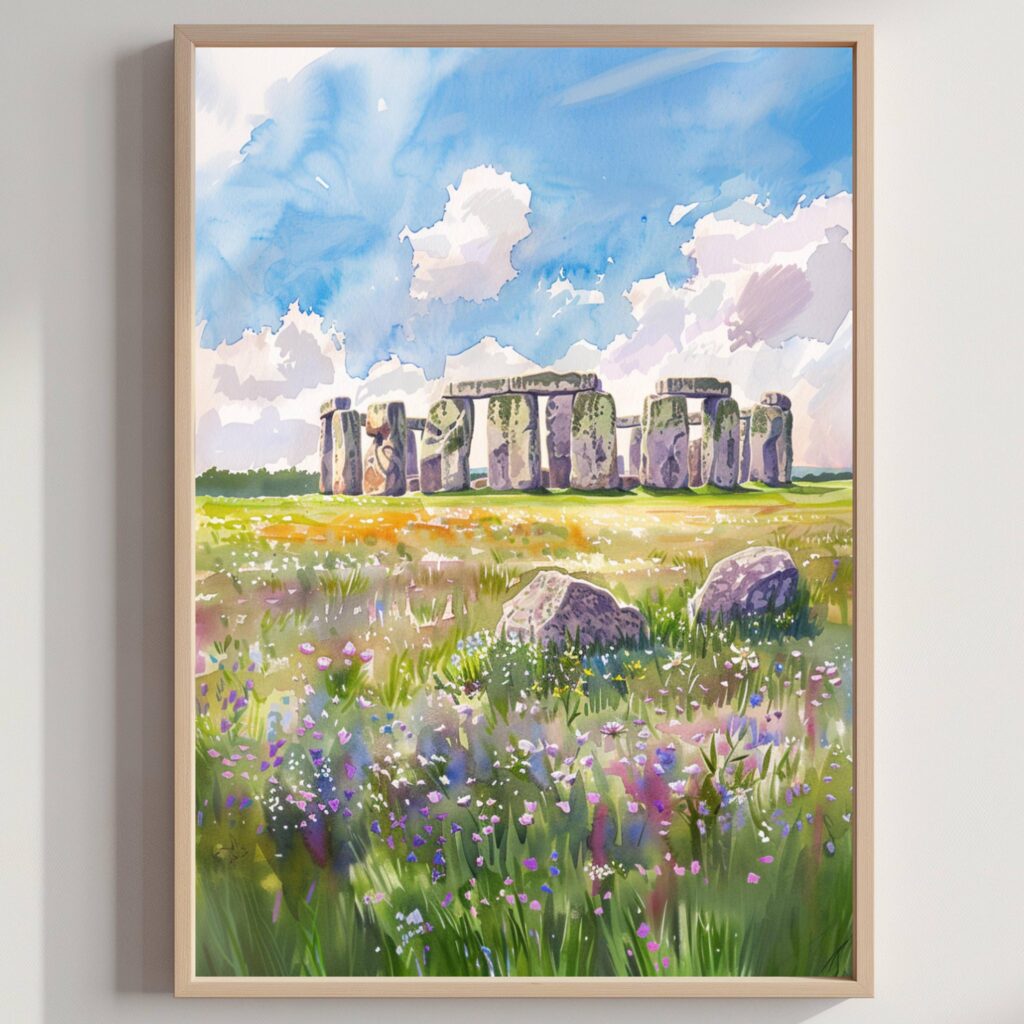
The stark simplicity of Stonehenge, weathered stone silhouetted against Salisbury Plain’s wide, changeable sky, makes it a natural subject for watercolour’s play of light and open space. We’ve captured that quiet monumentality in our own Stonehenge Watercolor Print, painted first by hand and printed to order on archival paper, a small piece of ancient Britain for a wall at home.
Nearly five thousand years old and still not fully explained, Stonehenge remains one of the very few places where not knowing is part of the point.