
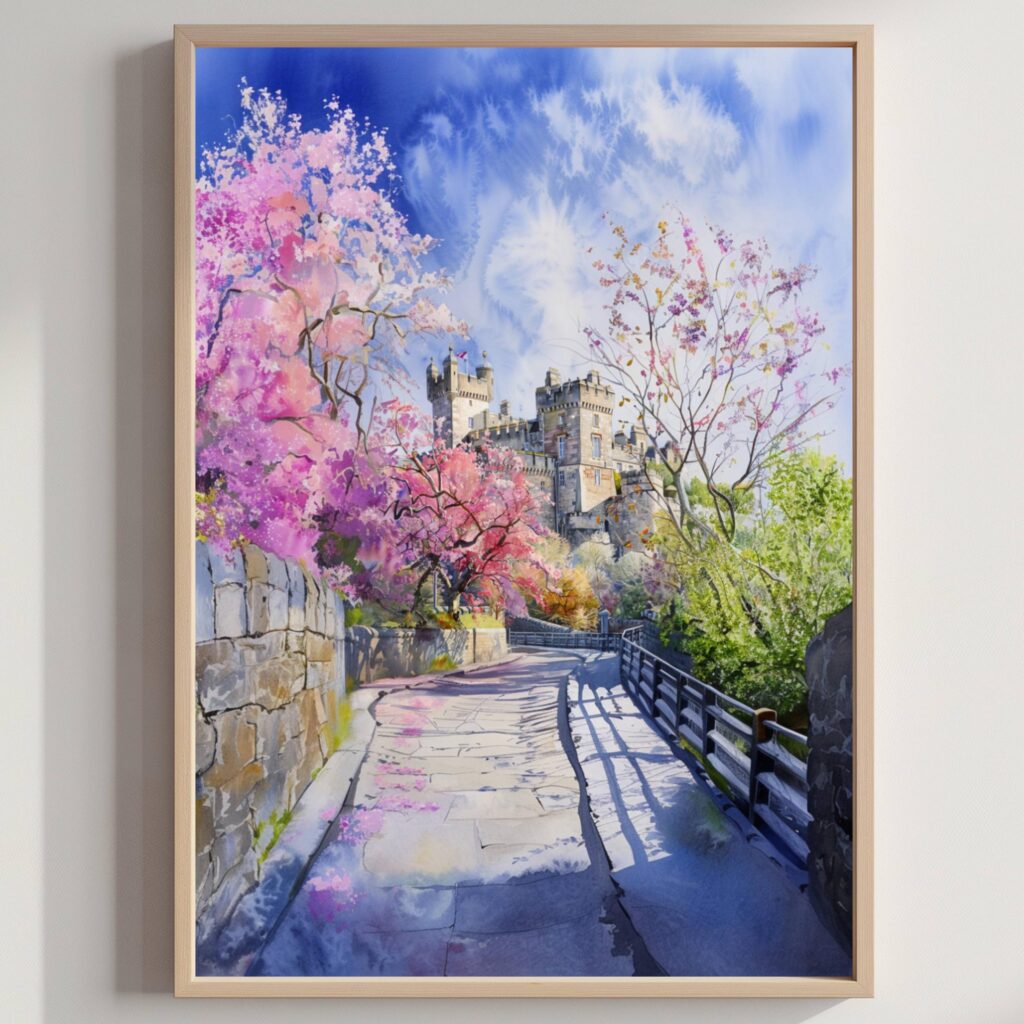
Stirling Castle sits atop a volcanic crag controlling the lowest crossing point of the River Forth, a position of such strategic importance that it changed hands repeatedly during the Wars of Scottish Independence in the late 13th and early 14th centuries, with the nearby Battle of Bannockburn in 1314, one of the most significant Scottish victories over England, fought largely to relieve an English garrison besieged inside the castle. Control of Stirling was long considered so central to controlling Scotland itself that a popular saying held whoever holds Stirling, holds Scotland.
Much of the castle’s surviving architecture dates not from its medieval military years but from the 15th and 16th centuries, when Stewart monarchs rebuilt it into a Renaissance palace, its Great Hall, completed around 1503, once the largest such hall ever built in Scotland.
A Royal Nursery as Much as a Fortress
Stirling Castle served as a childhood residence for several Scottish monarchs, including Mary, Queen of Scots, who was crowned there in 1543 at just nine months old, and later her son, James VI, who would go on to inherit the English throne as well, unifying the crowns of Scotland and England in 1603. The castle’s ornate Chapel Royal, rebuilt for James VI’s own son’s baptism in 1594, still stands as a rare surviving example of this specific moment in Scottish royal architecture.
Stirling Castle’s Great Kitchens, extensively restored and reinterpreted for visitors, give a detailed sense of the vast logistical operation once required to feed a royal court and garrison, a less glamorous but equally significant part of the castle’s long working life.
Painting a Fortress on Its Volcanic Crag
Stirling Castle’s commanding position above the Forth valley gives a watercolourist dramatic elevation and rugged stonework to work with. We’ve captured that setting in our own Stirling Castle Watercolor Print, painted first by hand and printed to order on archival paper, a small piece of Scotland for a wall at home.
Fought over more than almost any other Scottish stronghold and later a nursery for infant monarchs, Stirling Castle remains a fortress whose walls have held both battles and cradles in roughly equal measure.