
Shenandoah National Park, established in 1935 in Virginia’s Blue Ridge Mountains, is unusual among major American national parks for having been created almost entirely on land that was previously privately owned and farmed, rather than remote wilderness, requiring the relocation of roughly 500 mountain families through a combination of purchase and, controversially, eminent domain before the park could be established. Much of the forest now covering Shenandoah’s slopes has actually regrown since that displacement less than a century ago, meaning what looks like ancient wilderness today is, in significant part, a genuinely modern ecological recovery.
Skyline Drive, the 105-mile scenic road running the length of the park along the crest of the Blue Ridge, was built during the same 1930s period as part of Depression-era public works programmes, offering views across the Shenandoah Valley to the west and the Virginia Piedmont to the east from a single continuous ridge-top route.
A Forest Reclaimed Faster Than Expected
Shenandoah’s rapid forest regrowth since the 1930s has made it a notable case study in ecological recovery, and the park is now home to black bears in some of the highest population densities found anywhere in the country, a genuine wildlife resurgence on land that was cleared farmland within living memory of the park’s founding generation. Old Rag Mountain, one of the park’s most popular and demanding hikes, requires a substantial rock scramble near its summit, a challenge that has made it one of the most sought-after routes in the entire park.
Shenandoah sits close enough to Washington, DC to serve as a genuinely accessible wilderness escape for the capital region, a proximity that shaped much of the political motivation behind the park’s creation in the first place.
Painting Ridgeline Forest in Blue Haze
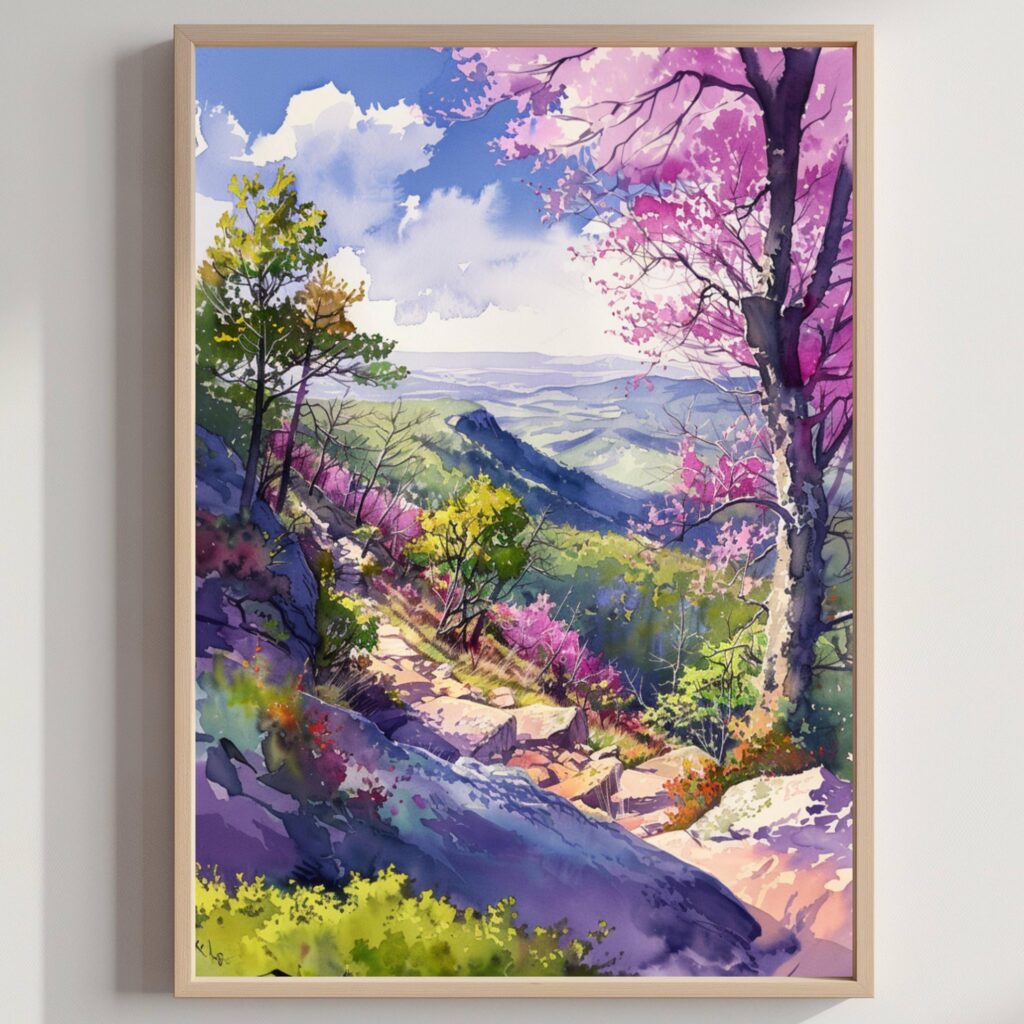
Shenandoah’s forested ridgelines fading into blue-grey haze give a watercolourist soft, layered colour and gentle atmospheric depth to work with. We’ve captured that character in our own Shenandoah Watercolor Print, painted first by hand and printed to order on archival paper, a small piece of Virginia for a wall at home.
Built on land farmed by families displaced within living memory, Shenandoah remains a park whose wilderness today is considerably younger than it looks.