
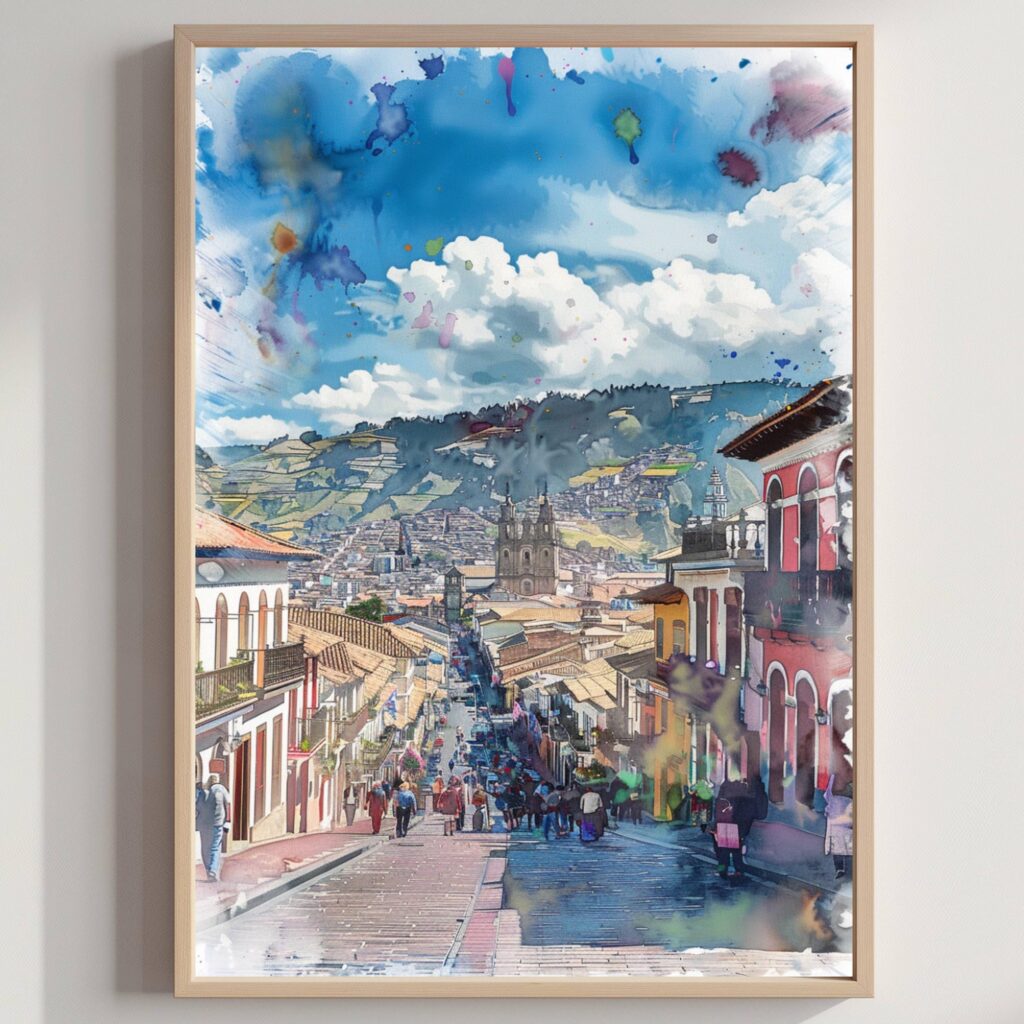
Quito’s historic centre is widely regarded as one of the best-preserved colonial old towns in Latin America, and was, along with Krakow, among the very first sites UNESCO designated as World Heritage Sites in 1978, recognition of its extraordinarily dense concentration of Spanish colonial churches, monasteries, and plazas built largely between the 16th and 18th centuries. The city sits at over 2,800 metres in elevation, nestled in a narrow valley along the eastern slopes of the Pichincha volcano, making it, alongside La Paz, one of the highest capital cities in the world.
Just north of the city, the Mitad del Mundo monument marks the equator’s approximate location, though modern GPS measurements later revealed the original 18th-century French geodesic survey used to place the monument was actually slightly off, the true equatorial line sits roughly 240 metres away, a small, good-natured embarrassment that hasn’t stopped the monument from remaining a popular attraction regardless.
A City Watched Over by an Active Volcano
Pichincha, the volcano rising directly beside Quito, remains active, a significant eruption in 1999 blanketed the city in ash, and the volcano is monitored continuously given the population living so close to its slopes. Quito’s La Compania de Jesus church, its interior covered almost entirely in gold leaf, took over 160 years to complete and is considered one of the most significant examples of Baroque architecture anywhere in South America, a single building whose construction spanned multiple generations of craftsmen.
The city’s cable car, the TelefériQo, climbs the slopes of Pichincha to nearly 4,100 metres, offering panoramic views across the entire Andean valley Quito occupies, a striking contrast between colonial architecture below and raw volcanic landscape above.
Painting Colonial Stone Beneath a Volcano
Quito’s colonial rooftops set against Pichincha’s looming volcanic slopes give a watercolourist dramatic scale and historic detail to work with. We’ve captured that setting in our own Quito Watercolor Print, painted first by hand and printed to order on archival paper, a small piece of Ecuador for a wall at home.
Built almost exactly astride the equator and watched constantly by an active volcano, Quito remains a capital whose geography is nearly as remarkable as its architecture.