
Phnom Penh, Cambodia’s capital, was forcibly evacuated almost entirely within days of the Khmer Rouge’s takeover in April 1975, an estimated two million residents driven out into the countryside under the pretext of American bombing threats, part of a broader, brutal social engineering campaign that would ultimately claim an estimated 1.7 to 2 million lives across Cambodia over the following four years. The city sat almost completely empty for years, buildings left exactly as residents had abandoned them, a period locals still refer to simply as “Pol Pot time,” named for the Khmer Rouge’s leader.
The Tuol Sleng Genocide Museum, housed in a former high school converted into a notorious Khmer Rouge prison and interrogation centre known as S-21, remains one of the most sobering historical sites in Southeast Asia, preserved deliberately so the scale of what happened cannot be denied or forgotten by future generations.
A City That Chose to Rebuild Rather Than Relocate
Following the Khmer Rouge’s fall in 1979, residents gradually returned to Phnom Penh, and the city has since undergone substantial reconstruction and modern development, its riverside promenade along the Tonle Sap and Mekong rivers now lined with restaurants and hotels built alongside older French colonial architecture surviving from Cambodia’s period as part of French Indochina. The Royal Palace, home to the King of Cambodia, and the adjoining Silver Pagoda, its floor lined with over 5,000 silver tiles, survived the Khmer Rouge period relatively intact, a rare architectural continuity in a city where so much else was lost.
Cambodia’s population today is notably young, a demographic legacy of the genocide’s enormous loss of life across a specific generation, and Phnom Penh’s rapid modern growth reflects a country actively rebuilding much of its social and economic foundation within living memory of near-total collapse.
Painting a Riverside City Rebuilding Itself
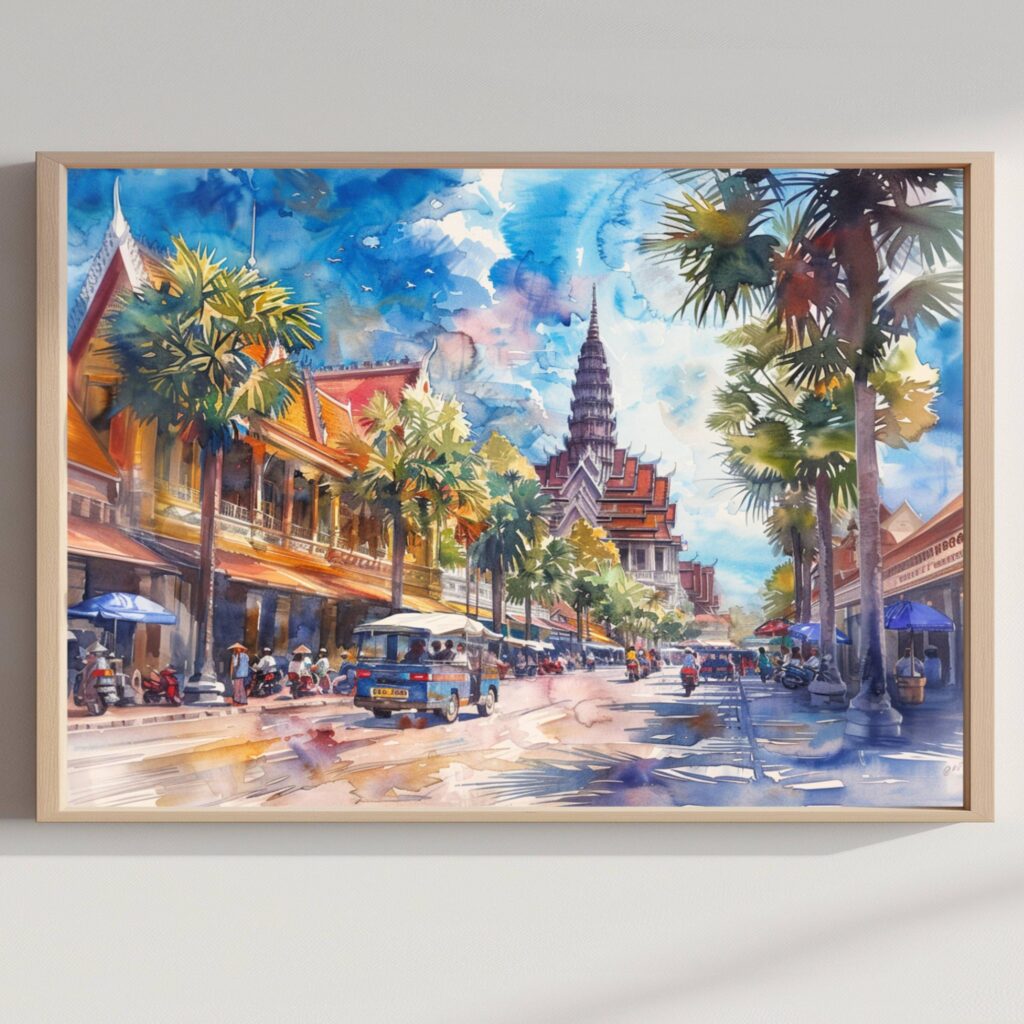
The Royal Palace’s gilded rooftops along the Tonle Sap River give a watercolourist rich colour and a genuine sense of quiet resilience to work with. We’ve captured that riverside character in our own Phnom Penh Watercolor Print, painted first by hand and printed to order on archival paper, a small piece of Cambodia for a wall at home.
Nearly emptied entirely within living memory, Phnom Penh remains a capital whose ordinary daily life today represents its own quiet, considerable achievement.