
Palm Springs’ rise as a Hollywood retreat through the 1930s to 1950s was substantially driven by a clause reportedly written into studio contracts requiring stars to remain within a two-hour reach of the studio at all times, a rule Palm Springs, roughly a two-hour drive from Los Angeles, happened to satisfy exactly, making it a favoured escape for stars including Frank Sinatra, Marilyn Monroe, and members of the Rat Pack. This era left the city with one of the largest concentrations of Midcentury Modern architecture anywhere in the world, low-slung glass-and-steel homes designed by architects including Richard Neutra and Albert Frey still drawing dedicated preservation tourism today.
The city sits within the traditional territory of the Agua Caliente Band of Cahuilla Indians, whose reservation lands are interspersed throughout Palm Springs in a checkerboard pattern dating to 19th-century railroad land grants, giving the tribe a significant and continuing role in the city’s development and economy.
A Desert City Cooled by an Unusual Wind Corridor
Palm Springs sits at the entrance to the San Gorgonio Pass, a natural wind corridor between two mountain ranges that channels strong, consistent winds through the area, conditions that have made the surrounding valley one of the most productive wind energy regions in the United States, its thousands of turbines a striking sight for visitors arriving from the Los Angeles side. Despite its desert setting, the city receives water from an aquifer fed partly by snowmelt from the San Jacinto Mountains, which rise dramatically and abruptly at the edge of town.
The Palm Springs Aerial Tramway, opened in 1963, carries visitors nearly 2,600 metres up the face of San Jacinto Peak in under fifteen minutes, a journey that shifts from desert heat to alpine forest conditions within a single cable car ride.
Painting Midcentury Lines Against Desert Mountains
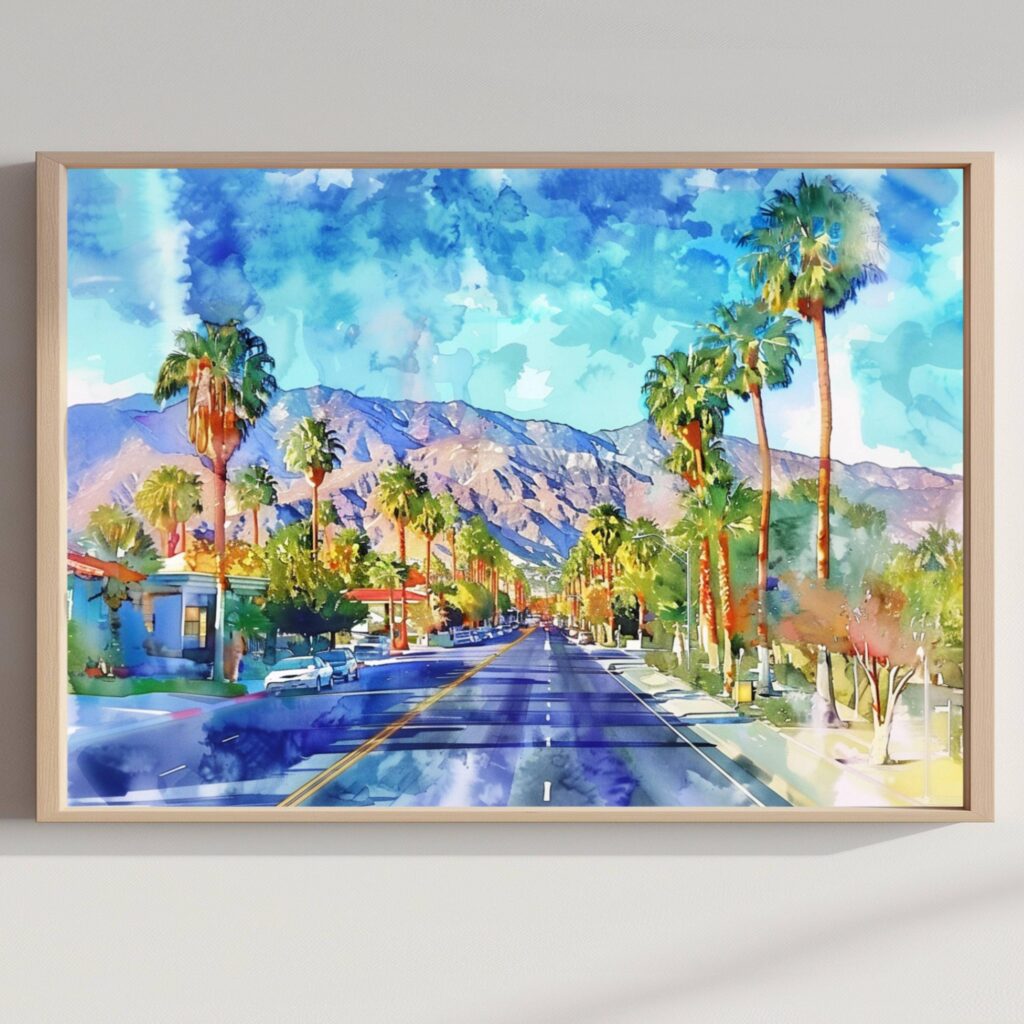
Palm Springs’ clean modernist architecture set against its dramatic desert mountains gives a watercolourist striking geometry and warm colour to work with. We’ve captured that setting in our own Palm Springs Watercolor Print, painted first by hand and printed to order on archival paper, a small piece of California for a wall at home.
Built partly on a studio contract clause and shaped since by wind and mountain water, Palm Springs remains a desert retreat whose glamour has always rested on some genuinely practical foundations.