
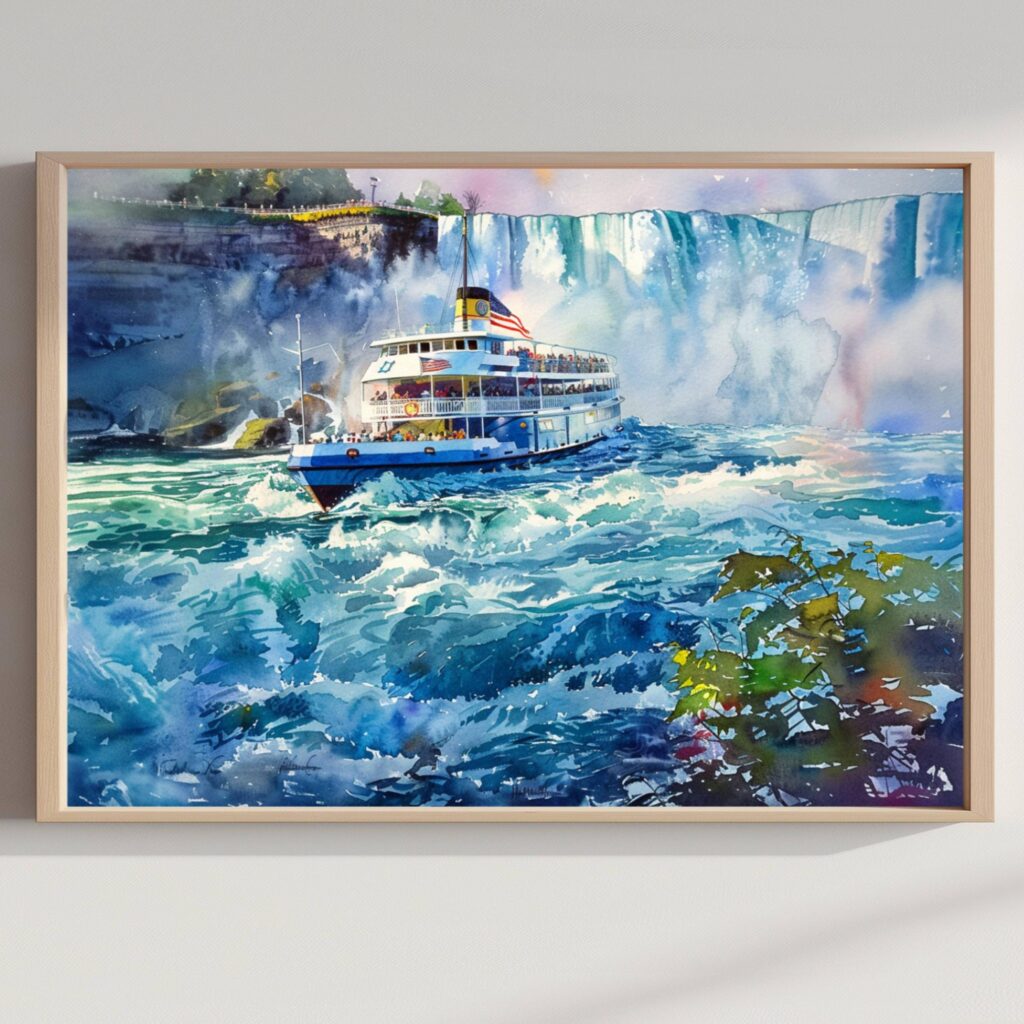
Niagara Falls isn’t one waterfall but three: the Horseshoe Falls, mostly on the Canadian side, along with the American Falls and the much smaller Bridal Veil Falls, both on the US side, separated by Goat Island. Together they carry more water over their combined crest than any other waterfall in North America, roughly 168,000 cubic metres per minute at peak flow, a volume that has been harnessed for hydroelectric power since the late 19th century.
The falls are also, geologically speaking, in slow motion. Erosion has been carving the rock face backward for thousands of years, historically at a rate of about a metre annually before engineering projects and diverted flow slowed that retreat to a few centimetres a year today. The falls are, quite literally, not where they used to be, and won’t be where they are now indefinitely.
Barrels, Boats, and a Dangerous Kind of Fame
Niagara has long attracted daredevils: in 1901, 63-year-old schoolteacher Annie Edson Taylor became the first person to survive going over the falls in a barrel, hoping the stunt would bring her fame and fortune, it brought mostly the former. The Maid of the Mist boat tours, meanwhile, have been ferrying visitors to the base of the falls since 1846, making it one of North America’s oldest continuously operating tourist attractions, passengers still don blue ponchos before getting close enough to feel the spray.
At night, the falls are lit in colour by powerful floodlights, a tradition dating back to 1925, turning the roar of falling water into one of the more theatrical natural spectacles anywhere on the continent.
Painting Mist and Motion
The constant spray and shifting light of Niagara make it a compelling, ever-changing subject, no two watercolour studies of it ever look quite the same. We’ve captured that motion in our own Niagara Falls Watercolor Print, painted first by hand and printed to order on archival paper, a small piece of the falls for a wall at home.
Slowly eating its way upstream, metre by metre, Niagara Falls is one of the rare landmarks that is, quite literally, still being carved today.