
Intramuros, Manila’s historic walled city, was founded by Spanish colonisers in 1571 and served as the administrative and religious centre of the Philippines for over three centuries, its thick stone walls and fortified gates designed to protect Spanish colonial authority from both external threats and the local population it governed. That fortified core made Manila one of the most important Spanish colonial cities in Asia, a key stop in the Manila-Acapulco galleon trade route that connected Asia to the Americas for roughly 250 years.
Much of Intramuros was almost completely destroyed during the Battle of Manila in 1945, when American and Filipino forces fought to retake the city from occupying Japanese troops, fighting so intense and destructive that Manila became one of the most devastated Allied capital cities of the entire Second World War, second only to Warsaw in the scale of destruction among wartime capitals.
A City Rebuilding Its Own Layered Memory
Post-war reconstruction of Intramuros has been gradual and, in places, incomplete, some sections remain in ruins today, deliberately left as memorials, while others, including Fort Santiago and San Agustin Church, one of the few structures to survive the 1945 destruction largely intact, have been carefully restored. San Agustin Church, completed in 1607, is the oldest stone church in the Philippines and, alongside several other Philippine Baroque churches, was designated a UNESCO World Heritage Site in recognition of its remarkable survival and architectural significance.
Manila’s broader identity reflects that same layered colonial history, roughly 300 years of Spanish rule followed by nearly 50 years of American administration, leaving a city where Spanish colonial architecture, American-era infrastructure, and distinctly Filipino culture all coexist within the same urban fabric.
Painting Stone Walls That Survived a War
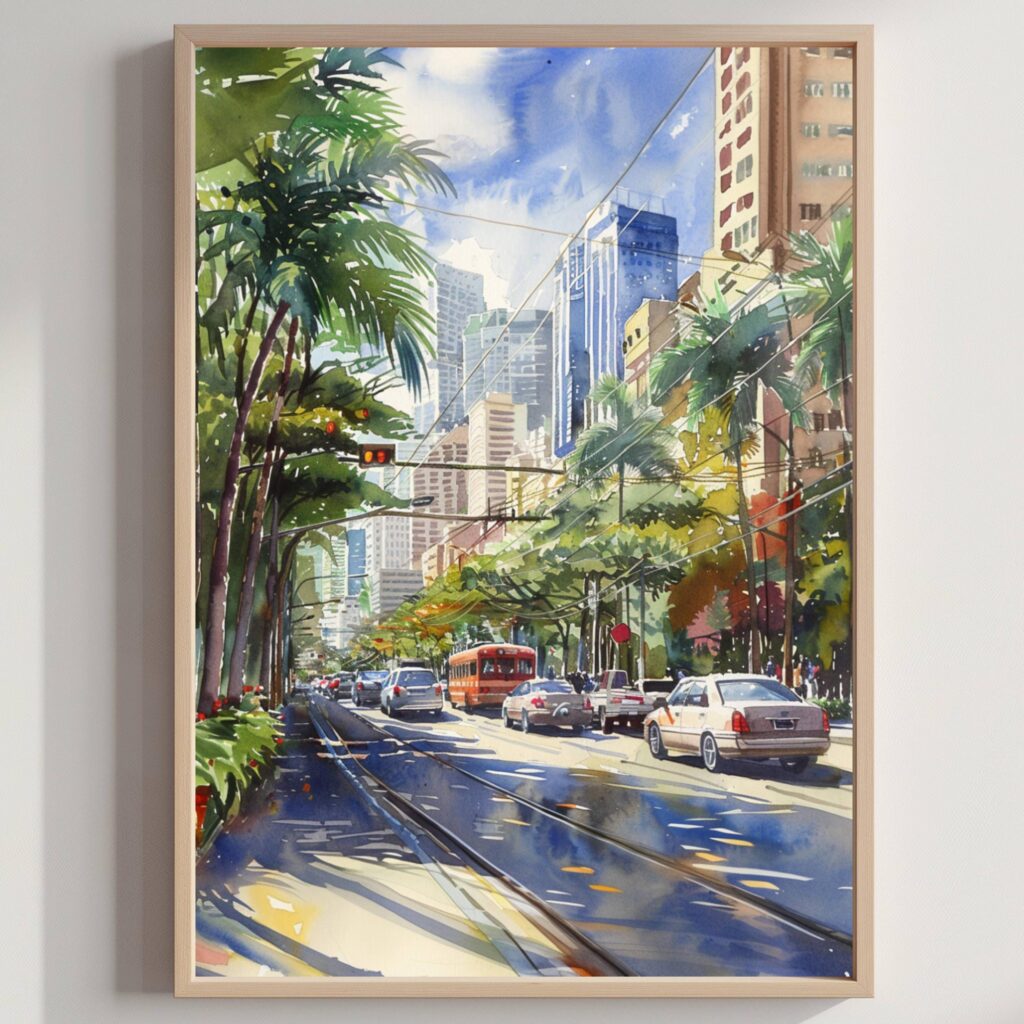
Intramuros’s weathered stone walls and Baroque church facades give a watercolourist rich historical texture to work with. We’ve captured that resilience in our own Manila Watercolor Print, painted first by hand and printed to order on archival paper, a small piece of the Philippines for a wall at home.
Nearly erased in the final months of the Second World War, Manila’s walled city remains standing today largely through the same determination that has defined much of its layered, difficult history.