
Madagascar separated from the African mainland roughly 160 million years ago and later from India around 90 million years ago, an isolation so ancient and complete that an estimated 90% of its wildlife, including all of its lemur species, exists nowhere else on Earth. That evolutionary separation makes the island one of the most biodiverse and ecologically distinct places on the planet, often described by biologists as an entirely separate evolutionary laboratory rather than simply another tropical island.
Lemurs, Madagascar’s most famous residents, evolved into over 100 distinct species found only on the island, ranging from the mouse lemur, among the smallest primates in the world, to the indri, whose haunting, whale-like call carries for kilometres through the island’s dwindling rainforest.
An Ecosystem Under Serious Pressure
Madagascar has lost a significant portion of its original forest cover since human settlement began roughly 2,000 years ago, and deforestation, driven by agricultural expansion and charcoal production, remains one of the island’s most urgent conservation crises, threatening species that, having evolved nowhere else, have nowhere else to retreat to. Conservation organisations have worked for decades to establish protected reserves, though balancing ecological protection against the needs of one of the world’s poorest nations remains a genuinely difficult ongoing challenge.
Madagascar’s baobab trees, particularly the dramatic Avenue of the Baobabs, some estimated to be over 800 years old, have become one of the island’s most iconic images, their swollen trunks store water to survive the region’s long dry seasons, a striking adaptation to an unpredictable climate.
Painting a Landscape Found Nowhere Else
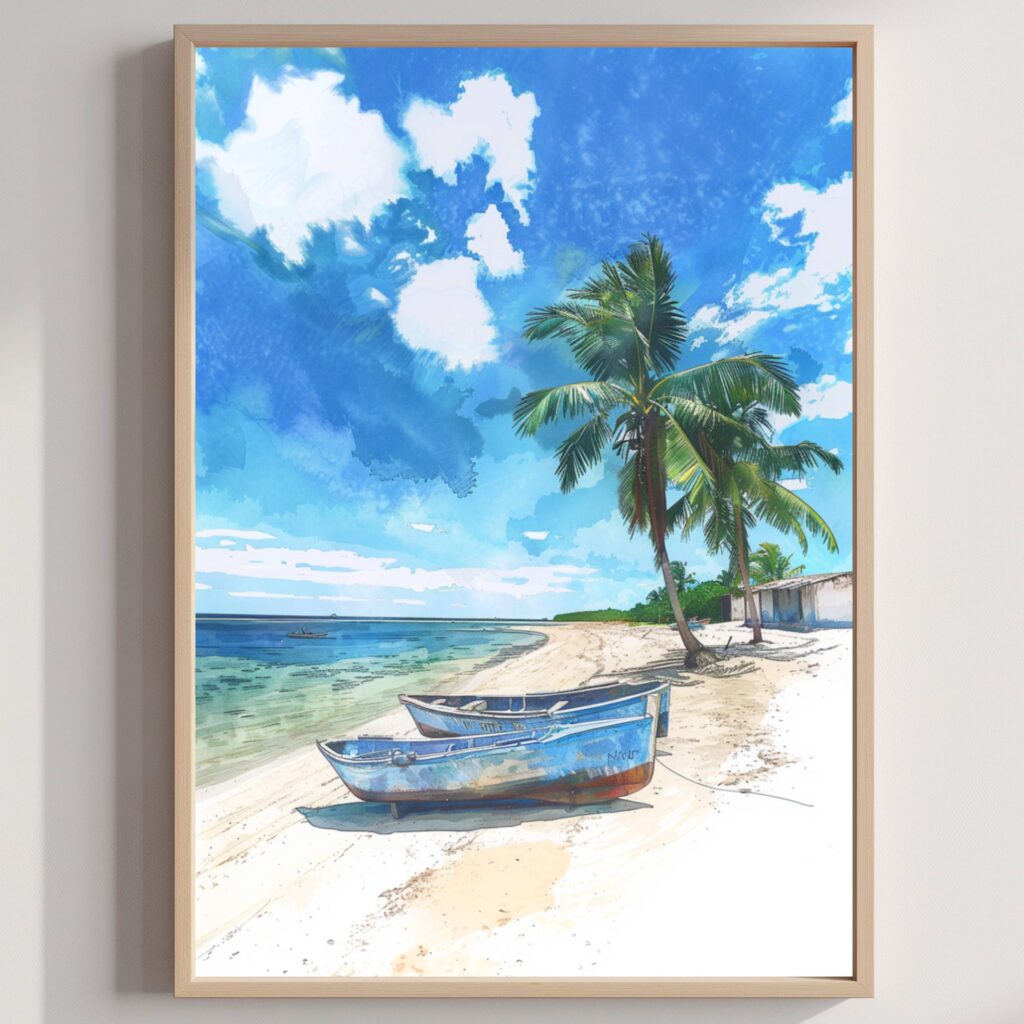
Madagascar’s dramatic baobab silhouettes against warm evening light give a watercolourist a genuinely unique subject to capture. We’ve painted that singular landscape in our own Madagascar Watercolor Print, printed to order on archival paper, a small piece of the Indian Ocean for a wall at home.
Isolated for 160 million years and still evolving on its own separate track, Madagascar remains one of the only places on Earth where nature genuinely had no outside influence to answer to.