
Hobart was founded in 1804 as a penal settlement, the second-oldest city in Australia after Sydney, its early economy and infrastructure built substantially on convict labour transported from Britain, a punitive history still visible in surviving structures like the Cascades Female Factory, a former convict women’s prison now recognised as a UNESCO World Heritage Site alongside several other Tasmanian convict sites. That harsh founding period stands in notable contrast to Hobart’s modern reputation as one of Australia’s most creatively vibrant small cities.
Much of that modern transformation traces to a single, deliberately provocative institution, the Museum of Old and New Art, MONA, opened in 2011 by professional gambler and art collector David Walsh, built largely underground into a riverside cliff and intentionally designed to challenge and unsettle visitors rather than simply display art conventionally, an approach that has drawn international attention and substantially reshaped Hobart’s cultural profile within little more than a decade.
A City Framed by a Mountain That Rarely Loses Its Snow
Mount Wellington, rising directly above Hobart, is visible from nearly every part of the city and frequently retains snow on its summit even as Hobart itself remains mild, a dramatic natural backdrop that has become as central to the city’s identity as its historic waterfront. Salamanca Place, Hobart’s row of Georgian sandstone warehouses along the harbour, originally built for the whaling and shipping trade in the early 19th century, now houses galleries, restaurants, and a long-running Saturday market considered one of the best in Australia.
Tasmania’s isolation from mainland Australia has helped preserve unique wildlife and wilderness across the island, and Hobart functions as the primary gateway to that wilderness, including the Tasmanian devil, a species now found in significant numbers only on the island itself.
Painting Sandstone Beneath a Watching Mountain
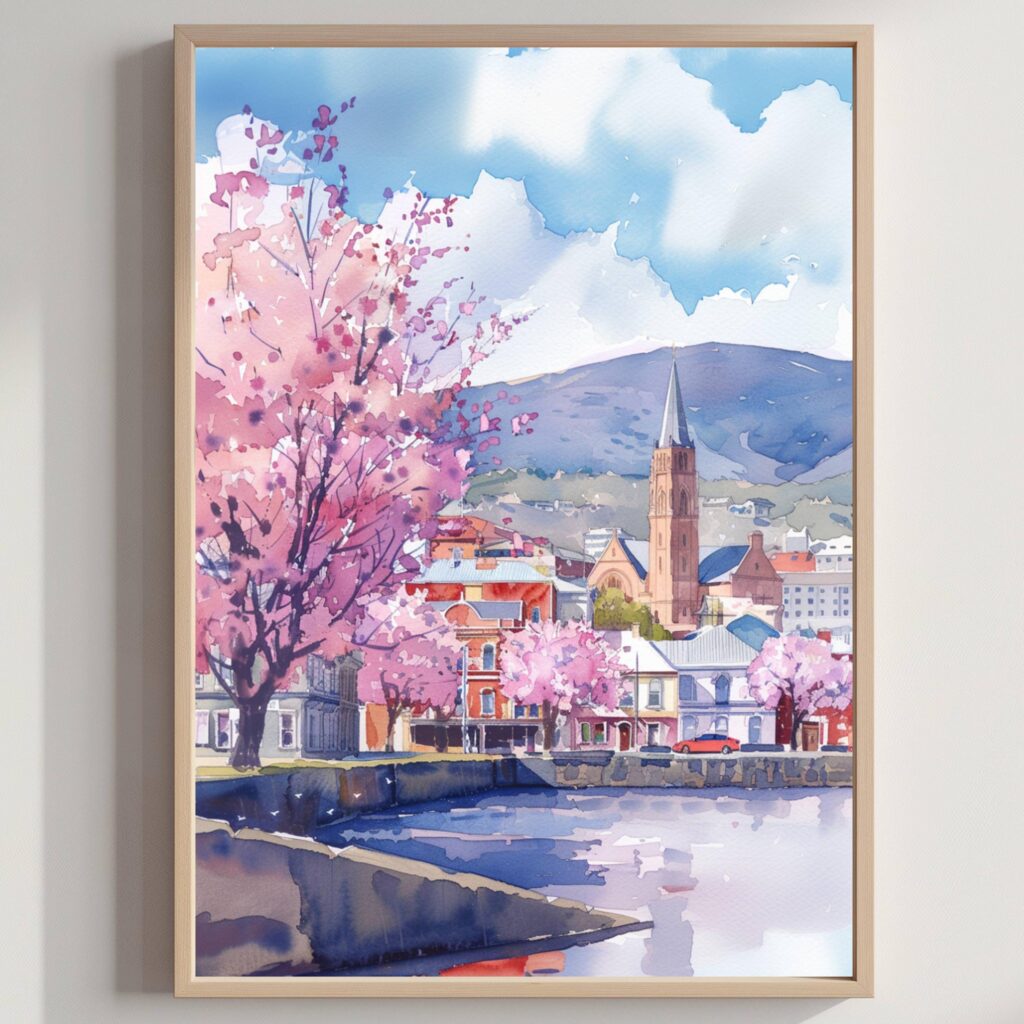
Hobart’s Georgian sandstone waterfront beneath Mount Wellington’s dramatic profile gives a watercolourist rich historic texture and natural scale to work with. We’ve captured that setting in our own Hobart Watercolor Print, painted first by hand and printed to order on archival paper, a small piece of Tasmania for a wall at home.
Founded as a convict outpost and reinvented since as an unlikely arts destination, Hobart remains a small city whose history and current identity have almost nothing obvious in common.