
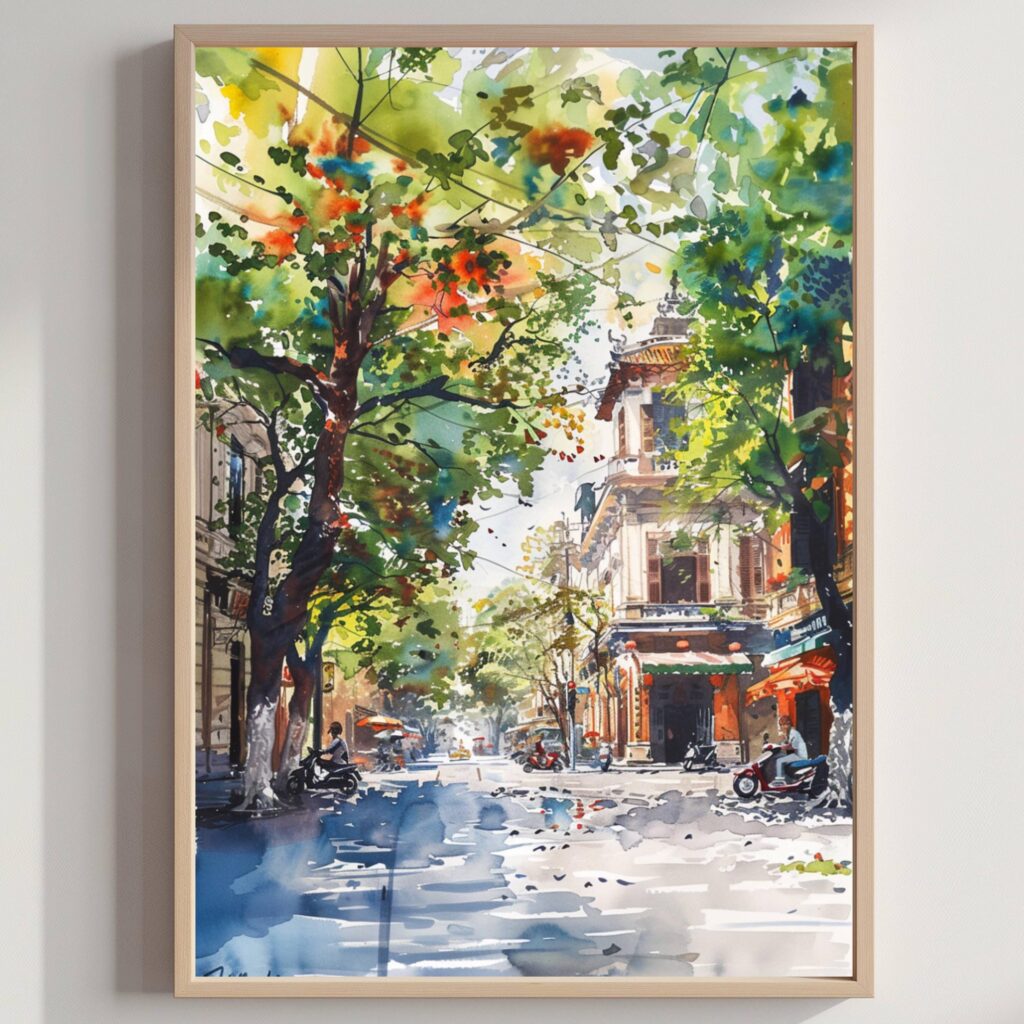
Hanoi’s Old Quarter still follows a street layout established roughly a thousand years ago, when the area was organised into 36 guild streets, each named for and dedicated to a specific trade, silk merchants, silversmiths, paper makers, a naming convention many streets retain even today, Hang Bac still associated with silver, Hang Gai still known for silk, long after most of the original guilds themselves have dispersed. That density of narrow, commerce-packed streets has made the Old Quarter one of the more distinctive surviving examples of pre-colonial Southeast Asian urban planning still functioning as an active, lived-in neighbourhood rather than a preserved museum district.
Hanoi has served, on and off, as the political centre of Vietnam for over a thousand years, first as the capital of successive Vietnamese dynasties beginning in 1010, then, following French colonisation in the late 19th century, as the administrative capital of French Indochina, and finally as the capital of a unified Vietnam following the end of the Vietnam War in 1975.
A City Layered With French Colonial Architecture
French colonial rule left Hanoi with a substantial legacy of European-style architecture, wide tree-lined boulevards, government buildings, and the Hanoi Opera House, completed in 1911 and modelled closely on the Palais Garnier in Paris, sitting in direct architectural contrast to the dense, informal Old Quarter nearby. That colonial layer coexists today with Hanoi’s socialist-era monuments, including the Ho Chi Minh Mausoleum, where the preserved body of Vietnam’s revolutionary leader remains on public display, a site of genuine national significance visited by millions of Vietnamese citizens annually.
Hoan Kiem Lake, at the heart of the city, is tied to a Vietnamese legend in which a magical sword was returned to a golden turtle god, and the small Ngoc Son Temple on an island within the lake remains a popular spot for locals seeking a quiet break from the surrounding city’s persistent motorbike traffic.
Painting a City of Layered Streets and Lakes
Hanoi’s mix of French colonial facades and dense Old Quarter streets gives a watercolourist genuinely rich architectural texture to work with. We’ve captured that character in our own Hanoi Watercolor Print, painted first by hand and printed to order on archival paper, a small piece of Vietnam for a wall at home.
Built on a thousand-year-old street plan and layered since with French and socialist history alike, Hanoi remains a capital whose old bones are still doing most of the daily work.