
Halifax’s modern layout and much of its civic memory trace back to December 6, 1917, when a French cargo ship carrying wartime explosives collided with another vessel in the harbour, triggering an explosion so massive it remained the largest human-made blast in history until the development of nuclear weapons. The Halifax Explosion killed roughly 2,000 people and levelled a significant portion of the city’s north end, a disaster whose scale prompted one of the earliest large-scale international humanitarian relief efforts, aid arriving from across Canada and the United States within days.
That relief effort forged a lasting bond specifically with Boston, whose emergency response was so significant that Halifax has sent Boston a large Christmas tree as an annual gift of thanks every year since 1971, a tradition marking gratitude for assistance given over a century ago.
A Naval Port Central to Two World Wars
Halifax’s deep, ice-free natural harbour, one of the largest in the world, made it strategically vital during both World Wars, serving as the primary Canadian departure point for troop convoys crossing the Atlantic, a role that also explains why the harbour was so heavily trafficked with munitions ships in 1917 in the first place. The Halifax Citadel, a star-shaped fortress overlooking the harbour, was built and rebuilt several times beginning in the 18th century, reflecting the city’s long-standing military significance to British colonial and later Canadian defence.
Pier 21, Halifax’s former ocean immigration terminal, processed roughly one million immigrants to Canada between 1928 and 1971, now preserved as a national museum documenting Canada’s immigration history, a considerably gentler chapter in the same harbour’s layered past.
Painting a Harbour Rebuilt From Disaster
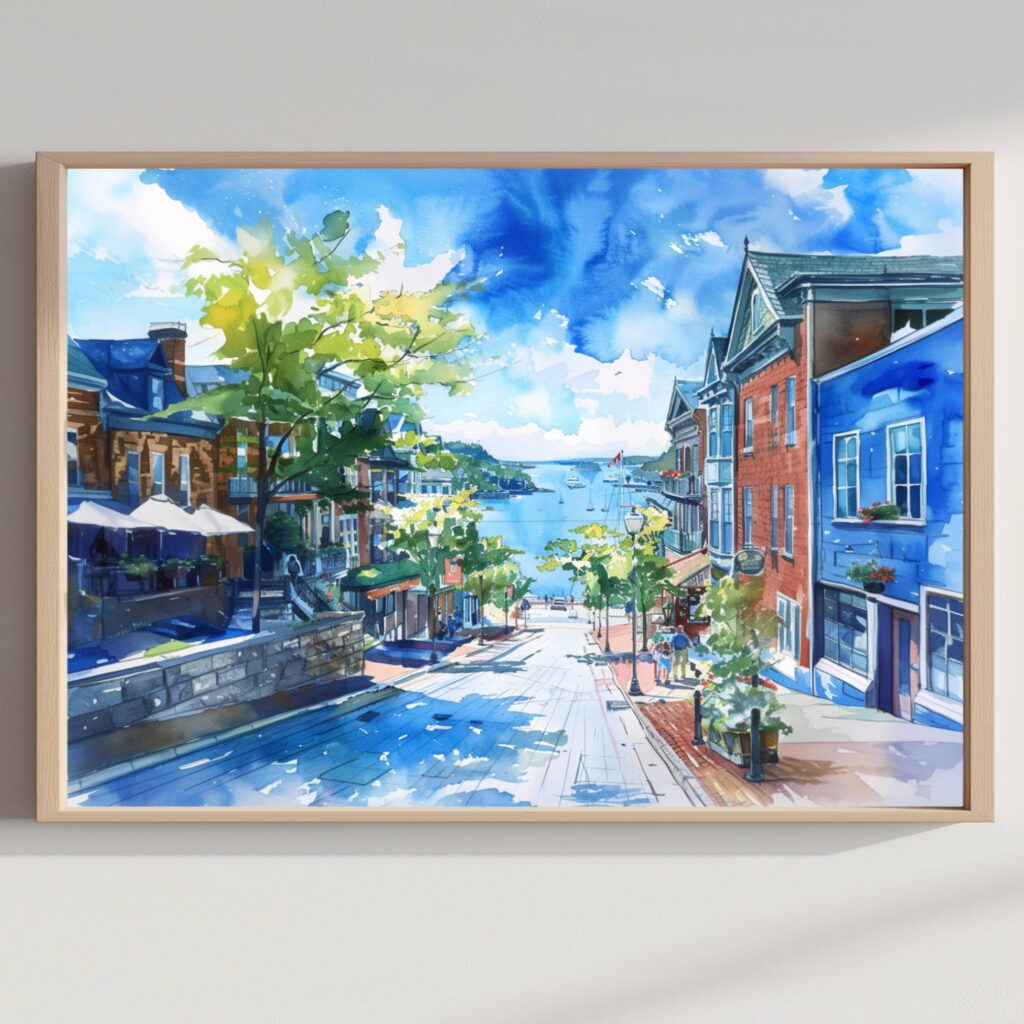
Halifax’s historic waterfront against its deep natural harbour gives a watercolourist rich maritime history and reflected light to work with. We’ve captured that character in our own Halifax Watercolor Print, painted first by hand and printed to order on archival paper, a small piece of Nova Scotia for a wall at home.
Reshaped by the largest explosion the world had seen before the atomic age, Halifax remains a city whose harbour still carries both genuine tragedy and genuine gratitude in equal measure.