
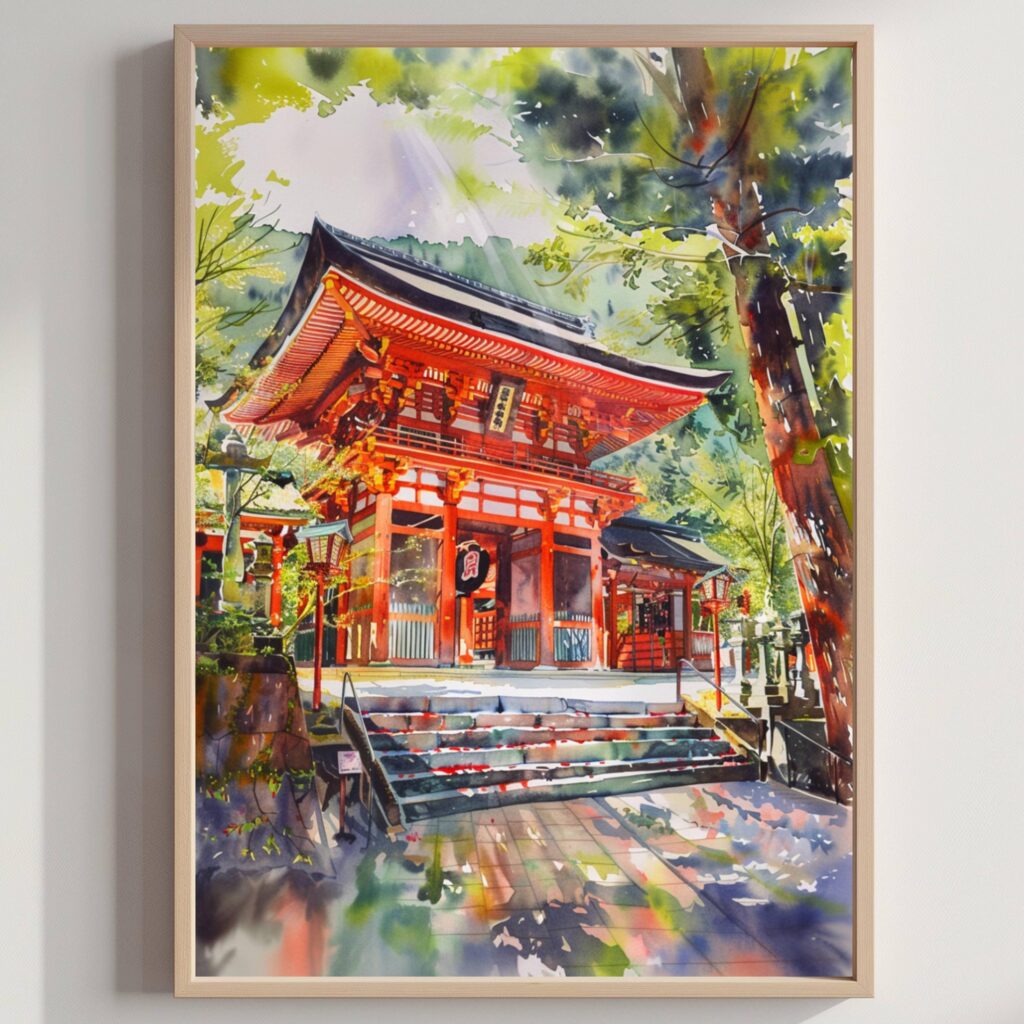
The vermillion gates of Fushimi Inari Taisha don’t just decorate the mountainside, they form a continuous tunnel, thousands of them in unbroken succession, climbing over 4 kilometres up the slopes of Mount Inari on the outskirts of Kyoto. Each one, known as a torii, was donated by an individual or a business, a practice dating back to the Edo period that continues today. Look closely and every gate carries an inscription, a name, a date, a wish for prosperity.
The shrine itself predates the gates by centuries, founded in 711 CE and dedicated to Inari, the Shinto deity of rice, agriculture, and business prosperity. Foxes, believed to be Inari’s messengers, appear everywhere across the grounds as stone statues, often depicted holding a key, said to be the key to a rice granary, in their mouths.
A Climb, Not Just a Photograph
Most visitors see only the first stretch of gates near the main shrine buildings, but the full path continues for two to three hours round trip, past smaller shrines, teahouses, and increasingly quiet forest as the crowds thin with elevation. The full climb rewards those who make it with views back across Kyoto and a much more solitary, contemplative version of a site most people experience only in its busiest few hundred metres.
Unlike many of Japan’s most famous religious sites, Fushimi Inari Taisha has no entrance fee and stays open 24 hours, a rarity that means the gates can be experienced in the hush of early morning or evening, long after the day’s crowds have gone home.
Painting Vermillion in Sequence
The repetition of the gates, that same saturated red, receding into shadow and light along the mountainside, makes for a striking watercolour subject, rhythm and colour doing most of the work. We’ve captured that procession of torii in our own Fushimi Inari Taisha Watercolor Print, painted first by hand and printed to order on archival paper, a small piece of Kyoto for a wall at home.
Few sites in Japan combine devotion and spectacle quite so seamlessly, thousands of individual gifts, given over centuries, forming one continuous path up a sacred mountain.