
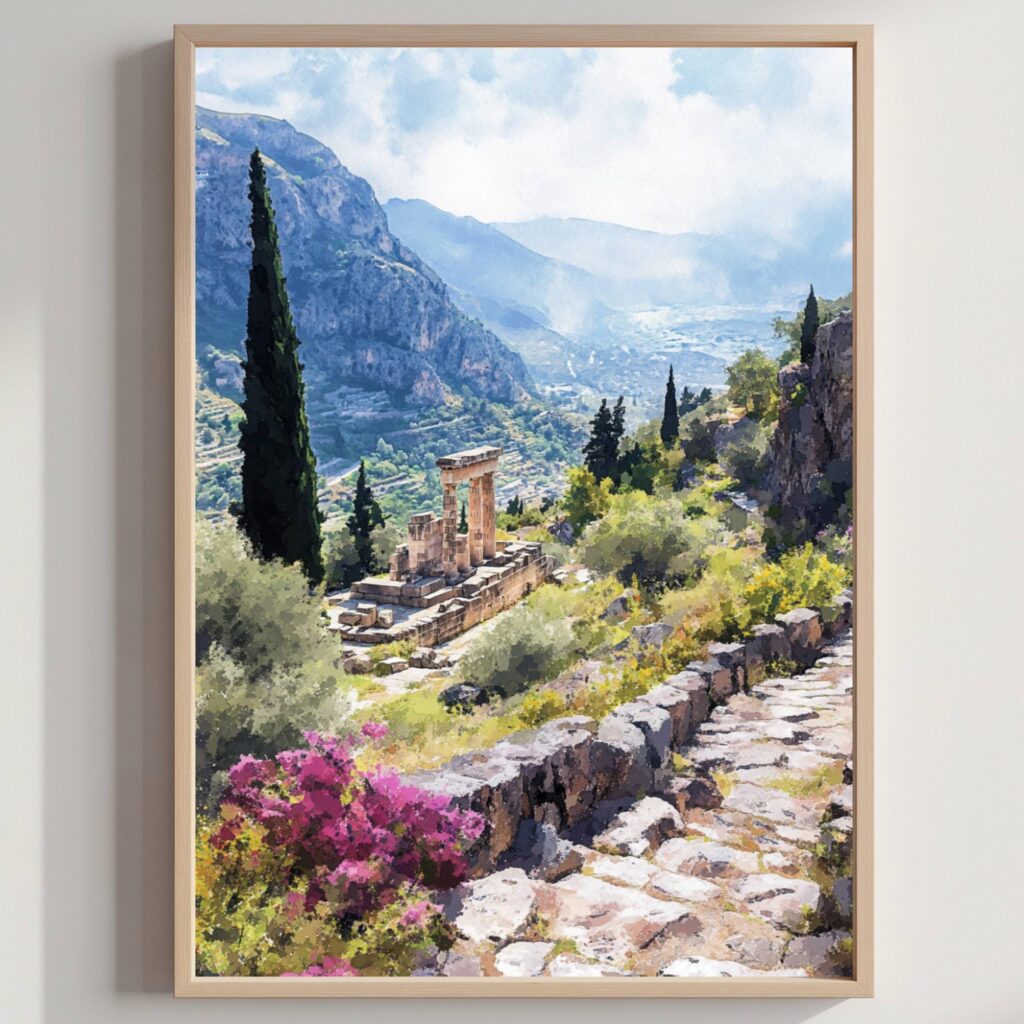
Ancient Greeks believed Delphi marked the exact centre of the world, according to myth, Zeus released two eagles from opposite ends of the earth and they met precisely above Delphi, a spot marked afterward by a carved stone, the omphalos, meaning “navel,” still displayed at the site’s museum today. That belief in Delphi’s cosmic centrality made it the location of the most important oracle in the ancient Greek world, the Temple of Apollo’s Pythia, a priestess whose cryptic pronouncements, delivered in a trance, were consulted by kings, generals, and ordinary citizens alike for over a thousand years.
Modern geological research has suggested a possible scientific basis for the Pythia’s trances, fault lines beneath the temple may have released hydrocarbon gases capable of inducing altered mental states, a theory that remains debated but offers a genuinely plausible explanation for phenomena ancient visitors experienced as direct divine communication.
A Site Built Around Competition as Much as Prophecy
Delphi also hosted the Pythian Games, one of the four Panhellenic games of ancient Greece alongside the Olympics, held every four years and combining athletic competition with music and poetry contests, reflecting Apollo’s association with both prophecy and the arts. The site’s well-preserved theatre and stadium, along with the Treasury of the Athenians, built to house offerings from Athens in gratitude for military victory, together make Delphi one of the most architecturally complete sanctuary complexes surviving from the ancient Greek world.
UNESCO designated Delphi a World Heritage Site in 1987, recognising it as one of the most important pan-Hellenic sanctuaries and a site that shaped ancient Greek political and religious life for well over a millennium.
Painting Ruins Against Mountain Light
Delphi’s weathered stone columns set against the dramatic slopes of Mount Parnassus give a watercolourist rich texture and mountain scale to work with. We’ve captured that ancient setting in our own Delphi Watercolor Print, painted first by hand and printed to order on archival paper, a small piece of Greece for a wall at home.
Believed for centuries to be the literal centre of the world, Delphi remains a site whose ruins still carry the weight of every decision once made in consultation with them.