
Darwin has been almost entirely destroyed and rebuilt twice within living memory, first during Japanese air raids in 1942, when the city, then a strategically vital northern military outpost, suffered the largest single attack ever launched against Australia, more bombs dropped on Darwin that February morning than had hit Pearl Harbor just months earlier. The city rebuilt through the following decades, only to be almost completely flattened again on Christmas Eve 1974, when Cyclone Tracy, one of the most destructive tropical cyclones in Australian history, killed dozens of people and destroyed an estimated 70% of Darwin’s buildings in a single night.
That second disaster prompted a genuinely unprecedented response, the largest peacetime evacuation in Australian history saw roughly 30,000 of Darwin’s 47,000 residents airlifted out in the days following the cyclone, and the city’s subsequent rebuilding incorporated significantly stricter cyclone-resistant building codes still in effect today.
A City Positioned Closer to Asia Than to Most of Australia
Darwin sits geographically closer to several Southeast Asian capitals than to Sydney or Melbourne, a positioning that has shaped both its strategic military significance and its genuinely multicultural population, substantial Indigenous, Southeast Asian, and Pacific Islander communities giving the city a demographic character distinct from Australia’s larger southern cities. That tropical, monsoonal climate, divided sharply into a wet season and dry season rather than four temperate seasons, further sets Darwin apart from the rest of the country.
Kakadu National Park and Litchfield National Park, both within reach of Darwin, protect some of Australia’s most significant Indigenous rock art sites, some estimated to be tens of thousands of years old, a cultural and archaeological record considerably older than either of the disasters that twice reshaped the modern city nearby.
Painting a Harbour Rebuilt Against the Odds
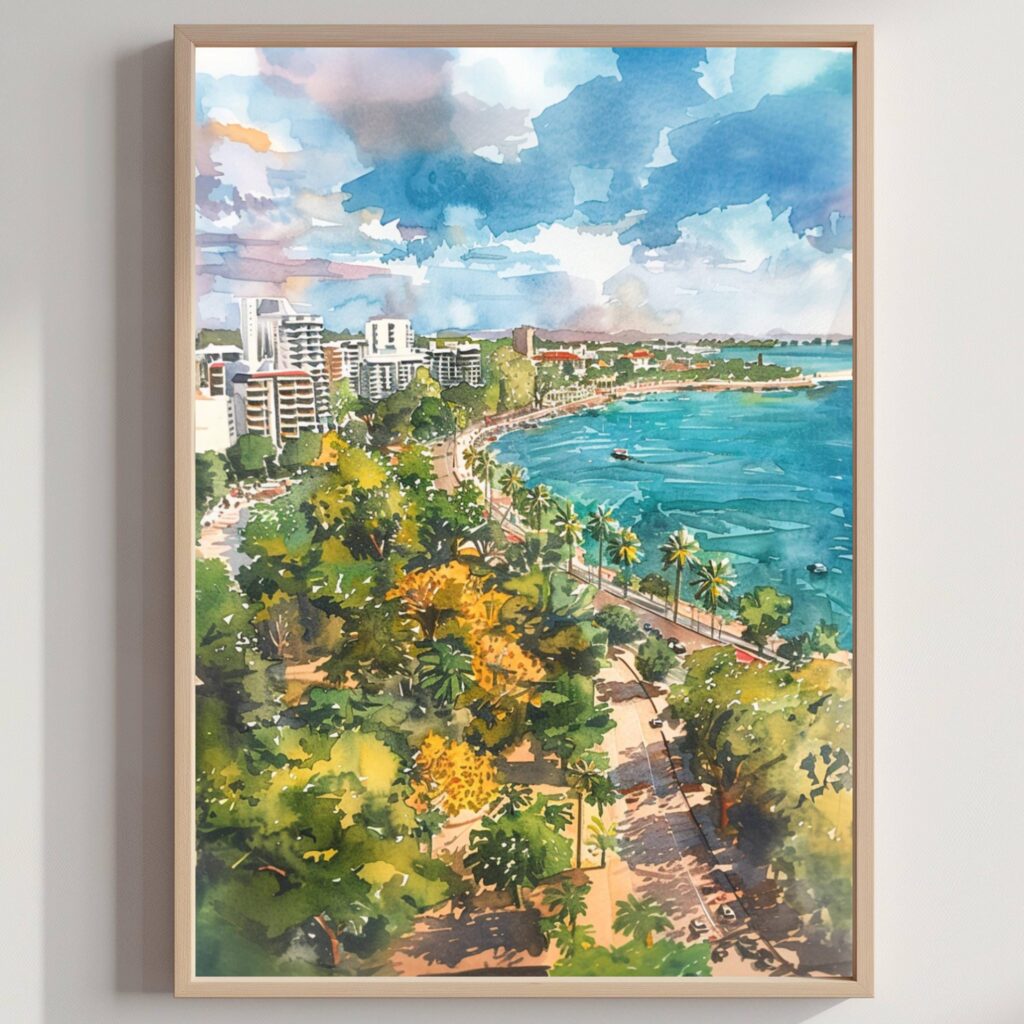
Darwin’s tropical waterfront and dramatic sunset skies give a watercolourist warm, saturated colour and genuine resilience to work with. We’ve captured that character in our own Darwin Watercolor Print, painted first by hand and printed to order on archival paper, a small piece of the Northern Territory for a wall at home.
Bombed once and levelled by a cyclone decades later, Darwin remains a city whose modern skyline exists largely because its residents simply kept choosing to rebuild it.