
Corsica has belonged to France only since 1768, purchased from the Republic of Genoa the year before Napoleon Bonaparte, its most famous native son, was born in the island’s capital, Ajaccio, a historical coincidence of timing that meant France’s most consequential emperor was born, technically, a Genoese subject rather than a French one. That relatively recent French ownership, layered atop centuries of Genoese, Pisan, and earlier Roman rule, has left Corsica with a distinct culture and language, Corsican, closer linguistically to Italian Tuscan dialects than to French.
The island’s rugged interior, dominated by granite mountains rising directly from the Mediterranean coastline, includes Monte Cinto, its highest peak at over 2,700 metres, making Corsica, remarkably, one of the most mountainous islands in the entire Mediterranean.
An Island That Fought for Its Own Identity
Before French rule, Corsica briefly achieved genuine independence under Pasquale Paoli, whose short-lived Corsican Republic, established in 1755, is often cited by historians as one of the first constitutional democracies in the modern sense, predating the American and French revolutions. That period of independence remains a significant source of Corsican cultural pride, and calls for greater autonomy, occasionally full independence, have persisted in various forms into the present day.
The GR20, a demanding long-distance hiking trail crossing Corsica’s mountainous spine, is frequently ranked among the most difficult hiking routes in Europe, drawing serious trekkers specifically for its dramatic granite peaks and near-total absence of easy terrain.
Painting Granite Mountains Meeting the Sea
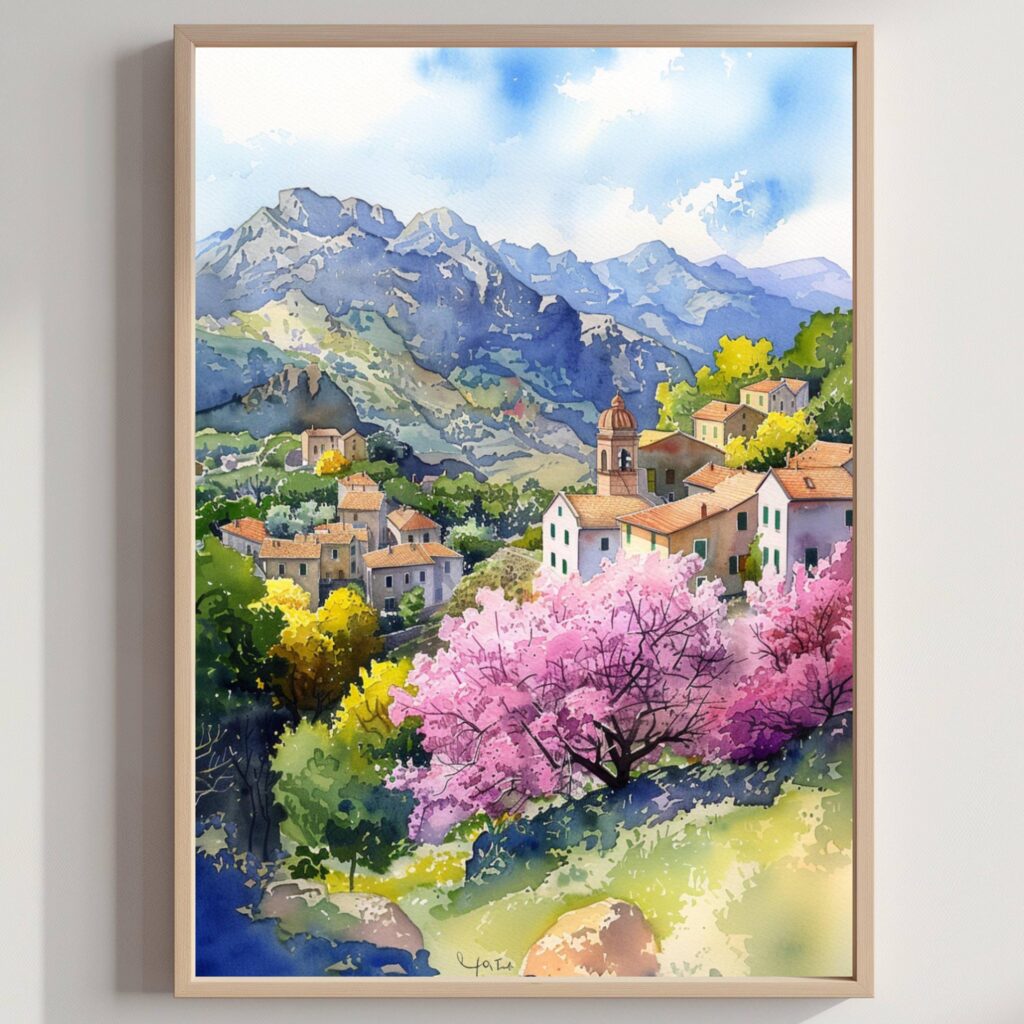
The contrast of Corsica’s sharp granite peaks dropping directly into turquoise Mediterranean water gives a watercolourist dramatic scale to work with. We’ve captured that coastal drama in our own Corsica Watercolor Print, painted first by hand and printed to order on archival paper, a small piece of the Mediterranean for a wall at home.
Bought by France the year before its most famous son was born, Corsica has spent the centuries since holding onto an identity that never fully became French at all.