
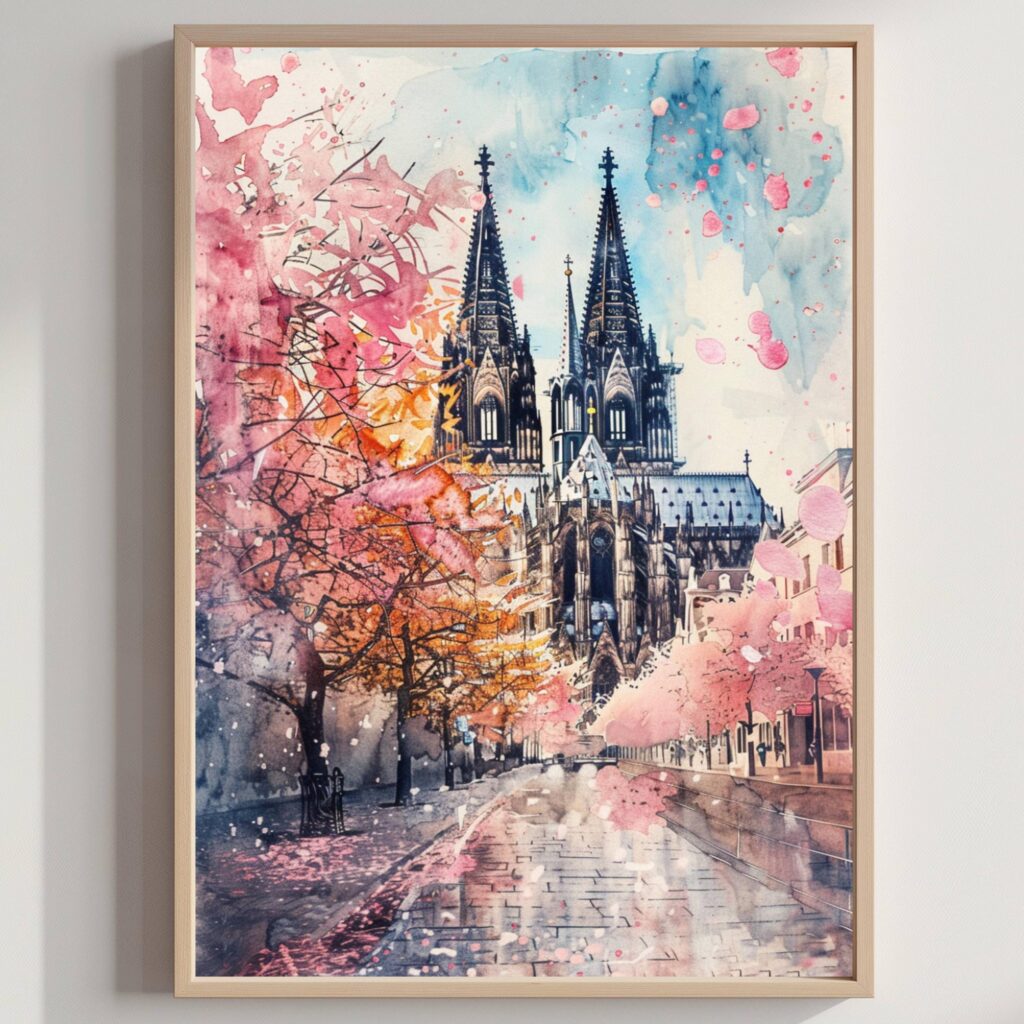
Construction on Cologne Cathedral began in 1248 and stopped almost entirely in 1473, left unfinished for over 300 years with a medieval crane still perched atop its incomplete south tower, a visible symbol of interrupted ambition that became a familiar part of the Cologne skyline for generations. Work only resumed in the 19th century, driven by a renewed Romantic-era interest in Gothic architecture, and the cathedral was finally completed in 1880, 632 years after the first stone was laid, briefly making it the tallest building in the world at the time of completion.
Despite that centuries-long gap, builders largely followed the original medieval plans, discovered and preserved remarkably intact, resulting in a building whose two halves, one genuinely medieval and one 19th-century, are almost seamlessly unified in style.
A Survivor of Devastating Bombing
Cologne was one of the most heavily bombed German cities during the Second World War, with much of the historic centre reduced to rubble, yet the cathedral, despite being struck by multiple bombs, remained standing, its Gothic structure proving surprisingly resilient even as buildings around it collapsed entirely. Some historians have suggested Allied bombers deliberately used the cathedral’s twin spires as a navigational landmark, inadvertently helping preserve it even as they targeted the surrounding city.
Inside, the Shrine of the Three Kings, a large gilded reliquary said to house the remains of the Biblical Magi, has drawn pilgrims to Cologne since the 12th century, making the cathedral one of the most significant pilgrimage destinations in northern Europe long before its spires were ever finished.
Painting Twin Spires Against the Rhine
The cathedral’s soaring twin Gothic spires against the Rhine River give a watercolourist dramatic vertical scale to work with. We’ve captured that height in our own Cologne Cathedral Watercolor Print, painted first by hand and printed to order on archival paper, a small piece of Germany for a wall at home.
Left unfinished for centuries and rebuilt almost exactly to its original medieval plan, Cologne Cathedral remains proof that some ambitions simply wait for the right generation to finish them.