
Christ the Redeemer wasn’t a government project, it was funded almost entirely by donations from Brazil’s Catholic community, following a fundraising campaign that began in the 1920s under the name “Semana do Monumento,” Monument Week. The statue was conceived partly as a response to what some in Brazilian society saw as rising secularism, and partly as a statement of national identity as the country approached its centennial of independence.
Standing 30 metres tall on the peak of Corcovado mountain, with arms stretching 28 metres wide, the statue took nine years to build and was completed in 1931, engineered by Brazilian Heitor da Silva Costa with input from French sculptor Paul Landowski, who is responsible for the distinctive face and hands.
Struck by Lightning, Rebuilt by Hand
Perched on one of the highest points above Rio, Christ the Redeemer is a natural lightning rod, and has been struck repeatedly over the decades, most notably in 2014, when a strike damaged one of its fingers, since carefully repaired by stonemasons working in the same soapstone as the original. The statue’s outer layer is made from thousands of small soapstone tiles, chosen specifically because the material resists weathering better than solid concrete alone.
Reaching the summit today usually means a ride on the Corcovado Rack Railway, a cog railway built specifically for the mountain in 1884, decades before the statue itself existed, originally intended simply to give Rio’s elite easier access to the peak’s views.
Painting a City From Above
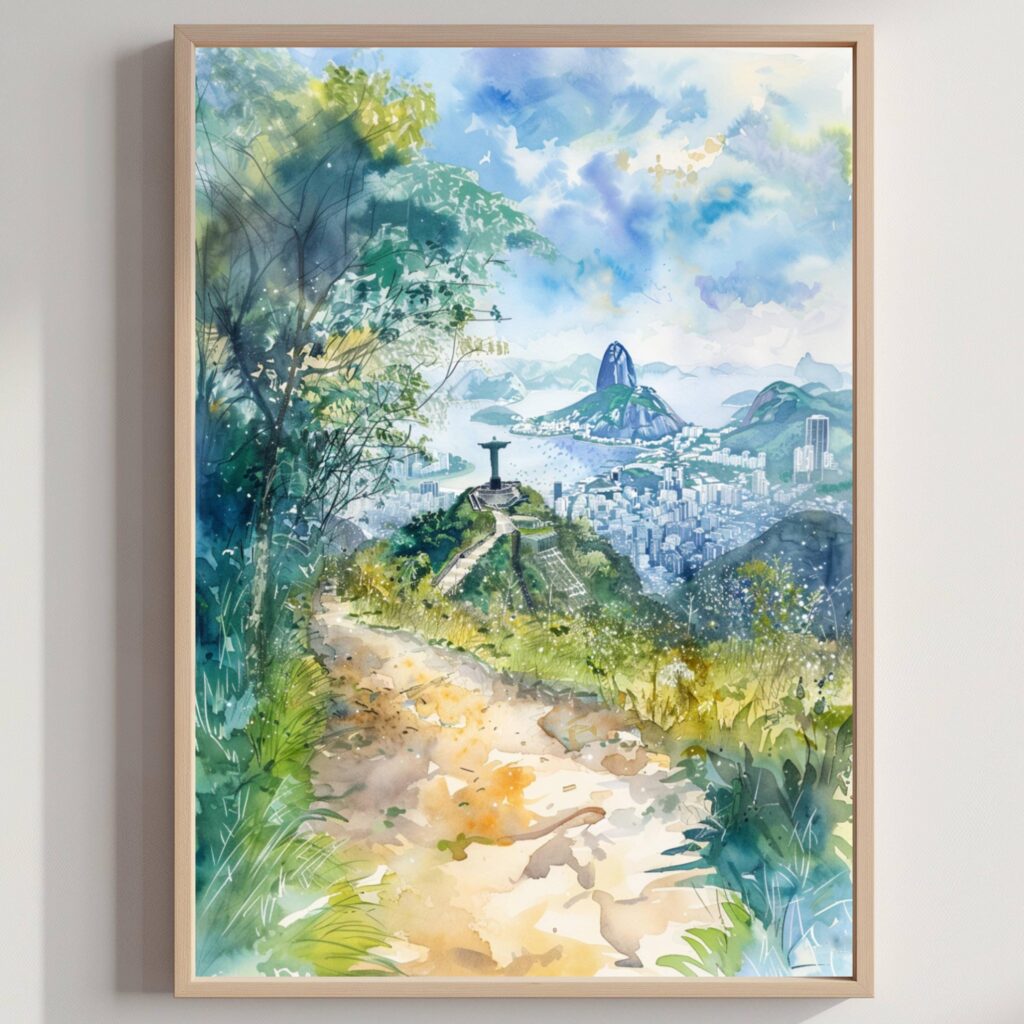
The combination of stark white stone against Rio’s dramatic coastline and cloud-wrapped peaks makes for a striking watercolour composition, equal parts monument and landscape. We’ve captured that vantage point in our own Christ the Redeemer Watercolor Print, painted first by hand and printed to order on archival paper, a small piece of Rio for a wall at home.
Built by public subscription rather than state decree, Christ the Redeemer has spent nearly a century watching over the city whose ordinary citizens paid to put it there.