
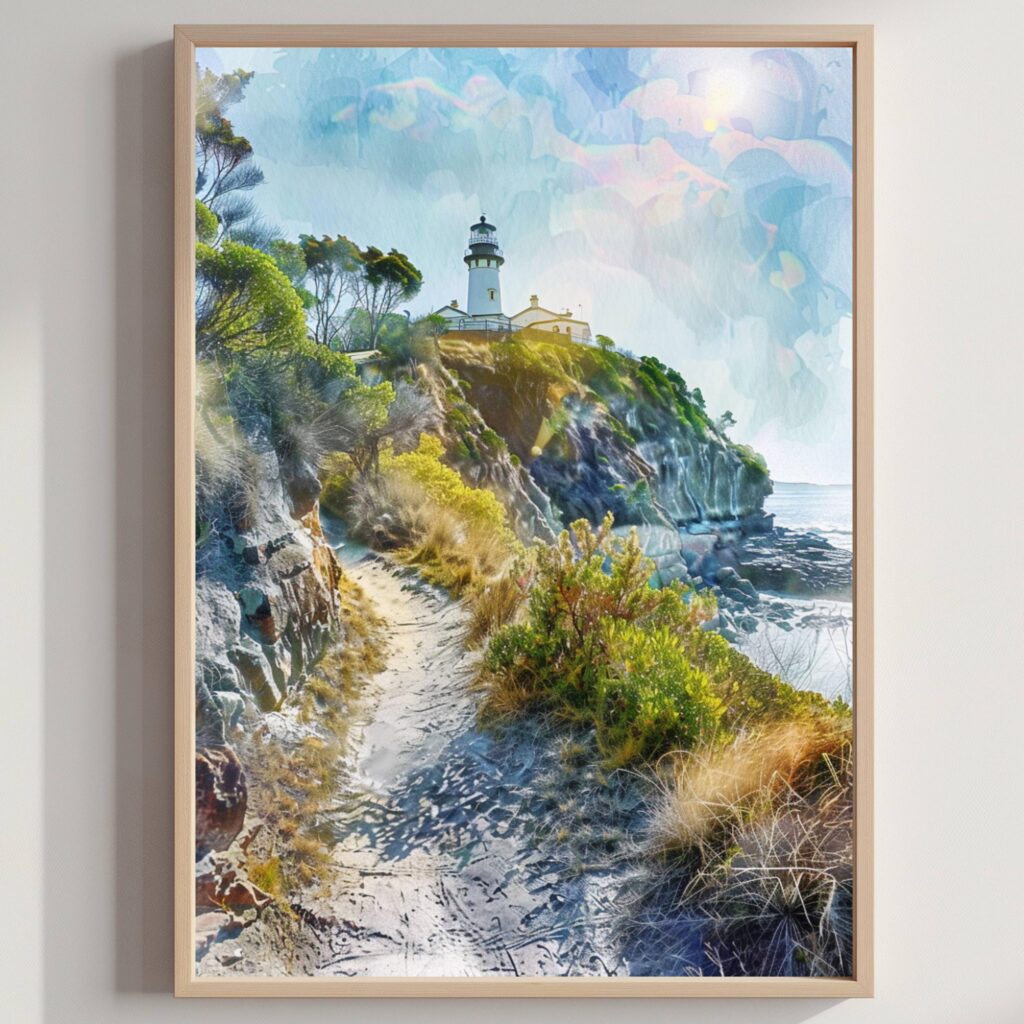
Cape Byron Lighthouse, completed in 1901, marks the easternmost point of the Australian mainland, its beam historically among the most powerful in the Southern Hemisphere, visible for over 40 kilometres out to sea, built specifically to warn ships away from the treacherous rocky headland below after a series of shipwrecks in the surrounding waters. The lighthouse was constructed using precast concrete blocks, an unusually modern technique for its era, allowing for a level of structural precision and durability that has kept it operational, now fully automated, for well over a century.
The headland itself carries deep significance for the Bundjalung people, the traditional custodians of the land, who have inhabited the region for tens of thousands of years and continue to hold cultural and spiritual connections to Cape Byron that long predate the lighthouse or the town’s modern tourism identity.
A Whaling Town That Chose an Entirely Different Path
Byron Bay’s early 20th-century economy was built substantially around whaling and meatworks, industries that left the town relatively industrial and unglamorous through much of its early history, a character that shifted dramatically from the 1970s onward as surfers, alternative lifestyle communities, and eventually broader tourism discovered the area’s consistent surf breaks and relaxed pace. That transformation has made Byron Bay one of Australia’s most recognisable small towns internationally, despite, or perhaps because of, its determined resistance to large-scale high-rise development.
The waters around Cape Byron form part of a significant whale migration route, humpback whales pass close to the headland during their annual journey between Antarctic feeding grounds and warmer breeding waters, visible from the lighthouse grounds during peak migration months, a modern, considerably gentler relationship with the same whales the town once hunted commercially.
Painting a Lighthouse at the Edge of a Continent
Cape Byron Lighthouse against dramatic ocean cliffs gives a watercolourist a striking sense of edge-of-the-world scale to work with. We’ve captured that setting in our own Byron Bay Lighthouse Watercolor Print, painted first by hand and printed to order on archival paper, a small piece of New South Wales for a wall at home.
Built to warn ships away from a whaling town, Byron Bay’s lighthouse now watches over a place that has almost entirely reinvented what it once was.