
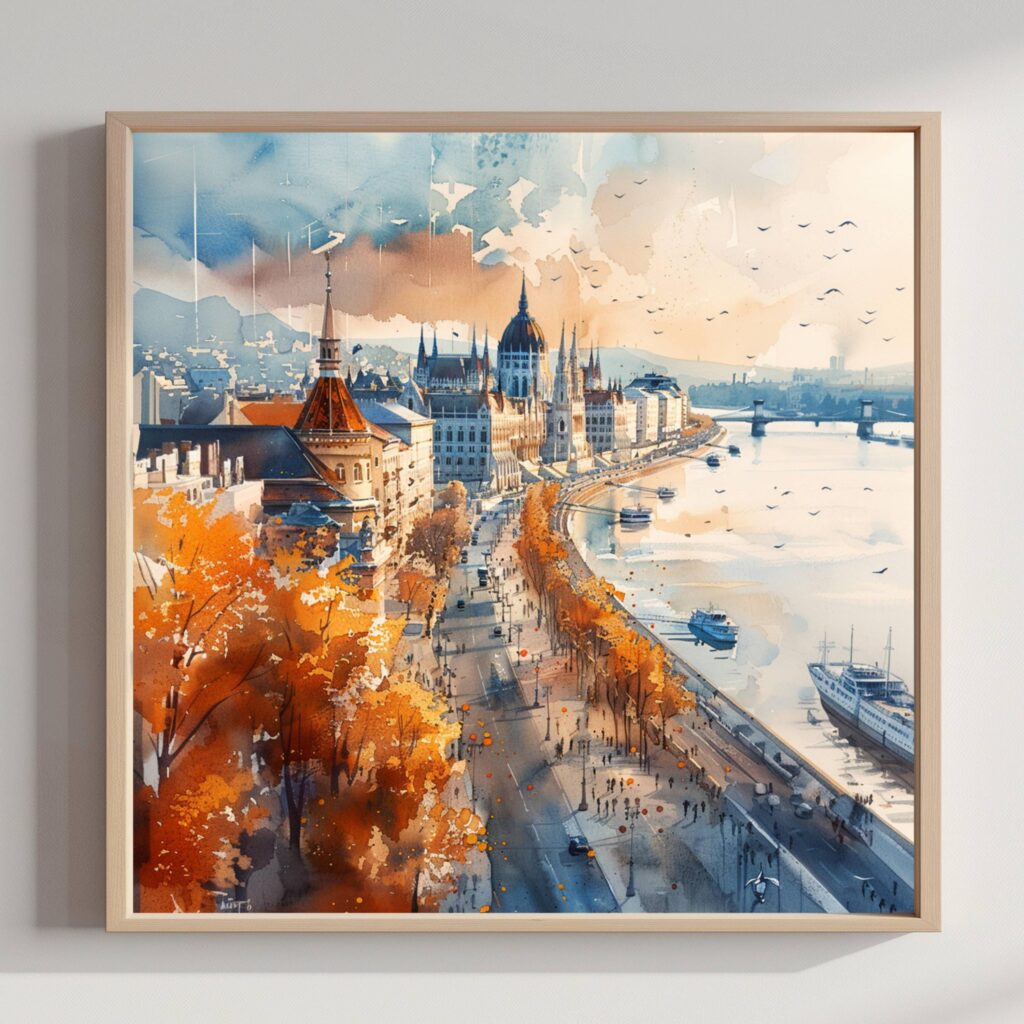
Budapest wasn’t always a single city. Buda and Óbuda, on the hilly west bank of the Danube, and Pest, flat and commercial on the east bank, were three separate settlements that only formally unified in 1873, creating the city that would go on to become one of the great capitals of the Austro-Hungarian Empire. That dual history is still visible today, Buda’s medieval castle district looks down over Pest’s grand 19th-century boulevards from across the water.
The Hungarian Parliament Building, completed in 1904, was deliberately built to be the largest building in Hungary, a statement of national ambition during the empire era, its neo-Gothic spires and riverside setting making it one of the most photographed parliament buildings anywhere in the world, illuminated dramatically along the Danube each night.
A City Built Around Its Baths
Budapest sits on more than 100 natural thermal springs, a legacy of Ottoman-era bathhouses combined with a distinctly Hungarian bathing culture that predates Ottoman rule entirely. Szechenyi Baths, one of the largest thermal bath complexes in Europe, has drawn bathers since 1913, its outdoor pools remaining popular even in winter, steam rising off the water against a backdrop of falling snow.
Chain Bridge, the first permanent bridge to connect Buda and Pest when it opened in 1849, was considered an engineering marvel of its era and remains, alongside the Parliament, one of the defining images of the unified city that grew from its two once-separate halves.
Painting a River Between Two Histories
The interplay of Buda’s hillside castle and Pest’s riverside grandeur, reflected in the Danube, gives a watercolourist a naturally layered cityscape to work with. We’ve captured that river-split skyline in our own Budapest Watercolor Print, painted first by hand and printed to order on archival paper, a small piece of Hungary for a wall at home.
Two cities and a town that spent centuries growing toward each other, Budapest remains a capital still visibly built from three separate beginnings.