
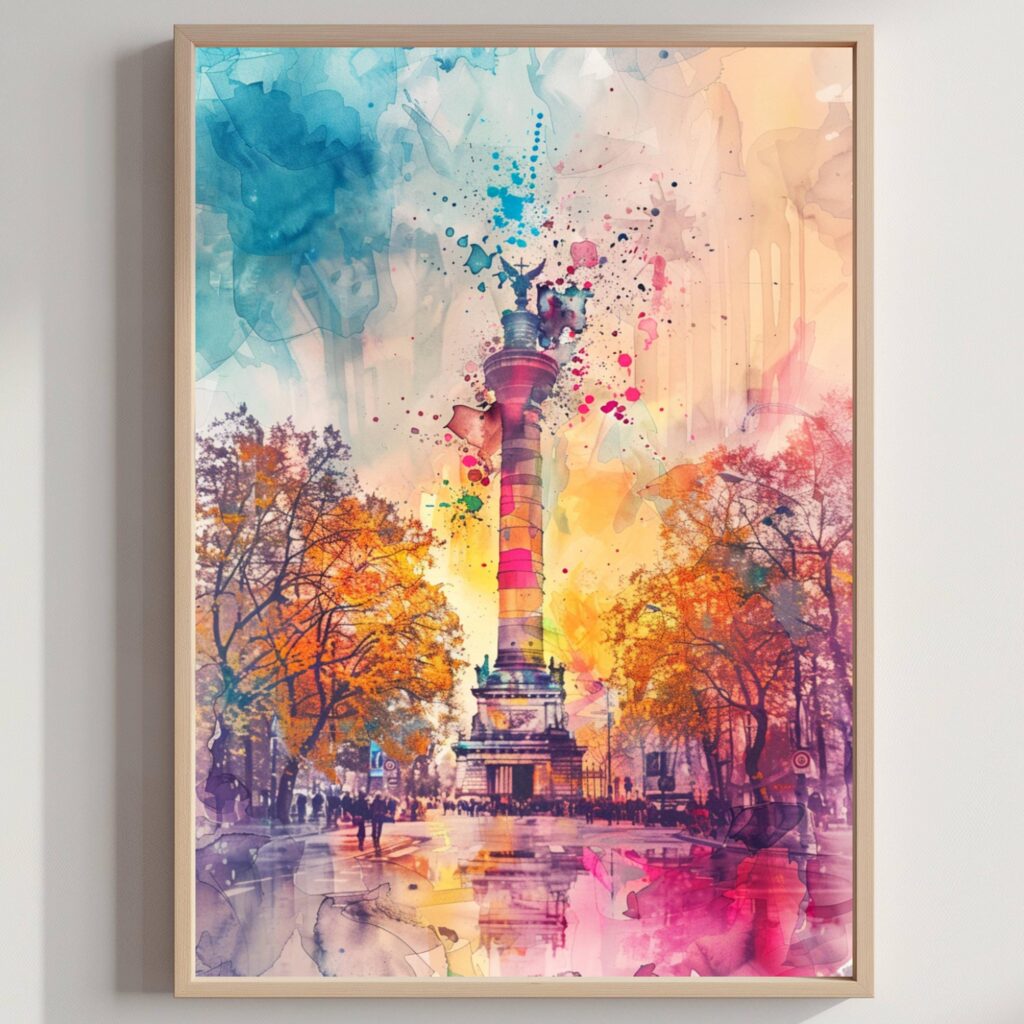
Berlin’s Victory Column was built to commemorate Prussia’s military victories in the 1860s, and by the time it was finally unveiled in 1873, it had gained a fourth relief plate to also celebrate victory in the Franco-Prussian War, a conflict that led directly to German unification, the column ended up commemorating rather more than originally intended. Standing 67 metres tall and topped by a gilded statue of Victoria, the Roman goddess of victory, weighing 35 tonnes, Berliners nicknamed her “Goldelse,” roughly “Golden Lizzy,” a nickname that has stuck for well over a century.
The column originally stood in front of the Reichstag before the Nazi government relocated it in 1938 as part of a broader plan to redesign Berlin’s monumental architecture, an ironic twist that likely saved it from destruction, its original site was later heavily bombed during the Second World War, while the relocated column survived largely intact.
A Landmark That Became a Cultural Meeting Point
After the war, the column briefly became a subject of dispute between the Allied powers before France, one of the original war’s losing sides, formally agreed in 1987 to let it remain standing rather than have it dismantled. The surrounding Tiergarten park and the “Großer Stern” traffic circle around the column have since become a fixture of Berlin civic life, most notably as the endpoint of the city’s annual Love Parade in the 1990s and 2000s, a celebration that would have startled the monument’s original 19th-century military architects considerably.
Visitors can climb 285 steps to a viewing platform just below Victoria’s feet, offering panoramic views across the Tiergarten and central Berlin, the same city whose fractured 20th-century history the column, somewhat improbably, managed to survive.
Painting Gold Against Berlin Sky
The gilded statue catching light against Berlin’s open sky gives a watercolourist a striking, luminous focal point to work with. We’ve captured that gleam in our own Berlin Victory Column Watercolor Print, painted first by hand and printed to order on archival paper, a small piece of Berlin for a wall at home.
Moved once to survive a war it had nothing to do with, Berlin’s Victory Column remains a monument that has quietly outlasted almost everything it was originally built to honour.