
Alice Springs sits almost exactly at the geographic centre of Australia, roughly 1,500 kilometres from the nearest major coastline in any direction, its existence made possible by a permanent waterhole along the usually dry Todd River, a genuinely rare, reliable water source in the surrounding arid desert that made the site significant to the Arrernte Aboriginal people for tens of thousands of years before European settlement. The town itself developed from an 1870s repeater station built for the Overland Telegraph Line, a project connecting Australia to the rest of the world via undersea cable through Darwin, Alice Springs existing initially purely to relay that telegraph signal across the otherwise unbroken desert interior.
The town was originally named Stuart, after explorer John McDouall Stuart, and only later renamed Alice Springs after the wife of the telegraph line’s superintendent, though the “springs” in question turned out to be a waterhole rather than a true natural spring, a small historical inaccuracy that has stuck permanently regardless.
A Gateway to Uluru and Deep Aboriginal Culture
Alice Springs functions as the primary gateway to Uluru and the wider Red Centre region, and the town itself hosts significant Aboriginal art galleries and cultural centres, reflecting the Arrernte people’s continuous connection to the surrounding country, one of the oldest continuous cultures on Earth, still actively practised rather than presented purely as historical artefact. The Royal Flying Doctor Service, founded in 1928 to provide emergency medical care across Australia’s vast, sparsely populated outback, maintains a significant base in Alice Springs, a genuinely essential service in a region where the nearest hospital might otherwise be hundreds of kilometres away.
The MacDonnell Ranges, stretching east and west from the town, contain dramatic gorges and waterholes that provide rare, permanent water and shade within the surrounding desert, landscapes that have sustained both wildlife and human settlement across the harsh central Australian interior for millennia.
Painting Red Desert Around a Rare Waterhole
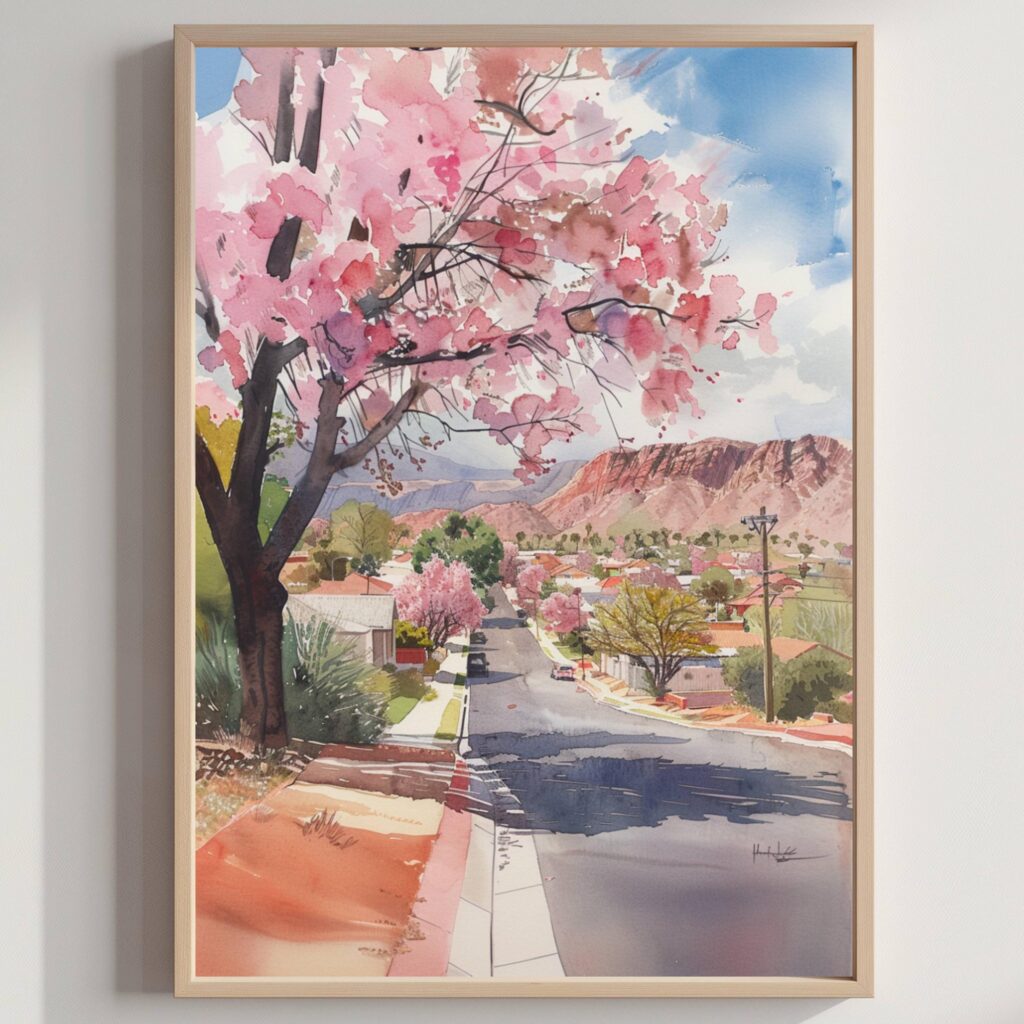
The deep red desert landscape surrounding Alice Springs gives a watercolourist a genuinely distinctive, sun-baked palette to work with. We’ve captured that outback colour in our own Alice Springs Watercolor Print, painted first by hand and printed to order on archival paper, a small piece of the Northern Territory for a wall at home.
Built around a telegraph line and a waterhole that isn’t quite a spring, Alice Springs remains a town whose entire existence still depends on the same scarce resource that first drew people to it.