
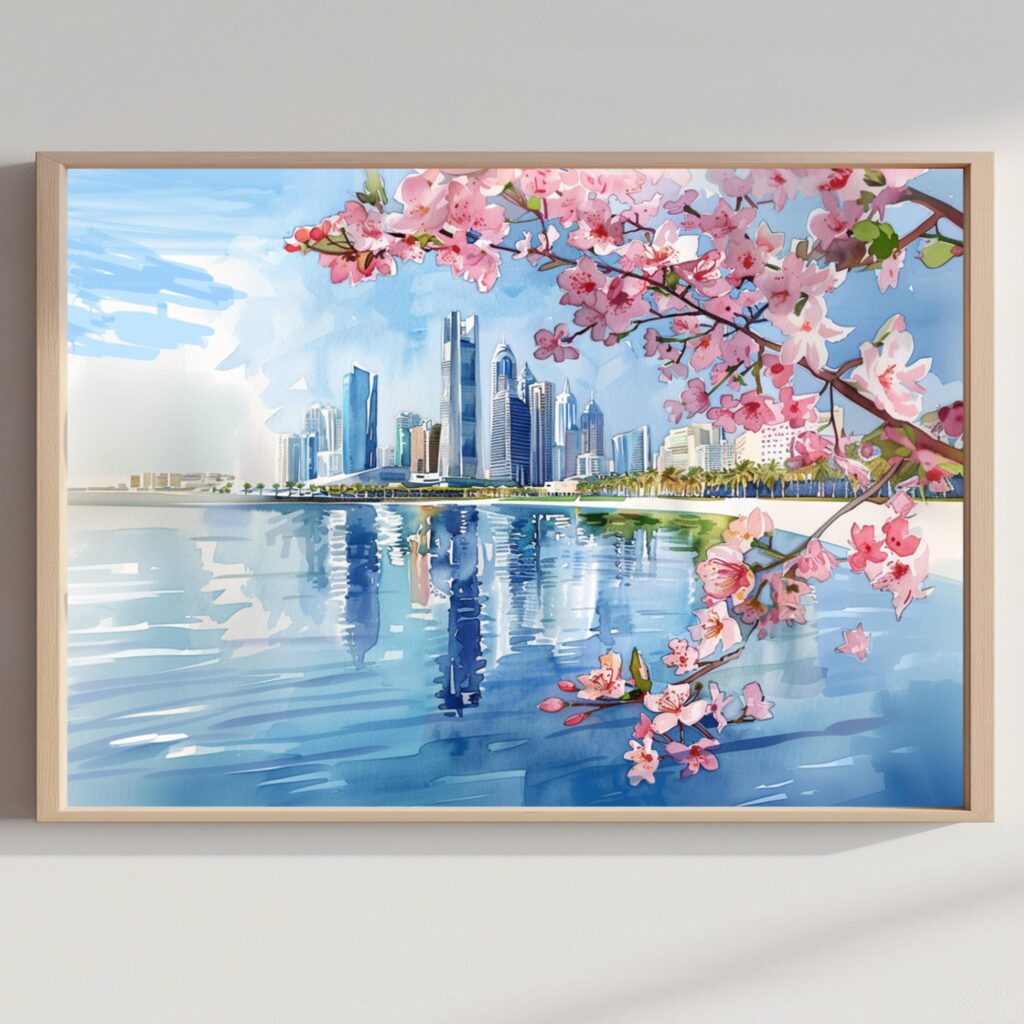
Abu Dhabi, unlike neighbouring Dubai, sits atop the vast majority of the United Arab Emirates’ actual oil reserves, wealth that has funded not just rapid infrastructure development but a deliberate, long-term strategy to establish the emirate as a genuine global cultural centre, most visibly through Saadiyat Island’s cluster of major museum institutions. The Louvre Abu Dhabi, opened in 2017 under a landmark agreement with the French government, licenses the Louvre name and curatorial expertise for 30 years, its striking dome, perforated to allow filtered light to fall in a “rain of light” pattern below, was engineered specifically to reference traditional Arabic latticework at architectural scale.
Sheikh Zayed Grand Mosque, completed in 2007, remains one of the largest mosques in the world, capable of holding over 40,000 worshippers, its main prayer hall containing the world’s largest hand-knotted carpet, woven by around 1,200 artisans and taking approximately two years to complete.
An Island City Built Around Deliberate Environmental Ambition
Abu Dhabi has positioned significant investment toward renewable energy and sustainability, including Masdar City, an ambitious planned development intended to demonstrate low-carbon urban design, reflecting a broader, forward-looking strategy to diversify the emirate’s economy and reputation well beyond oil dependency, similar in spirit to Dubai’s own diversification but pursued through a distinctly different set of priorities. The city itself is built primarily across a T-shaped island connected to the mainland by bridges, its Corniche waterfront promenade offering one of the most extensively landscaped public spaces in the Gulf region.
Formula One’s Abu Dhabi Grand Prix, held at Yas Marina Circuit since 2009, is run partly at twilight, transitioning from daylight to a floodlit night race, a detail specifically engineered into the circuit’s scheduling to showcase the venue dramatically for international broadcast.
Painting Domes and Desert Light
Sheikh Zayed Grand Mosque’s white domes against clear Gulf sky give a watercolourist striking scale and luminous colour to work with. We’ve captured that grandeur in our own Abu Dhabi Watercolor Print, painted first by hand and printed to order on archival paper, a small piece of the UAE for a wall at home.
Built on the region’s deepest oil wealth and spent deliberately on culture and sustainability alike, Abu Dhabi remains a capital whose ambitions have always reached considerably further than its reserves alone required.