
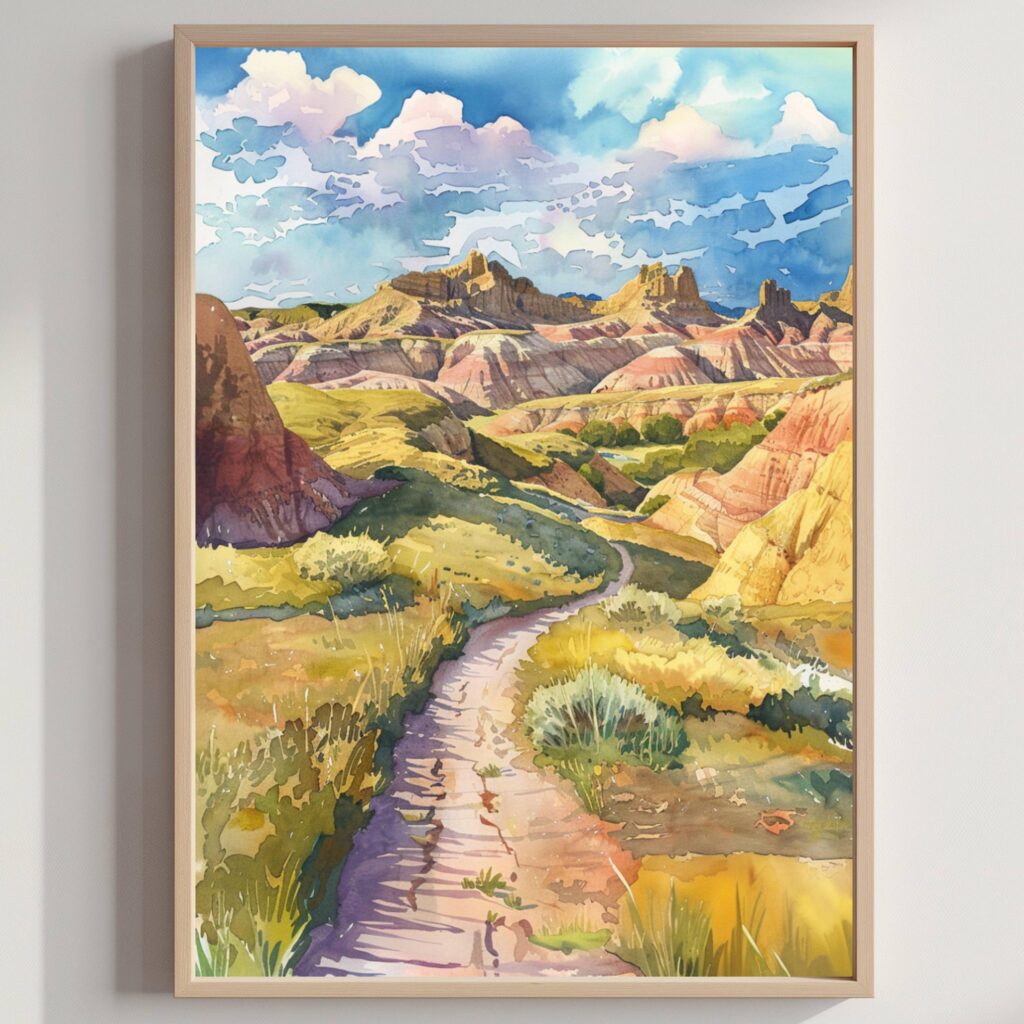
Badlands National Park in South Dakota takes its English name directly from a translation of the Lakota phrase “mako sica,” meaning bad lands, a description reflecting the genuine difficulty early travellers, including Lakota hunting parties before them, faced crossing this eroded, water-scarce terrain of sharp ridges and steep gullies. The park’s dramatic striped rock layers, visible across its eroded buttes and canyons, were deposited over roughly 75 million years and now record a detailed geological history stretching from the age of dinosaurs through the more recent Ice Age, exposed gradually as ongoing erosion strips away roughly an inch of rock from the landscape each year.
That same rapid erosion has made the Badlands one of the richest fossil beds in the world, yielding extensive remains of ancient mammals, including early rhinoceroses, horses, and sabre-toothed predators that once roamed this region tens of millions of years before the American bison herds now more commonly associated with the area.
A Landscape Still Sacred to the Lakota
The Badlands sit within land of deep spiritual and historical significance to the Lakota people, and the park includes the site of the Wounded Knee Massacre of 1890, where United States cavalry killed several hundred Lakota men, women, and children, one of the most devastating events in the long history of conflict between Indigenous nations and the US government. A portion of the park remains part of the Pine Ridge Indian Reservation today, co-managed with the Oglala Sioux Tribe, a rare arrangement reflecting the land’s continuing significance to its original inhabitants.
Bison, once hunted to near extinction across the Great Plains, were reintroduced to the Badlands in the 1960s and now roam the park in significant numbers, a partial restoration of an ecosystem that once supported tens of millions of the animals before 19th-century hunting decimated their population.
Painting Striped Rock Beneath Wide Prairie Sky
The Badlands’ layered, colourful rock formations beneath vast open sky give a watercolourist dramatic geological texture and warm, banded colour to work with. We’ve captured that character in our own Badlands Watercolor Print, painted first by hand and printed to order on archival paper, a small piece of South Dakota for a wall at home.
Named for how hard it was simply to cross, the Badlands remain a landscape whose difficulty turned out to be exactly what preserved its deeper history so well.