
The Cayman Islands take their original name from the Taino word for the marine turtles that once swarmed the surrounding waters in vast numbers, a population so significant that early European sailors, including Christopher Columbus, who sighted the islands in 1503 and initially named them Las Tortugas, relied on them as a crucial food source during long Caribbean voyages. Sustained hunting eventually devastated the wild turtle population, and the islands’ once-defining resource had become commercially scarce well before the 20th century, a depletion the islands have worked to address since through conservation and captive breeding programmes.
The Cayman Islands remain a British Overseas Territory today, having never gained full independence unlike many other former Caribbean colonies, a status the territory has consistently chosen to maintain through referenda and political decisions over the decades.
A Tax Status That Reshaped the Islands’ Economy Entirely
Beginning in the 1960s, the Cayman Islands developed into one of the world’s most significant offshore financial centres, its lack of direct taxation and favourable regulatory environment attracting international banking and investment fund registration on a scale wildly disproportionate to the territory’s small population, transforming what had been a modest fishing and seafaring economy into one of the wealthiest per capita nations in the Caribbean. This financial industry now sits alongside a substantial tourism economy, with the islands’ clear waters and coral reefs, particularly around the popular Stingray City sandbar, drawing divers and snorkellers from around the world.
Grand Cayman’s Seven Mile Beach, despite its name actually measuring closer to five and a half miles, remains one of the most consistently ranked beaches in the Caribbean, its powder-fine sand a significant draw for the territory’s tourism industry.
Painting Turquoise Water Against White Sand
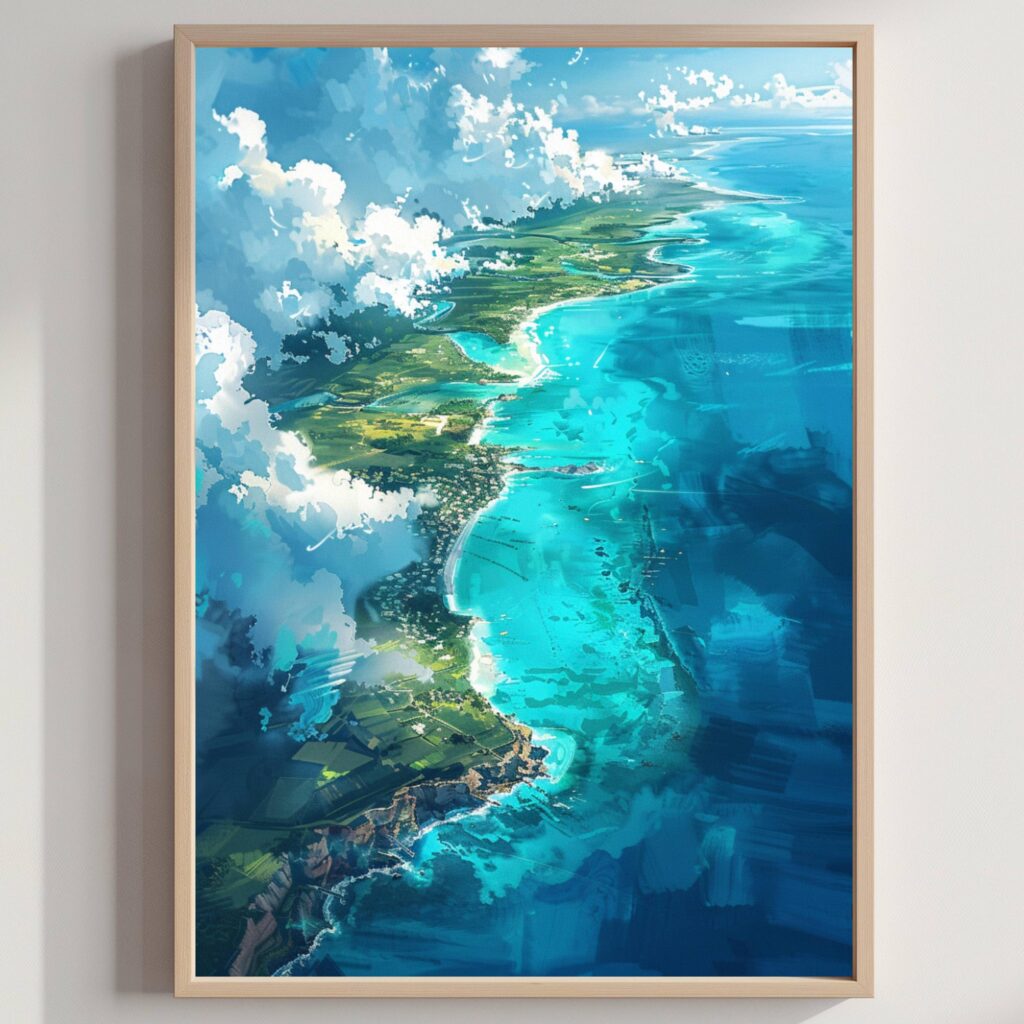
The Cayman Islands’ brilliant turquoise shallows and white sand give a watercolourist vivid, luminous colour to work with. We’ve captured that character in our own Cayman Islands Watercolor Print, painted first by hand and printed to order on archival paper, a small piece of the Caribbean for a wall at home.
Named for turtles that no longer swarm its waters and now known for banking rather than seafaring, the Cayman Islands remain a territory whose economy has changed shape almost entirely at least twice.