
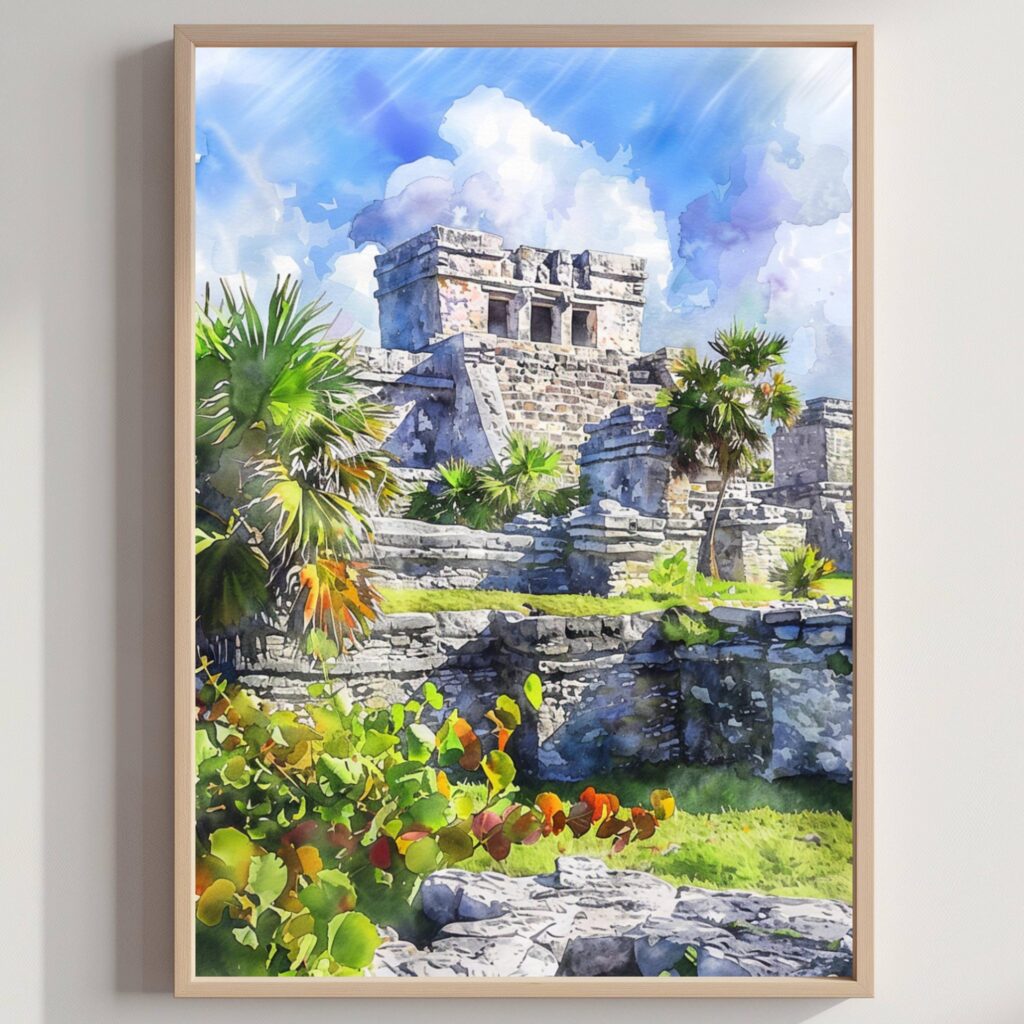
Tulum is one of the few Maya cities built directly on a coastline, its clifftop ruins overlooking the Caribbean Sea in a location chosen deliberately for both defence and trade, serving as a significant port city for the Maya during the Postclassic period, roughly the 13th to 15th centuries CE, considerably later than many of the more famous inland Maya cities. The city’s name today, meaning wall or fence in Yucatec Maya, references the defensive walls still surrounding much of the site, though the settlement’s original Maya name is generally believed to have been Zama, meaning dawn, a fitting reference given its position facing directly east over the water.
Tulum was still a functioning, inhabited city when Spanish conquistadors first sighted it from their ships in 1518, one of the relatively few Maya sites the Spanish encountered still actively occupied rather than already abandoned, though it was largely deserted within a century or so of European contact.
A Port City Built for Trade Along the Coast
Tulum’s position made it a significant node in a long-distance Maya trading network that moved goods including obsidian, jade, and copper along the Caribbean coastline by canoe, connecting it to distant Maya centres and reflecting a genuinely sophisticated maritime trade system rather than the purely land-based image many people have of Maya civilisation. The city’s main structure, El Castillo, perched directly on the clifftop, may have doubled as a lighthouse or navigational marker for boats approaching the coast, though this function remains debated among archaeologists.
Tulum’s murals, particularly those found in the Temple of the Frescoes, retain traces of their original paint and depict deities and cosmological scenes, offering rare surviving colour evidence of how vividly decorated Maya buildings once were before centuries of weathering.
Painting Ancient Stone Above a Turquoise Sea
Tulum’s weathered stone ruins set against the vivid turquoise Caribbean give a watercolourist a striking contrast of ancient texture and brilliant coastal colour to work with. We’ve captured that setting in our own Tulum Watercolor Print, painted first by hand and printed to order on archival paper, a small piece of Mexico for a wall at home.
Built to face the sunrise over open water, Tulum remains one of the few Maya cities whose ruins still look out at exactly the view they were built for.