
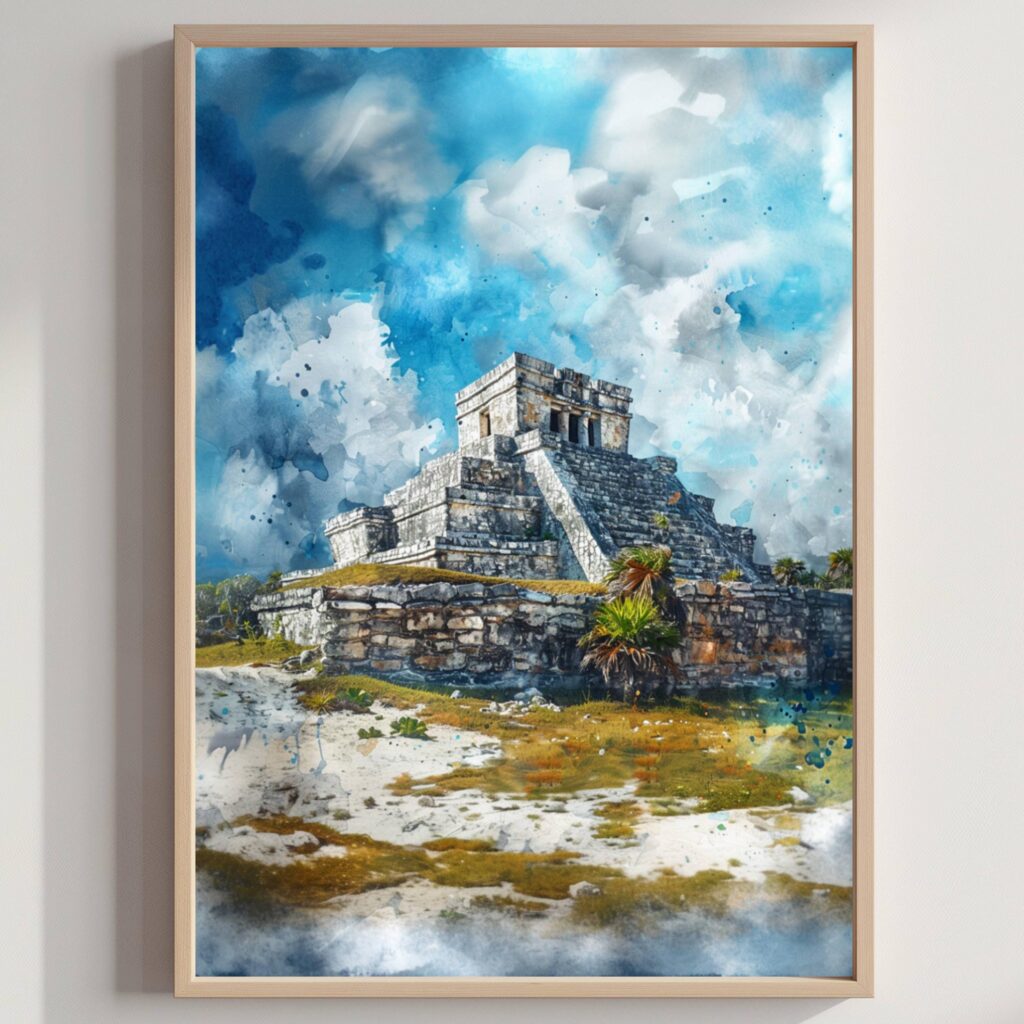
El Castillo, the stepped pyramid at the heart of the Maya city of Chichen Itza in Mexico’s Yucatan Peninsula, was built by the Maya sometime between the 9th and 12th centuries CE as a temple dedicated to the feathered serpent deity Kukulkan, its precise astronomical alignment causing a striking shadow effect, resembling a serpent descending the pyramid’s staircase, to appear twice a year at the spring and autumn equinoxes, drawing large crowds who still gather to witness the phenomenon today. The pyramid’s design encodes the Maya calendar directly into its structure, its four staircases totalling 365 steps, one for each day of the solar year, alongside 52 panels on each face representing the 52-year cycle central to Maya timekeeping.
Chichen Itza was named one of the New Seven Wonders of the World in a global public poll conducted in 2007, a modern recognition of a site that had already been a UNESCO World Heritage Site since 1988.
A City That Combined Two Distinct Maya Traditions
Chichen Itza is unusual among Maya sites for showing clear architectural influence from the Toltec culture of central Mexico, a blending some historians attribute to conquest and others to trade and cultural exchange, resulting in a city that combines styles rarely found together elsewhere in the Maya world. The site’s Great Ball Court, the largest and best-preserved of its kind anywhere in ancient Mesoamerica, hosted a ritual ball game whose exact rules remain only partially understood, but which is generally believed to have carried deep religious and possibly sacrificial significance.
Climbing El Castillo was permitted for decades and was a popular visitor activity, but access to the pyramid’s staircases was closed to climbers in 2006, following the death of a visitor who fell, shifting the site’s focus toward preservation over direct physical access.
Painting a Pyramid Built From Precise Mathematics
El Castillo’s stepped stone form against the flat Yucatan jungle gives a watercolourist bold geometric structure and warm ancient stone colour to work with. We’ve captured that character in our own El Castillo Watercolor Print, painted first by hand and printed to order on archival paper, a small piece of Mexico for a wall at home.
Built to track a calendar in stone centuries before modern astronomy, El Castillo remains a pyramid whose precision still draws crowds waiting for a shadow to fall exactly where it was designed to.