
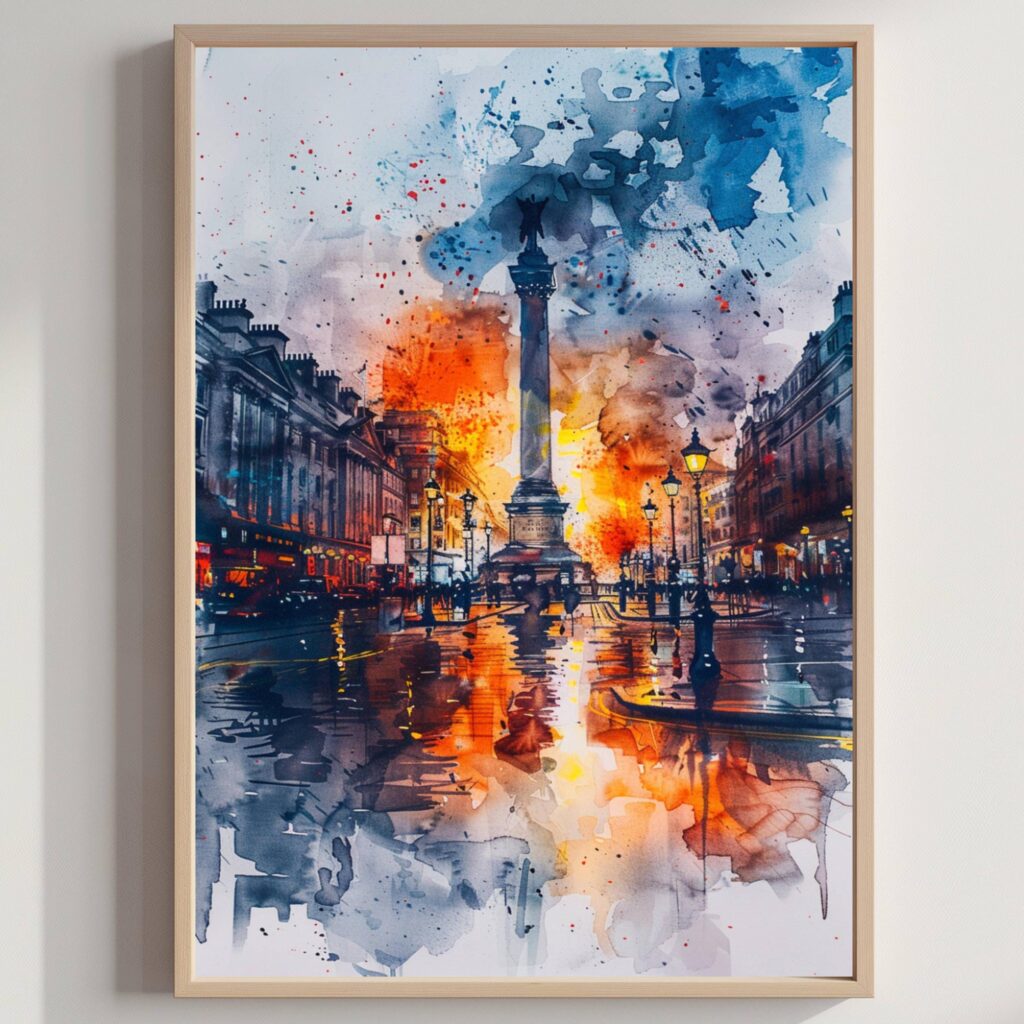
Trafalgar Square was laid out in the 1830s and 1840s on the site of former royal stables, its name and centrepiece column commemorating Admiral Horatio Nelson’s decisive naval victory over a combined French and Spanish fleet at the Battle of Trafalgar in 1805, a battle Nelson did not survive, killed by a sniper’s shot during the fighting. Nelson’s Column, completed in 1843, stands over 50 metres tall, its statue of the admiral gazing famously down Whitehall toward the Admiralty, the naval headquarters he served throughout his career.
The square’s four bronze lions, added at the column’s base in 1867, were sculpted by Sir Edwin Landseer, who was reportedly not a natural sculptor of animals and is said to have used a real lion carcass supplied by London Zoo as an anatomical reference to get the proportions right.
A Square Built for Grandeur, Used for Protest
Trafalgar Square was deliberately designed in the 19th century as a grand civic space intended to rival the great public squares of continental Europe, and it has since become one of London’s principal sites for public assembly, hosting political rallies, New Year’s celebrations, and demonstrations across two centuries, a democratic use its original planners likely never fully anticipated. The square’s fourth plinth, left empty for decades after funds ran out for an intended equestrian statue in the 1840s, has since 1999 hosted a rotating series of contemporary art commissions, a modern addition to an otherwise firmly Victorian space.
Trafalgar Square once hosted large flocks of feeding pigeons as one of London’s most photographed sights, until a ban on selling bird feed in the square, introduced in 2003, substantially reduced their numbers, a deliberate change aimed at protecting the square’s stonework from decades of accumulated damage.
Painting a Column Set Against London’s Grand Scale
Nelson’s Column rising above the square’s fountains and lions gives a watercolourist dramatic verticality and classic London stonework to work with. We’ve captured that setting in our own Trafalgar Square Watercolor Print, painted first by hand and printed to order on archival paper, a small piece of London for a wall at home.
Built to honour a battle won entirely at sea, Trafalgar Square remains a landmark whose grandest moments since have almost all played out firmly on dry land.