
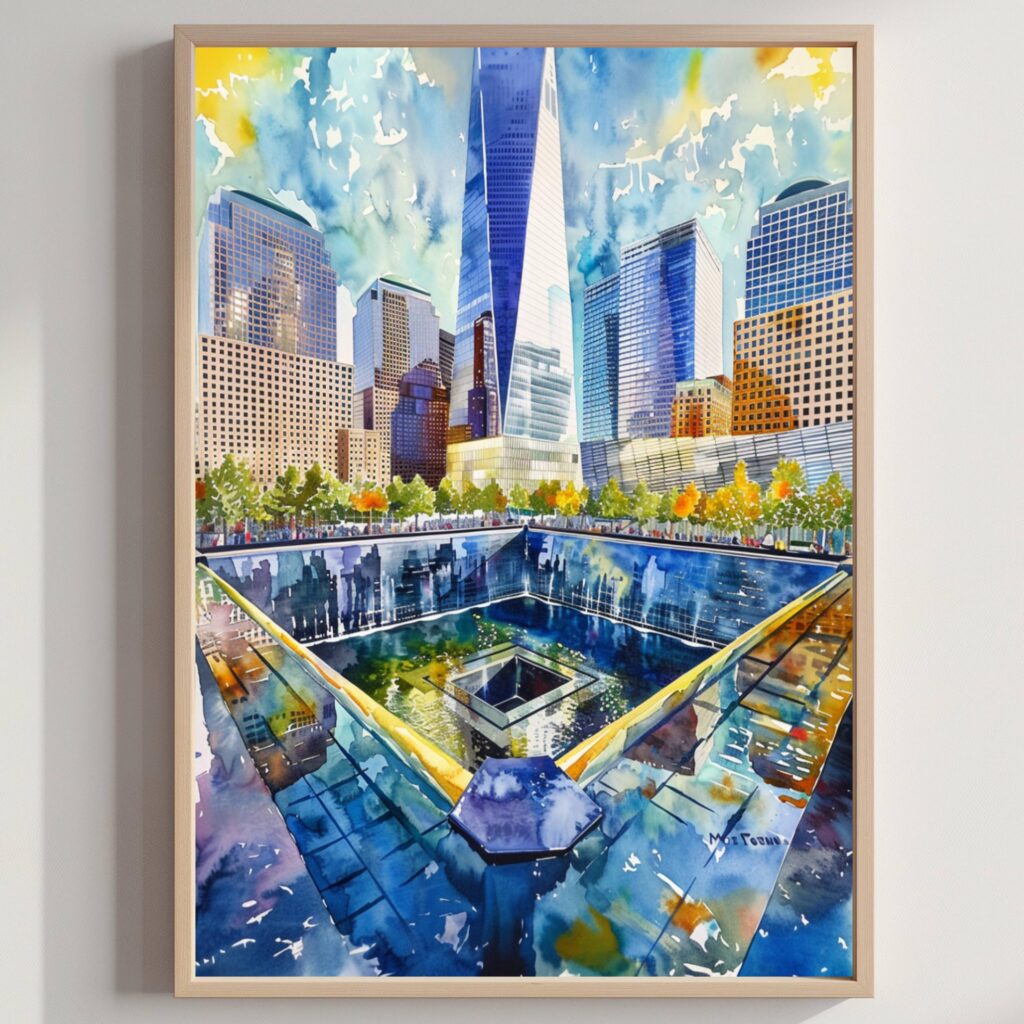
The National September 11 Memorial occupies the footprints of the original Twin Towers, destroyed in the terrorist attacks of September 11, 2001, its two square reflecting pools, each nearly an acre in size, built directly within the towers’ original foundations and designed by architect Michael Arad under the name Reflecting Absence, selected from over 5,200 entries in an international design competition. Water continuously cascades down the pools’ walls into a central void whose depth is never visible from above, a deliberate design choice intended to convey absence rather than offer resolution.
The names of the nearly 3,000 victims of both the 2001 attacks and the earlier 1993 World Trade Center bombing are inscribed around the pools’ bronze parapets, arranged not alphabetically but according to “meaningful adjacencies,” a system developed with victims’ families to place names near colleagues, friends, and loved ones who died together.
A Tree That Survived the Attack Became Part of the Memorial
A Callery pear tree, recovered severely damaged from the World Trade Center site in the weeks after the attacks, was nursed back to health over years at a New York City nursery before being replanted at the memorial in 2010, where it is now known as the Survivor Tree, a living counterpoint to the memorial’s more sombre architecture. Saplings grown from its seeds have since been distributed to communities affected by other tragedies around the world.
One World Trade Center, the primary tower rebuilt on the site and completed in 2014, rises to a symbolic height of 1,776 feet, a deliberate reference to the year of American independence, and remains the tallest building in the Western Hemisphere.
Painting Absence Rendered in Water and Stone
The memorial’s dark reflecting pools set among the city’s surrounding towers give a watercolourist a genuinely solemn, contemplative subject to work with. We’ve captured that setting in our own 9/11 Memorial Watercolor Print, painted first by hand and printed to order on archival paper, a small piece of New York for a wall at home.
Built into the exact footprints of what was lost, the memorial remains a place designed not to explain that absence, but simply to hold space for it.