
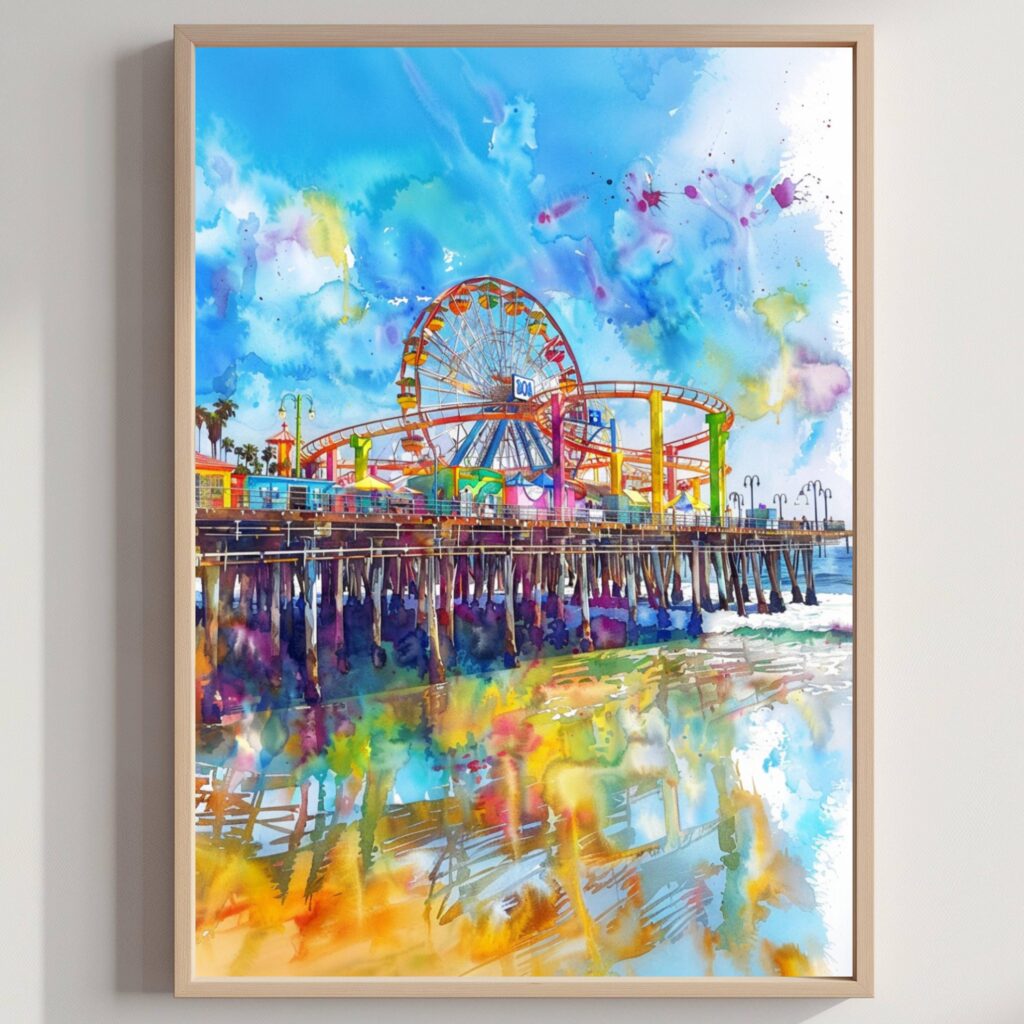
Santa Monica Pier, the wooden pier that has become the city’s defining symbol, was originally built in 1909 for a more mundane purpose, carrying sewage pipes out past the surf line, before a second, adjoining pleasure pier was added the following year, complete with a carousel and amusements aimed squarely at Los Angeles day-trippers. The pier came close to demolition in the 1970s, when the city considered replacing it with an artificial island development, a plan ultimately abandoned after public opposition, allowing the pier to survive and later be restored into the landmark it is today.
Santa Monica is also widely recognised as the symbolic western terminus of Route 66, the historic highway connecting Chicago to the Pacific coast, even though the road’s official endpoint was technically several blocks away; a sign at the pier now marks the spot regardless, drawing road-trippers completing the full cross-country route.
A City That Chose Incorporation to Avoid Being Swallowed by Los Angeles
Santa Monica incorporated as an independent city in 1886, a decision that has allowed it to remain a distinct municipality with its own government and character despite being almost entirely surrounded by the far larger city of Los Angeles today. That independence has shaped Santa Monica’s identity as a genuinely separate beach community rather than simply another Los Angeles neighbourhood, with its own strict rent control policies and coastal development rules that have periodically put it at odds with broader regional growth pressures.
The city’s Third Street Promenade, a pedestrianised shopping street a few blocks inland from the pier, was redeveloped in the early 1990s and has since become one of the most commercially successful pedestrian retail streets in the United States.
Painting a Pier Against the Pacific
Santa Monica’s Ferris wheel and wooden pier silhouetted against the Pacific give a watercolourist bright, nostalgic colour and open ocean light to work with. We’ve captured that character in our own Santa Monica Watercolor Print, painted first by hand and printed to order on archival paper, a small piece of California for a wall at home.
Built first for sewage pipes and saved once from an artificial island, Santa Monica Pier remains a landmark whose survival was never quite as guaranteed as its current fame suggests.