
Latvia’s national identity is unusually closely tied to a specific cultural tradition, the Latvian Song and Dance Festival, first held in 1873 and continuing roughly every five years since, in which tens of thousands of performers gather to sing traditional folk songs, a practice that took on deep political significance during the decades of Soviet occupation following the Second World War. In 1989, mass singing gatherings across Latvia, Estonia, and Lithuania became a defining, peaceful form of protest against Soviet rule, a movement now remembered as the Singing Revolution, which helped pave the way to the Baltic states regaining independence in 1991.
Latvia’s capital, Riga, holds one of the largest collections of Art Nouveau architecture in Europe, a legacy of a construction boom in the early 20th century when Riga was one of the Russian Empire’s most important industrial and trading cities.
A Small Nation Repeatedly Redrawn by Larger Powers
Latvia’s territory has been controlled at various points by German crusading orders, Polish-Lithuanian rulers, Sweden, and Russia, each leaving a distinct architectural and cultural layer still visible across the country today, before Latvia first achieved independence in 1918 following the collapse of the Russian Empire. That independence lasted barely two decades before Soviet, then Nazi, then Soviet occupation again over the course of the Second World War, a period of profound disruption from which Latvia did not fully emerge as a sovereign state again until 1991.
Latvia’s countryside remains heavily forested, covering roughly half the country’s land area, and the nation retains a strong connection to nature-based folk traditions, including a rich body of dainas, short traditional folk songs, of which well over a million distinct verses have been recorded and preserved.
Painting a Baltic Landscape of Forest and Coast
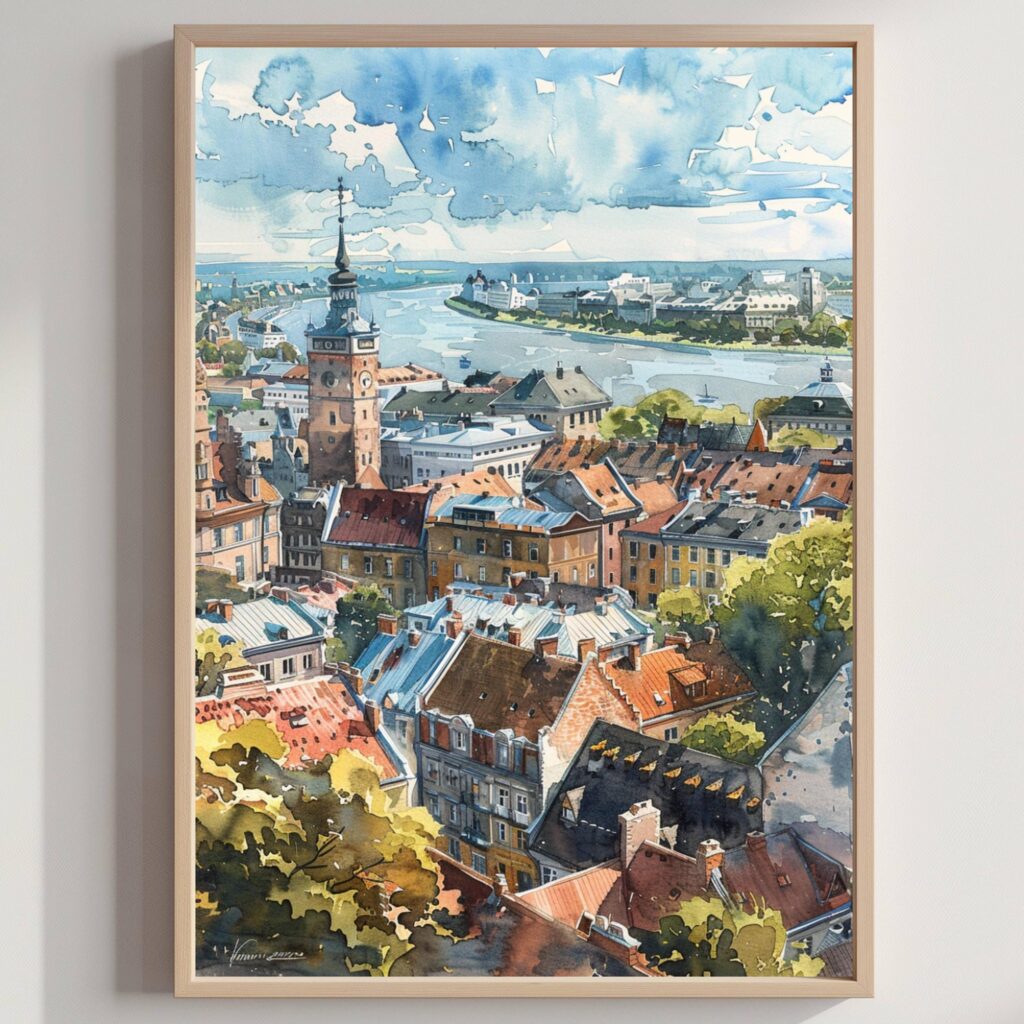
Latvia’s mix of Art Nouveau architecture, dense forest, and Baltic coastline gives a watercolourist genuinely varied texture and colour to work with. We’ve captured that character in our own Latvia Watercolor Print, painted first by hand and printed to order on archival paper, a small piece of the Baltics for a wall at home.
A nation whose independence has been won more than once, partly through the simple, persistent act of singing together, Latvia remains a country where culture and sovereignty have always been closely bound.