
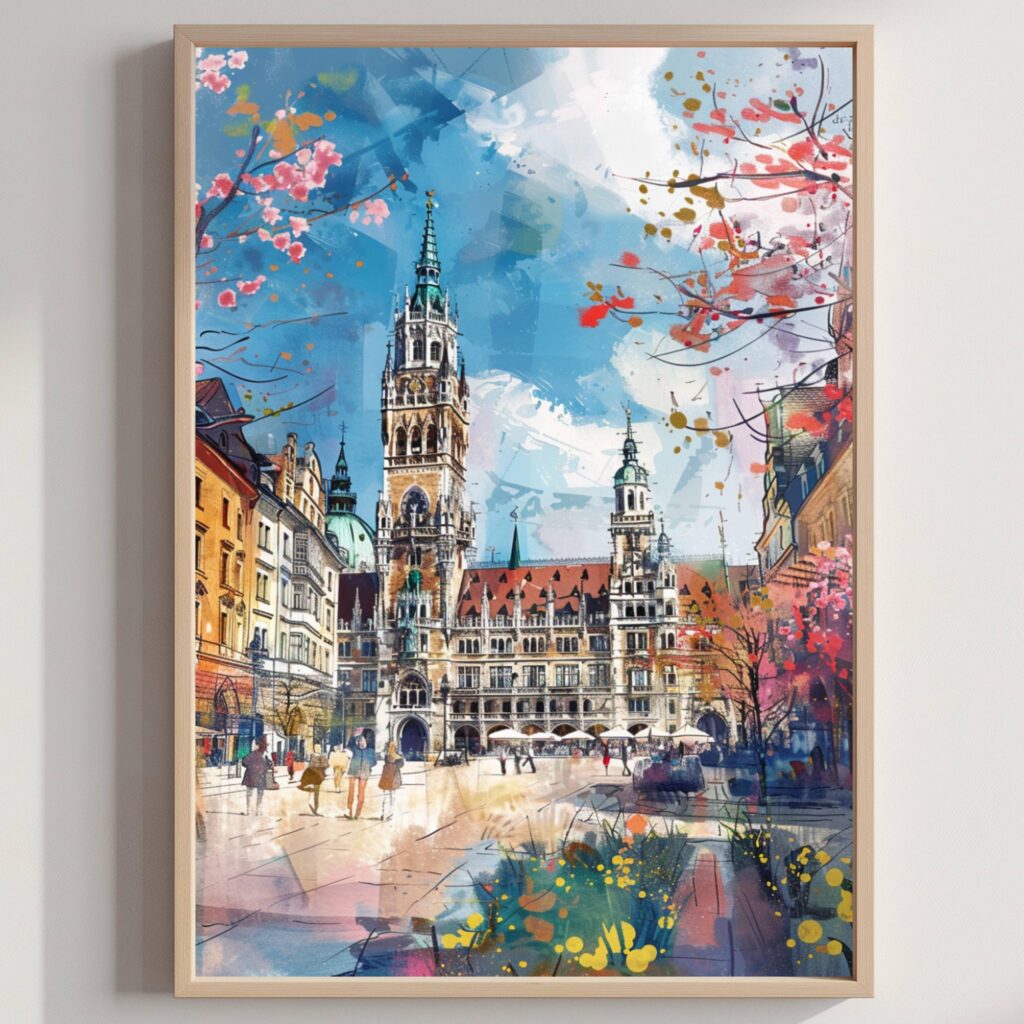
Marienplatz has served as Munich’s central square since the city’s founding in 1158, its name, meaning Mary’s Square, dating to 1638, when a golden statue of the Virgin Mary was erected at its centre to mark the end of Swedish occupation during the Thirty Years’ War. The square has hosted markets, tournaments, and public executions across its history, its role as the genuine civic centre of Munich never seriously displaced despite the city growing many times over around it.
The New Town Hall, whose neo-Gothic facade now dominates one side of the square, is considerably younger than it appears, built between 1867 and 1908, its elaborate spires and statuary designed deliberately to evoke a medieval grandeur the building itself never actually experienced.
A Clock Tower Built to Perform, Not Just Tell Time
The New Town Hall’s Rathaus-Glockenspiel, installed in 1908, remains one of Marienplatz’s principal draws, its 43 bells and 32 life-sized figures re-enacting two historical events each day at 11am, a royal wedding from 1568 and a folk dance from 1517 traditionally credited with helping lift the city’s spirits after a plague outbreak. The performance runs for roughly twelve minutes, drawing crowds into the square below regardless of the weather.
Marienplatz sits directly above one of Munich’s busiest transit interchanges, several U-Bahn and S-Bahn lines converging beneath the square, meaning the same ground that hosted medieval markets now sits atop one of the city’s most heavily used pieces of modern infrastructure.
Painting a Square Built Around Gothic Spires
Marienplatz’s ornate neo-Gothic town hall and golden Mary column give a watercolourist dramatic architectural detail and warm civic colour to work with. We’ve captured that character in our own Marienplatz Watercolor Print, painted first by hand and printed to order on archival paper, a small piece of Germany for a wall at home.
Named for a statue raised in relief after war and crowned since with a clock tower built to perform rather than simply tell time, Marienplatz remains a square that has always done more than mark the centre of the map.