
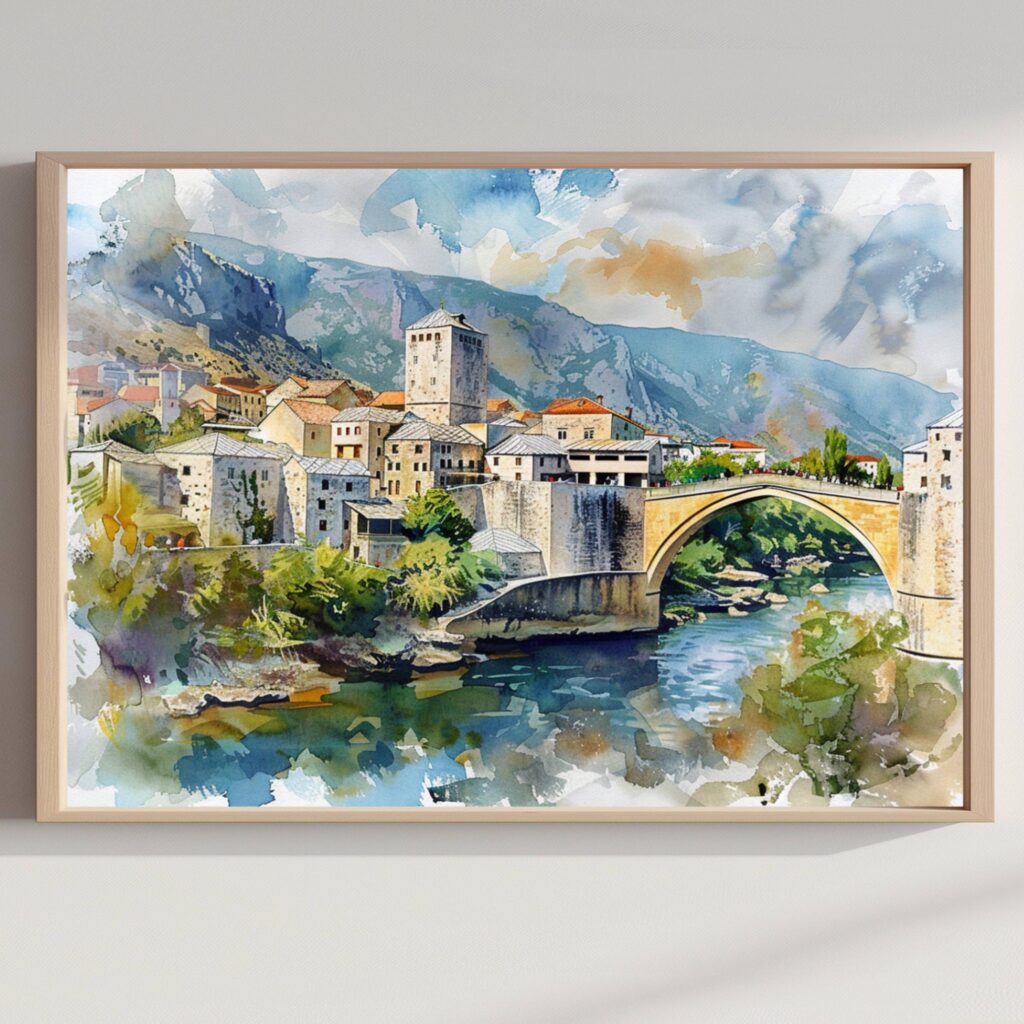
Mostar’s Old Bridge, Stari Most, originally built by the Ottoman Empire in 1566, stood for over four centuries as one of the finest examples of Ottoman-era engineering in the Balkans until it was deliberately destroyed by Croat forces during the Bosnian War in 1993, a targeted act specifically intended to erase a shared symbol of the city’s multi-ethnic identity rather than any direct military necessity, the bridge’s destruction becoming one of the most widely recognised images of cultural loss during the wider Yugoslav wars.
The bridge was rebuilt using original 16th-century construction techniques and, where possible, stone recovered from the riverbed below, reopening in 2004 in a reconstruction significant enough that UNESCO designated the Old Bridge area and its surrounding old town a World Heritage Site the following year, citing the reconstruction itself as a symbol of international reconciliation.
A City Whose Bridge Still Draws Daring Divers
Young men from Mostar have dived from the Old Bridge into the cold Neretva River below for generations, a local tradition dating back centuries and now formalised through an annual diving competition, divers leaping from a height of roughly 24 metres, a practice that continued even through the bridge’s postwar reconstruction and remains an active point of local pride and identity. The surrounding old town retains a dense concentration of Ottoman-era architecture, its stone buildings and cobbled streets giving Mostar one of the more visually striking historic centres in the Balkans.
Mostar’s population remains divided along the same ethnic lines that shaped the 1990s conflict, Bosniak and Croat communities largely occupying separate sides of the city even decades after the war’s end, a quieter but persistent legacy alongside the more visible symbolism of the rebuilt bridge connecting them.
Painting a Bridge Rebuilt From Its Own Ruins
Mostar’s arched stone bridge over the turquoise Neretva River gives a watercolourist dramatic Ottoman architecture and vivid water colour to work with. We’ve captured that setting in our own Mostar Watercolor Print, painted first by hand and printed to order on archival paper, a small piece of Bosnia and Herzegovina for a wall at home.
Destroyed deliberately and rebuilt stone by stone, Mostar’s bridge remains a structure whose reconstruction says as much about the city as its original four centuries of standing did.