
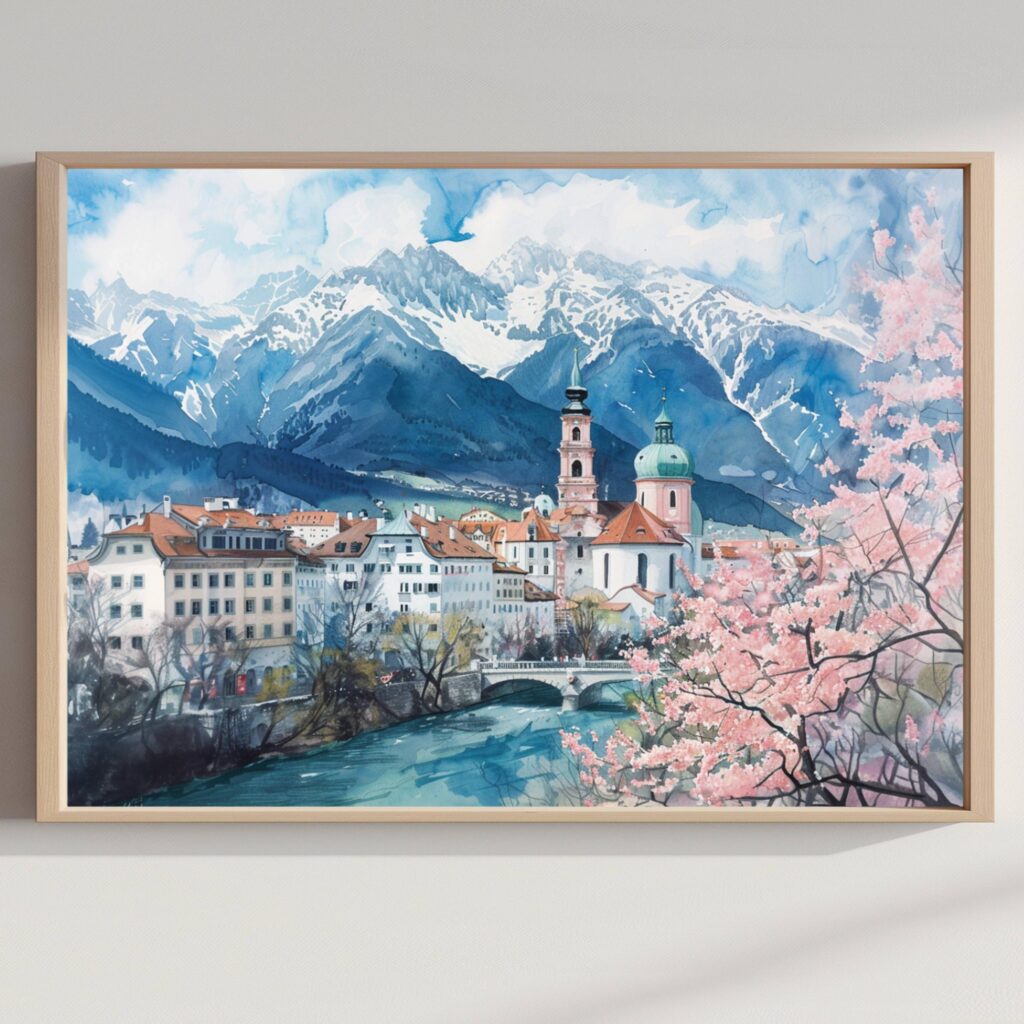
Innsbruck sits directly within the Inn River valley, hemmed in tightly enough by the Nordkette mountain range that its peaks are visible rising abruptly at the northern edge of the city centre, close enough that a funicular and cable car system, the Nordkettenbahnen, carries visitors from downtown Innsbruck to alpine terrain above 2,000 metres in well under half an hour, an unusually direct transition from dense urban centre to high-altitude wilderness found in few other European cities.
That proximity to serious alpine terrain made Innsbruck a natural choice to host the Winter Olympics, which it did twice, in 1964 and again in 1976, the second Games awarded after Denver, the original host city, withdrew following a local referendum rejecting the funding, Innsbruck stepping in on comparatively short notice using much of the infrastructure already built for the 1964 Games.
A City Shaped by Habsburg Imperial Ambition
Innsbruck’s Golden Roof, a balcony covered in 2,657 gilded copper tiles overlooking the old town, was commissioned around 1500 by Holy Roman Emperor Maximilian I, built specifically as a viewing box from which he and his court could watch festivals and tournaments in the square below, a small but deliberately opulent statement of Habsburg imperial wealth and status in what was, at the time, a significant regional capital. Innsbruck’s historic centre retains substantial architecture from this period, its pastel-coloured buildings and arcaded streets reflecting the city’s importance as a seat of Habsburg power for several centuries.
The Bergisel ski jump, rebuilt in 2002 to a striking modern design by architect Zaha Hadid, remains in active competitive use, hosting a leg of the Four Hills Tournament each New Year, a modern architectural landmark set directly against Innsbruck’s much older imperial core.
Painting a Capital Framed by Its Own Mountains
Innsbruck’s pastel old town set against the abrupt rise of the Nordkette range gives a watercolourist dramatic scale and architectural warmth to work with. We’ve captured that setting in our own Innsbruck Watercolor Print, painted first by hand and printed to order on archival paper, a small piece of Austria for a wall at home.
Hosting Olympic Games twice and gilding a roof for an emperor once, Innsbruck remains a city whose mountains have always been close enough to shape everything built beneath them.