
Managua has been substantially destroyed by earthquakes on multiple occasions, most devastatingly in 1972, when a major quake killed thousands and destroyed much of the city centre so completely that Nicaragua’s government, under considerable international scrutiny for allegedly mismanaging and diverting reconstruction aid, largely abandoned rebuilding the traditional downtown core entirely. That decision left Managua with a genuinely unusual urban structure even decades later, the city sprawls without the conventional dense central business district most capital cities retain, its layout instead organised loosely around several dispersed commercial and government districts.
Lake Managua and Lake Nicaragua, both bordering or near the city, sit within a genuinely active volcanic and seismic zone, the entire region straddling fault lines that have made earthquakes a recurring, defining feature of the city’s history rather than an isolated catastrophe.
A Capital Shaped by Revolution as Much as Geology
Managua served as the epicentre of Nicaragua’s 1979 Sandinista Revolution, which overthrew the decades-long Somoza family dictatorship, followed by the Contra War of the 1980s, a Cold War-era conflict that drew significant US involvement and left lasting scars on Nicaraguan politics and society, tensions still visibly present in the city’s murals and monuments commemorating that turbulent period. The ruins of the old cathedral, still standing damaged since the 1972 earthquake and never fully repaired, function today as a deliberate, poignant memorial rather than an active place of worship, one of the more visible physical reminders of the disaster that reshaped the entire city.
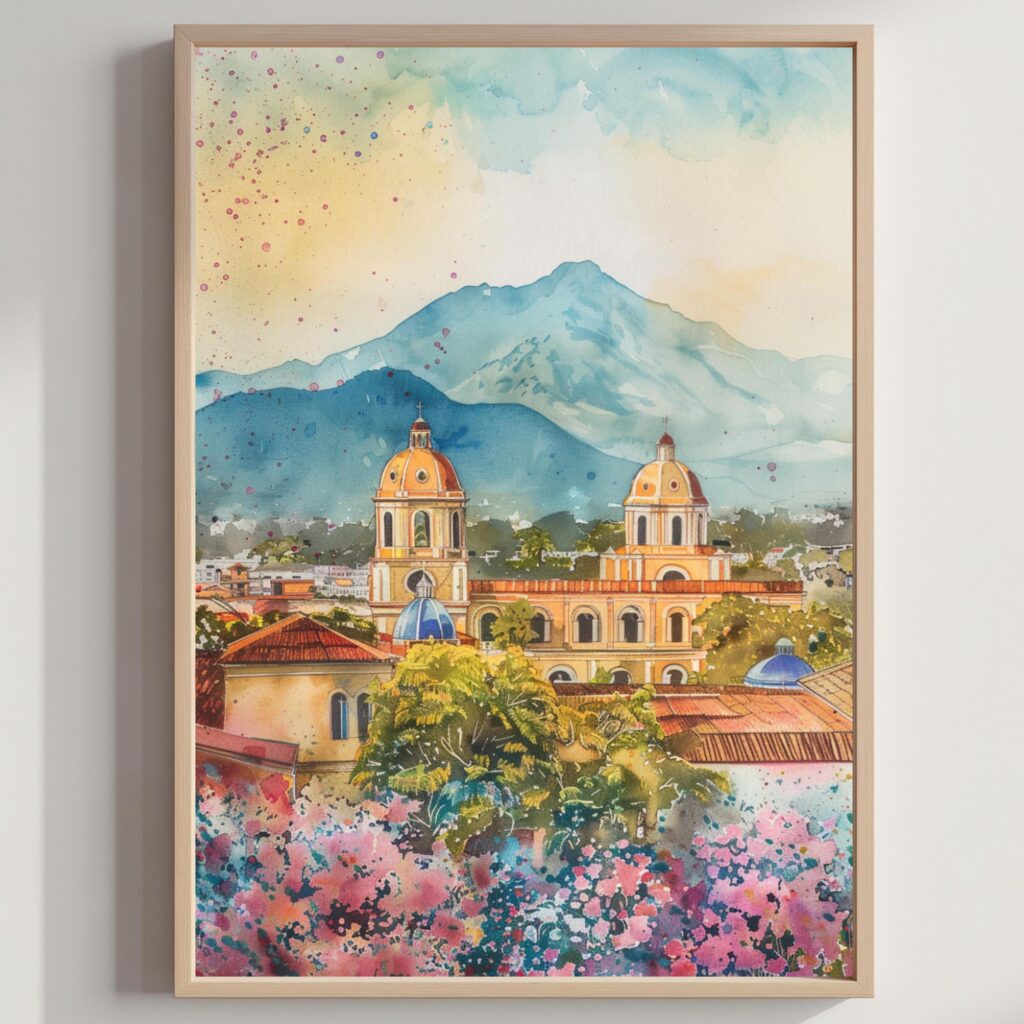
Momotombo, an active volcano visible from parts of the city on clear days, remains a striking natural backdrop to Managua’s relatively low-rise skyline, a further reminder of the volcanic and seismic forces that have repeatedly shaped the capital’s modern history.
Painting a City Still Marked by Its Own History
Managua’s mix of modern rebuilding and preserved earthquake ruins gives a watercolourist a genuinely layered, resilient subject to work with. We’ve captured that character in our own Managua Watercolor Print, painted first by hand and printed to order on archival paper, a small piece of Nicaragua for a wall at home.
Rebuilt repeatedly by both earthquakes and revolution, Managua remains a capital whose unconventional layout still visibly reflects just how much it has had to absorb.