
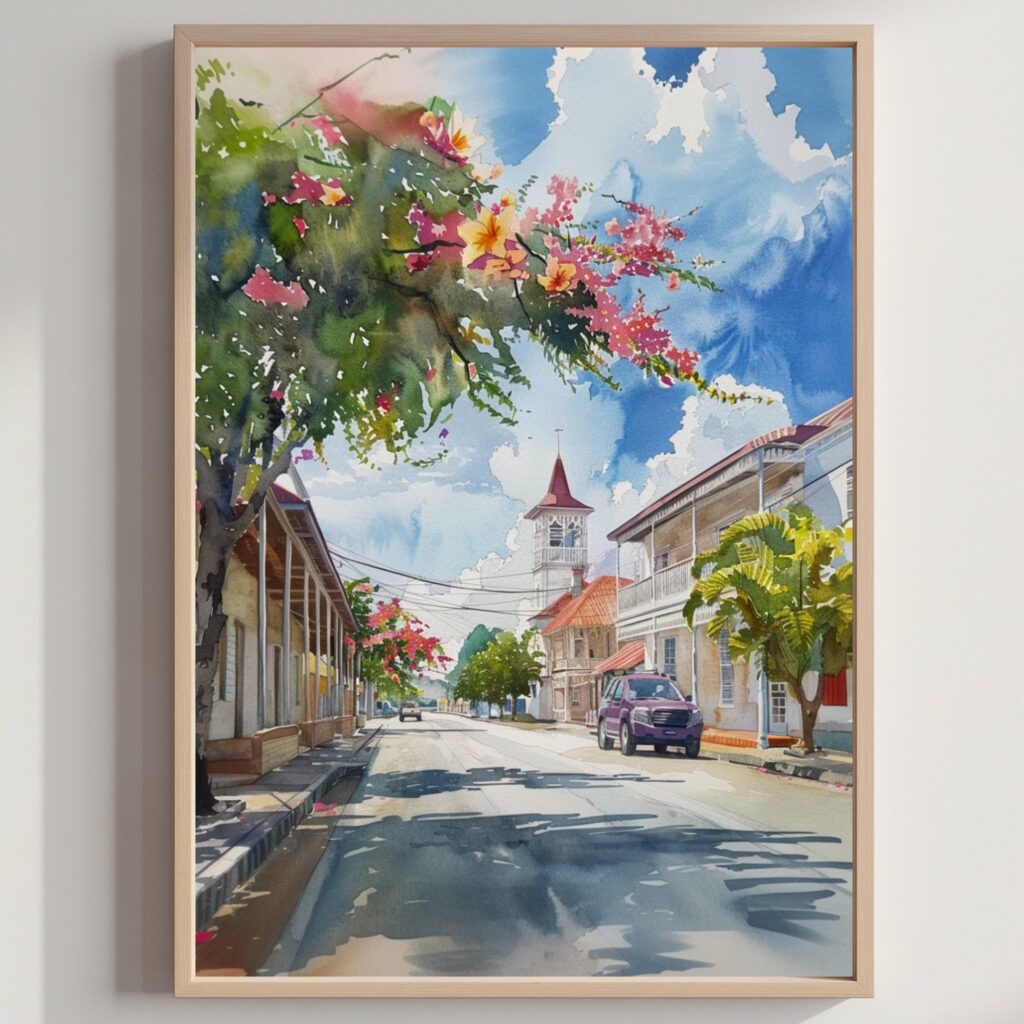
Georgetown, Guyana’s capital, sits below sea level along the Atlantic coast, protected by an extensive system of sea walls and drainage canals originally engineered by Dutch colonists in the 17th and 18th centuries, the same water-management expertise the Dutch applied at home in the Netherlands, adapted to protect this South American settlement from the ocean. That Dutch colonial foundation later passed to British control, and Guyana remains linguistically and culturally distinct from most of its Spanish and Portuguese-speaking South American neighbours, English serving as the official language, a legacy of over 150 years as a British colony.
St. George’s Cathedral, completed in 1892, is among the tallest wooden buildings in the world, its intricate white timber Gothic Revival architecture standing as one of Georgetown’s most distinctive landmarks, constructed almost entirely from local greenheart wood, a dense, naturally rot-resistant timber particularly suited to Guyana’s humid tropical climate.
A Genuinely Multicultural Population Shaped by Indenture
Guyana’s population reflects a particularly complex colonial labour history, following the abolition of slavery in British colonies, indentured labourers were brought from India in large numbers to work sugar plantations, resulting in a population today roughly evenly split between Guyanese of African and Indian descent, alongside significant Indigenous, Portuguese, and Chinese communities, a demographic mix that has shaped Guyana’s cuisine, festivals, and politics distinctly from other Caribbean and South American nations. That Caribbean cultural connection, despite Guyana’s South American geography, runs deep, the country is a full member of CARICOM, the Caribbean Community, rather than primarily aligning with its immediate South American neighbours.
Guyana’s vast, largely undeveloped rainforest interior, covering roughly 80% of the country, remains one of the most intact tropical forest ecosystems in the world, home to Kaieteur Falls, one of the tallest single-drop waterfalls on Earth, a dramatic natural contrast to Georgetown’s low-lying coastal engineering.
Painting Colonial Timber Against Tropical Sky
St. George’s Cathedral’s intricate white timber against Georgetown’s tropical light gives a watercolourist genuinely distinctive architectural detail to work with. We’ve captured that character in our own Georgetown Watercolor Print, painted first by hand and printed to order on archival paper, a small piece of Guyana for a wall at home.
Held back from the Atlantic by Dutch engineering and shaped since by British rule and Indian indenture, Georgetown remains a capital whose identity draws from genuinely more directions than its map position might suggest.