
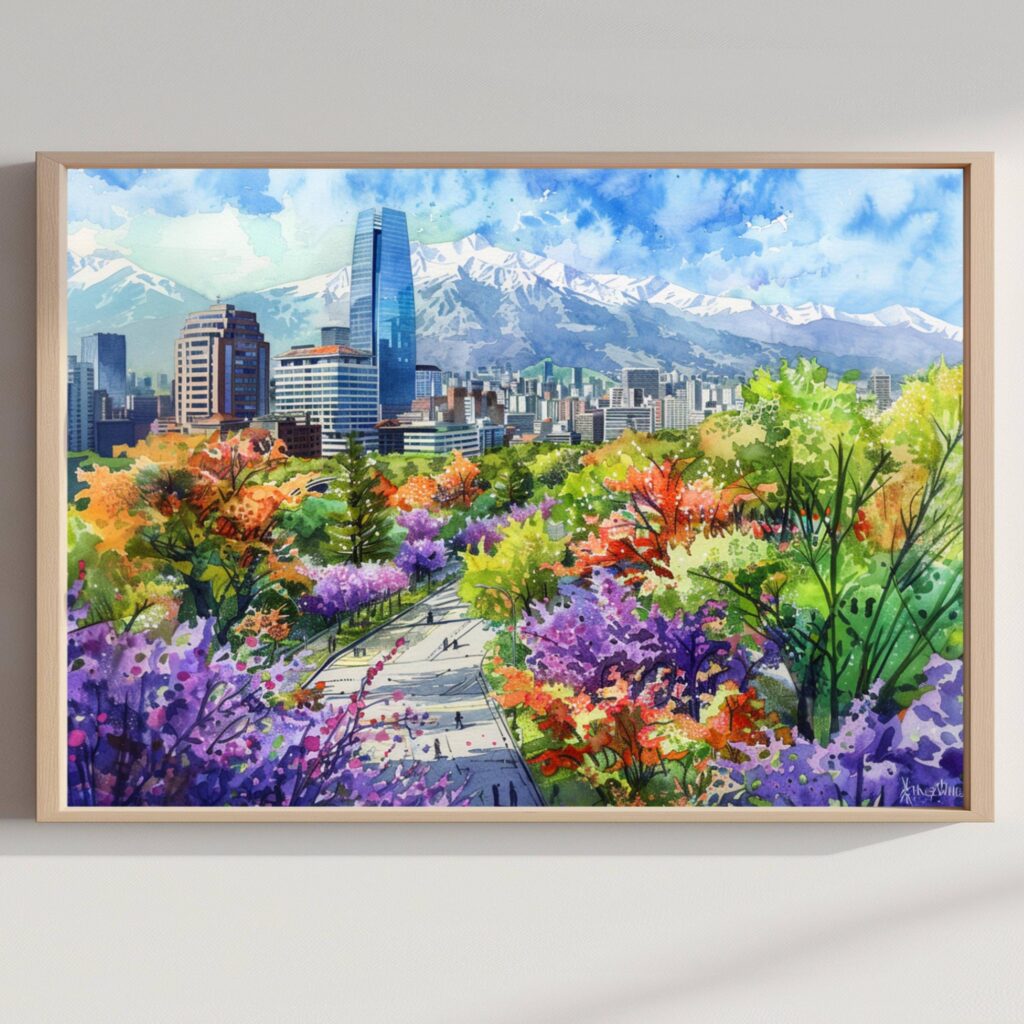
Santiago sits in a valley flanked directly by the Andes Mountains to the east, close enough that on clear days snow-capped peaks are visible rising abruptly at the end of city streets, a dramatic backdrop that also, less conveniently, traps air pollution within the valley basin, giving Santiago some of the more significant urban smog challenges of any major South American capital, particularly during the drier winter months when a temperature inversion holds pollutants close to the ground. That same mountain proximity makes Santiago one of the few capital cities in the world where visitors can genuinely ski at a major resort and return to a major metropolitan downtown within the same day.
Founded by Spanish conquistador Pedro de Valdivia in 1541, Santiago has served as Chile’s capital for nearly its entire colonial and independent history, its Plaza de Armas at the historic centre still anchored by the same colonial-era cathedral and government buildings established in the city’s earliest decades.
A City Shaped by a Difficult Modern History
Santiago was the epicentre of Chile’s 1973 military coup, when General Augusto Pinochet overthrew democratically elected President Salvador Allende, beginning nearly two decades of authoritarian rule during which significant human rights abuses occurred, a history the city has worked in subsequent decades to more directly confront and memorialise, including at the Museum of Memory and Human Rights, opened in 2010. That period, and Chile’s subsequent return to democracy in 1990, remains a significant part of how many Santiaguinos understand their city’s more recent identity.
Santiago’s Gran Torre Santiago, completed in 2014, is the tallest building in South America, part of the Costanera Center complex, a symbol of Chile’s post-dictatorship economic development and its position as one of the more economically stable nations in the region.
Painting a City Beneath Snow-Capped Peaks
Santiago’s modern skyline against the towering, snow-dusted Andes gives a watercolourist striking scale and mountain drama to work with. We’ve captured that setting in our own Santiago Watercolor Print, painted first by hand and printed to order on archival paper, a small piece of Chile for a wall at home.
Sitting close enough to genuine wilderness to ski before lunch, Santiago remains a capital whose mountain backdrop has always shaped both its beauty and its more practical daily challenges.