
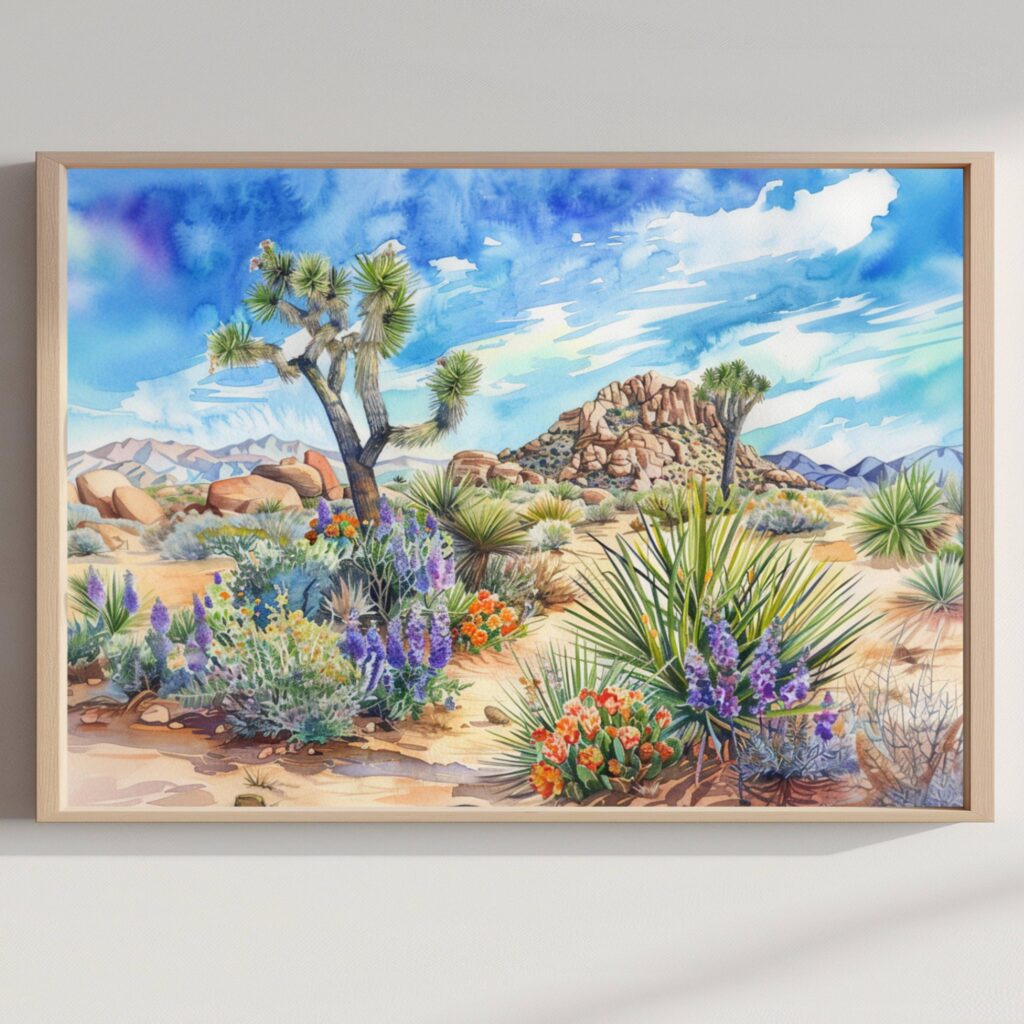
Joshua Tree National Park takes its name from Mormon settlers crossing the Mojave Desert in the mid-19th century, who reportedly saw the region’s distinctive, twisted yucca plants and thought their upstretched branches resembled the biblical figure Joshua raising his arms in prayer, a name that stuck permanently despite the plant being neither a tree nor a cactus but a species of yucca, a member of the agave family. The park sits at the ecological meeting point of two distinct deserts, the higher, cooler Mojave to the west, where Joshua trees actually grow, and the lower, hotter Colorado Desert to the east, giving the park genuinely varied desert ecosystems within a single protected area.
Joshua trees themselves grow remarkably slowly, sometimes less than an inch per year, and some individual specimens within the park are estimated to be several hundred years old, ancient by plant standards even though their somewhat ungainly, spiky appearance rarely suggests such longevity to casual visitors.
A Landscape That Became a Musical and Artistic Touchstone
Joshua Tree’s stark desert landscape and enormous, boulder-strewn rock formations have drawn musicians and artists for decades, most famously inspiring U2’s 1987 album The Joshua Tree, and the park remains closely associated with Gram Parsons, the influential country-rock musician who loved the area so deeply that, after his death in 1973, friends controversially stole his body from Los Angeles International Airport and cremated it informally within the park, honouring his own stated wish to have his ashes scattered there.
The park’s massive granite boulder formations, popular with rock climbers worldwide, were formed through a slow process of underground weathering followed by erosion gradually exposing the rounded rock, a geological process that continues shaping the landscape today, if considerably more slowly than any human visitor could observe directly.
Painting Twisted Trees Against Granite Boulders
Joshua Tree’s spiky silhouettes against enormous granite boulders give a watercolourist a genuinely distinctive, almost surreal desert composition to work with. We’ve captured that landscape in our own Joshua Tree Watercolor Print, painted first by hand and printed to order on archival paper, a small piece of California for a wall at home.
Named by settlers who saw scripture in a stubborn desert plant, Joshua Tree remains a landscape that has kept inspiring exactly that kind of devoted, slightly reverent attention ever since.