
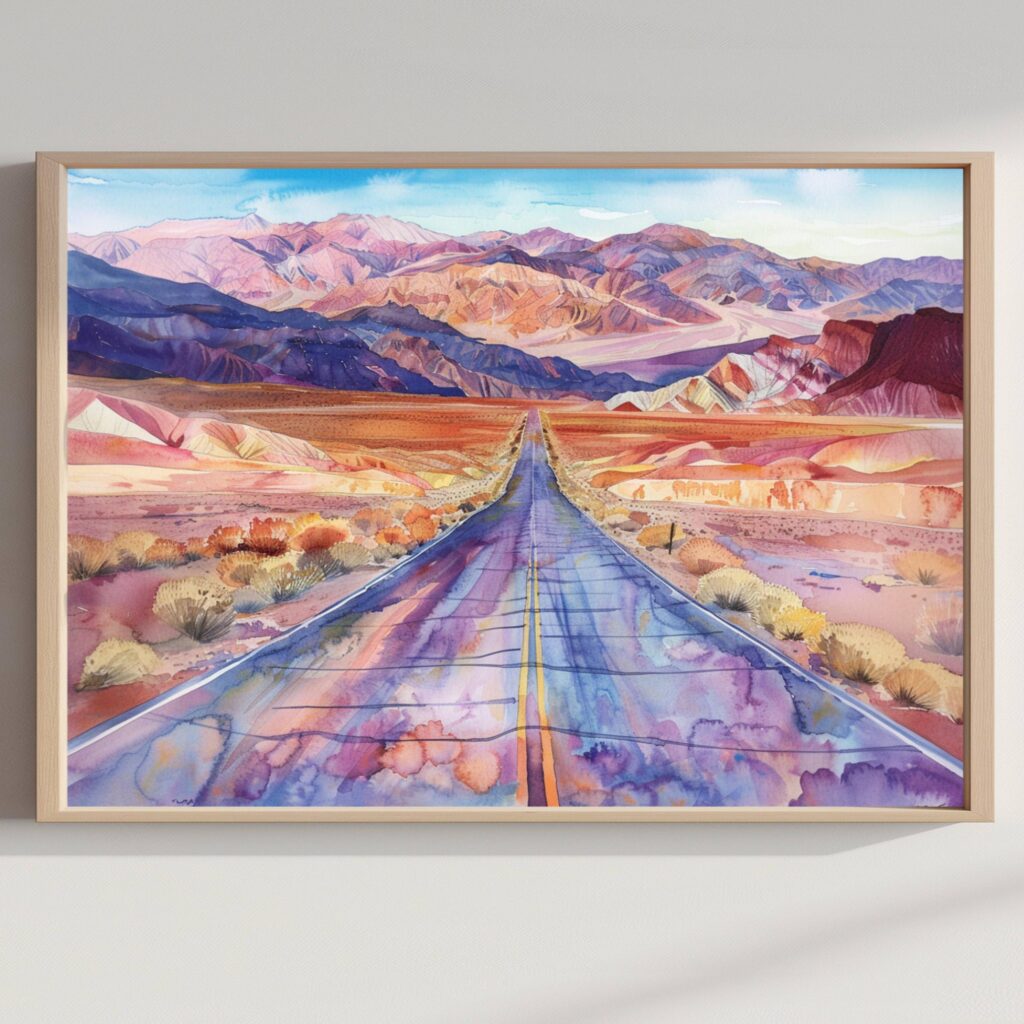
Death Valley holds the record for the highest reliably recorded air temperature on Earth, 56.7 degrees Celsius at Furnace Creek in July 1913, a figure still debated by some meteorologists but generally accepted as the official global record, a heat driven partly by the valley’s unusual geography, a long, narrow basin surrounded by steep mountains that trap and compress descending air, heating it further as it sinks. That same basin contains Badwater Basin, at 86 metres below sea level, the lowest point in North America, meaning Death Valley combines extreme heat, extreme aridity, and extreme low elevation within a single, relatively small national park.
Despite receiving barely 5 centimetres of rainfall in an average year, Death Valley experiences a genuinely spectacular “super bloom” in rare wet years, when unusually heavy winter rains trigger a mass germination of desert wildflower seeds that can lie dormant for years or even decades waiting for exactly the right conditions.
A Name Born From a Single Difficult Crossing
Death Valley’s name traces to a group of pioneers attempting to cross the region in 1849 during the California Gold Rush, most survived the crossing despite significant hardship, but the ordeal was severe enough that one member reportedly looked back at the valley and said “goodbye, Death Valley,” a farewell that became the region’s permanent name despite the group’s actual survival. The valley’s borax deposits, mined commercially from the 1880s onward, gave rise to the famous “20 Mule Team Borax” branding, mule-drawn wagon trains hauling the mineral out of the valley across some of the most punishing terrain in the American West.
Despite its harsh reputation, Death Valley supports a surprising range of specially adapted wildlife, including the Devil’s Hole pupfish, a species found in a single, isolated desert spring and nowhere else on Earth, one of the most geographically restricted vertebrate species known to science.
Painting Extremes of Colour and Salt
Death Valley’s cracked salt flats and colourful mineral-streaked hills give a watercolourist an unusually stark, dramatic desert palette to work with. We’ve captured that extremity in our own Death Valley Watercolor Print, painted first by hand and printed to order on archival paper, a small piece of California for a wall at home.
Named in farewell by pioneers who mostly survived it, Death Valley remains a landscape whose harsh reputation and genuine, if rare, bursts of colour have always existed side by side.